
Corning (GLW) Q3 Earnings Preview: Can AI Optical Momentum Continue and Springboard Acceleration Be Validated?
 2026/10/26 06:08
1. Investment Highlights Overview
Corning (GLW.US) is scheduled to report third-quarter 2026 results before the market open on October 27, 2026. Wall Street consensus expects revenue of approximately $5.0 billion (+17% to +22% YoY) and core EPS of about $0.88 (+31% YoY). The company’s own guidance is for core sales of $4.9–5.0 billion (~+16% YoY) and core EPS of $0.85–0.89 (~+28% YoY). Consensus has moved toward the high end of guidance, with the whisper number near $0.89. The key focus is whether strong AI-driven optical growth can be sustained, whether Enterprise Networks and Gen AI shipments continue to convert, and whether the Springboard plan (targeting a $20 billion annualized sales run rate by the end of 2026) remains on track or is accelerating. After a sharp pullback from June highs, the market is highly sensitive to growth quality and valuation.
Focus 1: Sustainability of Optical Communications and Enterprise Networks Growth
Optical Communications is the primary growth engine. In Q2, the segment generated $2.07 billion in sales (+32% YoY), with net income up 77% and a record margin of 21%. Enterprise Networks grew 65%, while Gen AI-related revenue nearly doubled. Investors will watch whether Q3 Enterprise growth remains elevated, whether AI data-center orders are translating into actual shipments, and the progress of long-term agreements with hyperscalers such as Amazon, NVIDIA, and Meta. Any slowdown could raise questions about the durability of the AI optical cycle.
Focus 2: Springboard Plan Progress and Annualized Run-Rate Validation
Corning previously raised its Springboard targets, aiming for a $20 billion annualized sales run rate by the end of 2026, $30 billion by 2028, and $40 billion by 2030, while entering a phase of accelerating growth. Management has hinted that the $20 billion milestone could be reached one quarter early. The report will be scrutinized for whether Q3 results approach or exceed the high end of guidance and for any commentary on the run-rate trajectory and the new Photonics platform, both of which are central to the long-term narrative.
Focus 3: Margin Expansion and Improvement in Other Businesses
In Q2, core operating margin expanded to 20.9%, gross margin reached 39.6%, and free cash flow was strong. For Q3, the market will monitor whether Optical margins can hold or improve further, whether the Solar business returns to profitability after a maintenance shutdown, and whether Carrier recovers (it grew only 1% last quarter). At the same time, Specialty Materials faces pressure from higher memory prices, which management expects to reduce handheld unit volumes by a mid-teens percentage this year.
Focus 4: Valuation Digestion and Re-rating Potential After Sharp Pullback
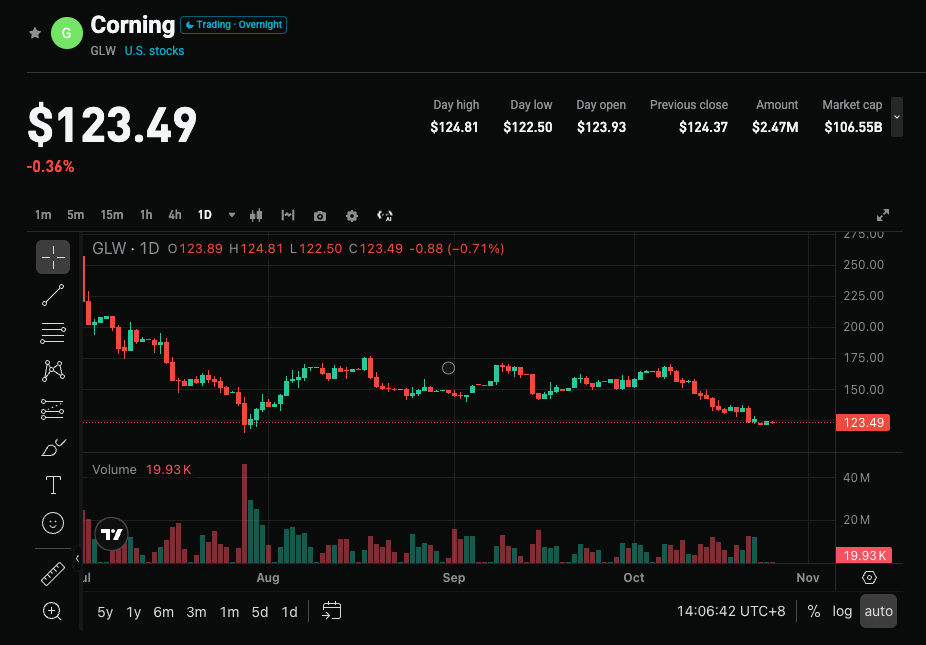
Shares have fallen sharply from their June peak of around $270 to the $120–130 range, bringing valuations down but still leaving the stock sensitive to growth quality. Sentiment has shifted from slightly cautious to modestly constructive, yet the stock has frequently sold off on earnings days even after beats. Management’s tone on the second-half outlook and longer-term targets will be a key sentiment inflection point.
3. Risks and Opportunities
Upside Catalysts:
- Optical and Enterprise growth remains strong (Enterprise near or above 60%), with clear acceleration in AI shipments.
- Revenue and EPS reach or exceed the high end of guidance, and management confirms the Springboard $20 billion run rate is on track or ahead of schedule.
- Optical margins hold at record levels, Solar returns to profitability, and free cash flow stays robust.
Downside Risks:
- Results merely meet the midpoint of guidance or come in light, with Enterprise growth decelerating and raising concerns that the AI optical cycle is peaking.
- Persistent weakness in Carrier, continued drag from Specialty Materials due to soft handset demand, or higher capex pressuring free cash flow.
- Cautious forward commentary from management, combined with residual valuation pressure, triggering further downside.
4. Trading Strategy Considerations
Bullish Case: Strong beats in Optical and total revenue, sustained margin expansion, and positive confirmation of Springboard progress would reinforce Corning’s position as a core AI infrastructure supplier and support a valuation re-rating.
Bearish Risk: In-line or softer results, signs of growth deceleration, or cautious guidance could spark profit-taking, particularly in a high-volatility tech environment.
Key Metrics to Watch:
- Total revenue and year-over-year growth
- Optical Communications and Enterprise Networks growth rates and margins
- Springboard annualized run-rate progress and next-quarter outlook
- Core operating margin and free cash flow
Tactical Notes: After a positive surprise with constructive long-term commentary, pullbacks may offer entry opportunities. If results are merely in line or growth momentum softens, near-term volatility risk rises and chasing strength should be avoided. Position sizing and stop levels should be adjusted according to individual risk tolerance.
Disclaimer: The above is for informational purposes only and does not constitute investment advice.
Disclaimer: The content of this article solely reflects the author's opinion and does not represent the platform in any capacity. This article is not intended to serve as a reference for making investment decisions.
You may also like
The script at the end of 2018: The Federal Reserve continued to raise interest rates, US stocks plunged 20% from the September highs, forcing the Federal Reserve to "pivot" in January.
Goldman Sachs' head of trading believes the current US stock market is repeating the scenario of late 2018, with monetary tightening and equity market pressure. The Goldman Sachs Financial Conditions Index has tightened by about 8 points in two weeks, reaching the highest level in a year. The selloff has broadened from tech stocks to defensive sectors. Gold and equities are declining simultaneously, possibly indicating investors are selling assets to raise cash, making gold a key indicator for observing liquidity stress.

Goldman Sachs Trader “Revisits the 2018 Playbook”: Still Clearly Remembers “On December 24th, Clients Asked Why the Market Dropped So Much—And I Had No Idea”
Brian Garrett pointed out that the current adjustment in the US stock market is similar to the sharp decline in Q4 2018: the S&P 500 has already experienced 42% of the corresponding drop, and the VIX is approaching its peak just before Christmas. If history repeats itself, the bottom of this cycle may appear in January next year. However, the credit market and Federal Reserve policy have yet to provide clear signals of a bottom.
Anthropic (ANT.US) nearly “broke issue price,” but Claude knocks on the doors of “the highest peak in mathematics”! 17 million lines of Lean code used to write a candidate proof for the Riemann Hypothesis
On November 20th, Eastern Time, on its second day of trading, Anthropic's intraday price dropped to a low of $83.05, just 5 cents above the offering price of $83, and finally closed at $88.91, a decline of 8.50%. On the same day, the company's mathematician Levant Alperg announced on his personal website that he and Claude had found a candidate proof for the Riemann hypothesis, which has puzzled the mathematics community for 167 years, and released about 17 million lines of Lean formalized code.

As US stocks plummet, the parent company of GTA 6 rises against the market! First-day sales hit a record $3.79 billion; Wall Street shifts focus to next-generation GTA Online.
According to Rentrak data, the global box office of "Grand Theft Auto VI" has also surpassed that of "Avengers: Endgame," the highest-grossing film of all time, which has a global box office of approximately $2.94 billion.

Crypto prices
More


