
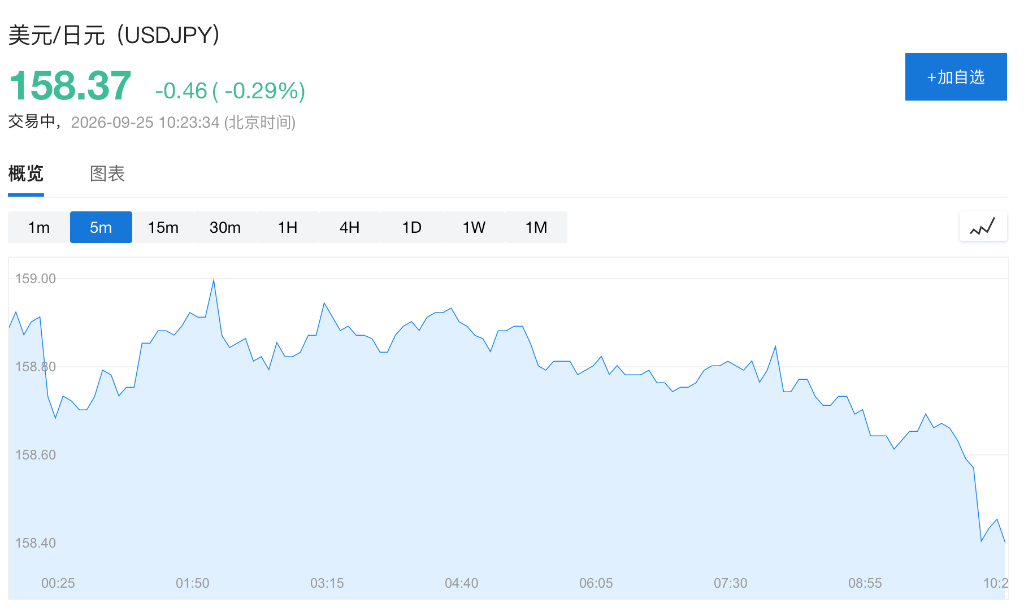
The yen surged in the short term. Japan's Finance Minister stated: Trump is concerned about the yen's depreciation and will closely coordinate with the US side.

Japanese Finance Minister Kaoru Katayama stated that Trump and the US side have recently expressed concerns about the weakening yen, and the Japanese side will continue to maintain close coordination with the US on exchange rate issues. Following the news, the yen rapidly strengthened in the short term.
On September 25, it was reported that Katayama said that specific monetary policy tools are decided by the Bank of Japan. The Bank of Japan's recent rate hike aims to achieve its inflation target. She hopes the Bank of Japan will implement appropriate monetary policy while maintaining communication and coordination with the government, and said she would not comment on specific exchange rate levels or exchange rate checks.
She also said that Trump and the US side expressed concerns about the weakening yen during the summit, and the Japanese side will maintain close coordination with the US on foreign exchange issues. Prime Minister Sanae Takashi expressed overall concern about the weakening yen.
As of press time, the yen had strengthened, with the USD/JPY falling 0.29% to 158.37.
Disclaimer: The content of this article solely reflects the author's opinion and does not represent the platform in any capacity. This article is not intended to serve as a reference for making investment decisions.
You may also like
Nvidia Acting CEO Kress Reassures the Market: No Customer Loss and No Employee Exodus
Nvidia released its first quarterly financial report since Jensen Huang's resignation, after which Colette Kress told the media that major client demand has not been affected and the workforce remains stable, emphasizing that "everything is business as usual." The company's share price rose over 3% after hours, though the stock is still down 24% for the month.
South Korea's KOSPI Index turns negative after rising more than 3% intraday
A 6% yield is not "extremely cheap"! Fidelity throws cold water: Long-term inflation and debt risks are key, and US Treasuries may no longer serve as a "safe haven" for the stock market.
In the view of Salman Ahmed, Head of Global Macro and Strategic Asset Allocation at Fidelity International, even if the 10-year US Treasury yield rises to 6%, it would not be considered "extremely cheap."

Japan's exports in October rose 20.5% year-on-year, exceeding expectations; semiconductor equipment exports surged nearly 50%.
Official data released by Japan on Wednesday showed that exports in October rose by 20.5% year-on-year, ending a two-month slowdown.

Crypto prices
More


