
Stanford study says 5-minute Bitcoin prediction markets enable settlement manipulation

Researchers at Stanford University and Singapore Management University found that Polymarket’s five-minute Bitcoin prediction markets create incentives for traders to manipulate spot prices around settlement, allowing sophisticated participants to profit at the expense of retail traders.
The study examined contracts in which traders bet on whether Bitcoin’s price would end above or below a predetermined level after five minutes. Because the contracts settle using Chainlink price feeds based on Bitcoin’s price at the end of each trading window, traders have an incentive to influence the spot market immediately before settlement.
Analyzing trading activity before and after Polymarket introduced the contracts in July 2024, the researchers found sharp increases in Bitcoin spot-market order flow just before settlement, followed by rapid price reversals, which were consistent with settlement-price manipulation.
The study estimated that the behavior transferred about $1.28 million from ordinary traders to manipulators during the sample period. The researchers said extending contract durations from five minutes to 15 minutes largely eliminated the effect.
Related:
The researchers said the results do not indicate prediction markets are inherently vulnerable to manipulation, arguing instead that settlement design can reduce the risk. They pointed to longer settlement windows and alternative pricing methods, such as time-weighted average prices, as potential solutions.
The findings could extend beyond crypto. The paper notes that traditional exchanges, including Nasdaq and Cboe, have proposed event contracts tied to asset prices, making contract design an increasingly important consideration as prediction markets expand into regulated financial markets.
World Cup fuels prediction market growth
Prediction markets posted record trading volumes in June as the expanded 2026 FIFA World Cup fueled activity across the sector. According to DefiLlama data, Kalshi processed about $9.4 billion in trading volume during the month, while Polymarket International handled roughly $4.3 billion.
The platforms’ World Cup winner markets have since generated more than $5.4 billion in combined trading volume, with Polymarket processing about $4.25 billion and Kalshi about $1.2 billion, according to data from the two platforms at the time of writing.
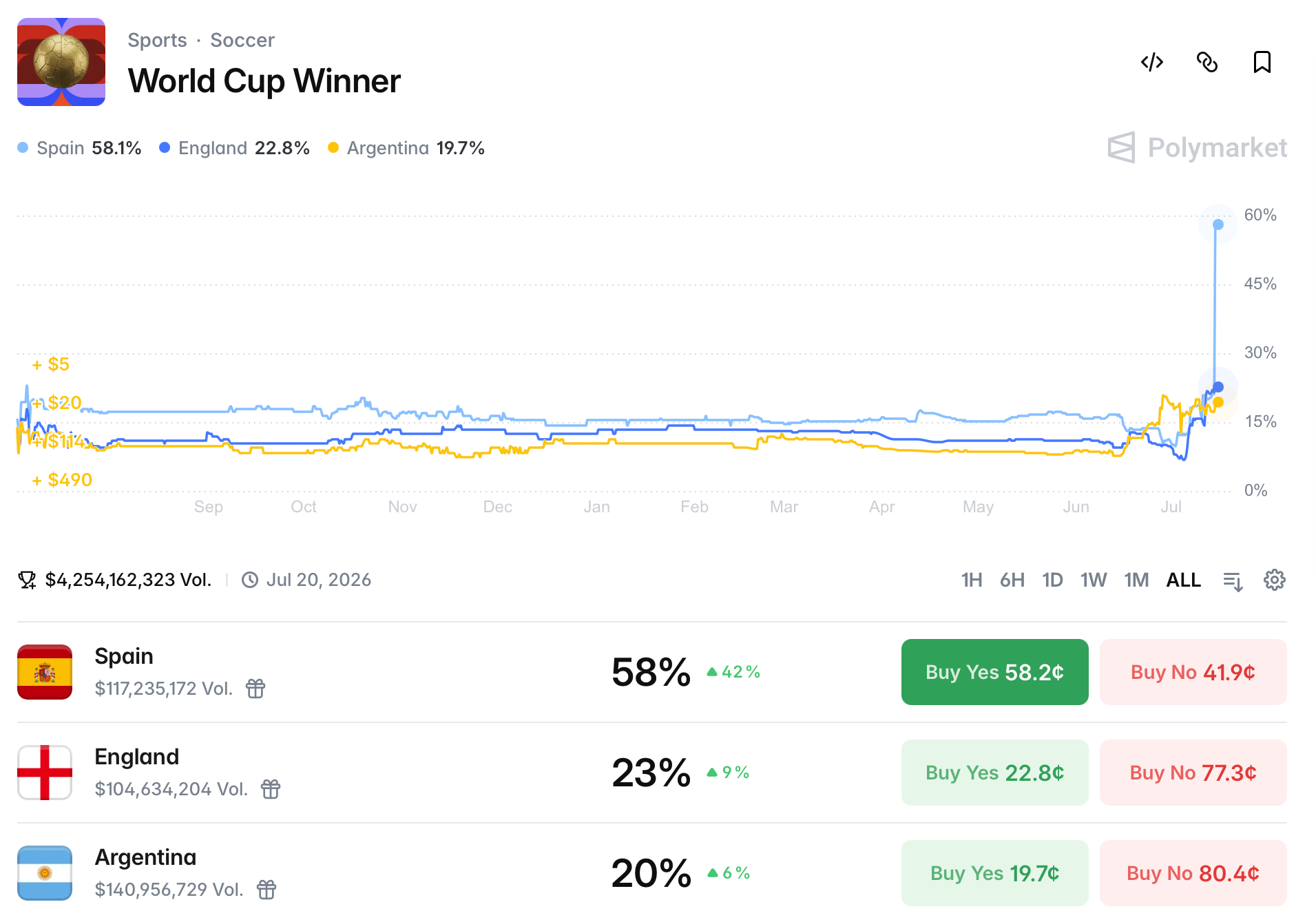
World Cup winner bets on Polymarket. Source: Polymarket
The sector’s growth has coincided with mounting legal scrutiny. Several US states have challenged companies, including Kalshi and Polymarket, this year, while the Commodity Futures Trading Commission has argued that federally regulated event contracts fall under its “exclusive jurisdiction” rather than state gambling laws.
The dispute is now moving through the federal courts, and legal observers have said conflicting appellate rulings could eventually prompt the US Supreme Court to decide whether states or the CFTC have primary authority over prediction markets.
Magazine:
Disclaimer: The content of this article solely reflects the author's opinion and does not represent the platform in any capacity. This article is not intended to serve as a reference for making investment decisions.
You may also like
Cross River Bank enters Bitcoin-backed lending with $250K loans

 VIPIndiscriminate Selling Strikes, Igniting the Market's Black Friday
1. Global markets were caught in a liquidity squeeze and indiscriminate selling this week. Apart from natural gas, which surged 16.04%, and the US Dollar Index (DXY), which edged up 0.39%, major global equity indices, precious metals, industrial metals, and cryptocurrencies all fell sharply. Silver and the Nasdaq 100 led the decline, plunging 16.24% and 10.43%, respectively. 2. Minutes from the Federal Reserve's Federal Open Market Committee (FOMC) meeting warned that AI infrastructure is pushing up near-term inflation and adding to market concentration risk. The warning triggered a wave of profit-taking in tech heavyweights. The Nasdaq Composite fell 5.28% on Friday, erasing its gains for the year, and NVIDIA declined for a seventh straight week. At the same time, AI giant Anthropic raised $81.3 billion in the largest IPO on record globally. This massive draw on capital, combined with selling pressure in the secondary market, quickly spread the cooling in risk appetite to high-beta crypto assets. 3. Fed officials dissented in favor of a 25-basis-point rate hike, and Governor Waller went further, warning that an outsized 50-basis-point hike may be needed in December to curb inflation. Tightening expectations drove DXY to a 19-month high of 103.97 and tipped markets into a dash-for-cash liquidity squeeze. Spot gold plunged to a 14-month low, and US equities, commodities, and cryptocurrencies fell in tandem as institutions systematically cut their cross-asset risk exposure. 4. Caught between the tech rout and a strong dollar, Bitcoin briefly fell below $60,000, and market-wide liquidations jumped to $1.33 billion in 24 hours. Institutional flows saw a watershed reversal. BlackRock's IBIT posted a net outflow of $541 million on Thursday, its largest single-day outflow since launch, and cumulative net outflows from US spot Bitcoin ETFs have neared $3.5 billion so far in November. Looking ahead, the market is set to search for a bottom in both sentiment and valuations in the near term. 5. Assets in focus: BTC, ANT, and NVDA

5 Best VPNs Worth Using for Crypto
Ripple ETF Investors Hold On, But XRP Buyers Go Missing
Crypto prices
More


