
The foreign exchange market is starting to diverge

Morning FX
K-shaped divergence is a hot term this year, used to describe the initial unbalanced economic structure of the AI revolution wave. Massive capital expenditures drive optimism, with every sector along the AI chain flourishing, but the traditional economy grows increasingly sluggish. Real household income is declining, and wealth disparity is severe.
Entering the second half of the year, the forex market is also showing divergence. On the one hand, there’s divergence in the medium-term outlook for the US dollar; on the other, a divergence in the internal logic among emerging markets.
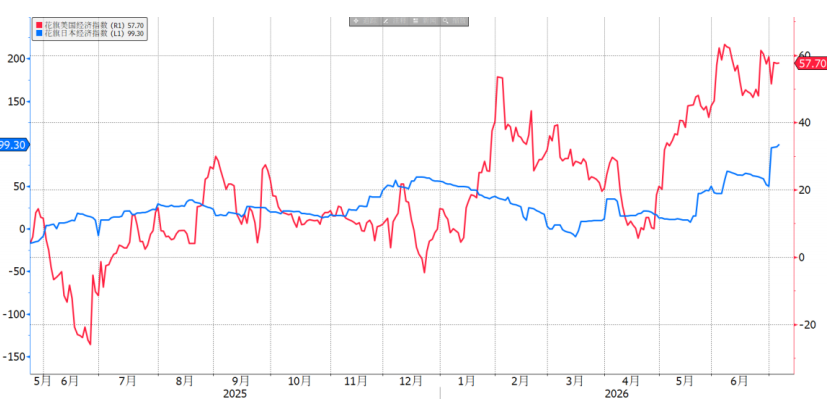
Chart: Economic surprise index strengthens after May in the US
I. From Weak Dollar to Strong Dollar
Since June, the market’s view on the US dollar has shifted, from long-term bearish to medium-term bullish. This is reflected not only in positioning but also in price sentiment and public opinion.
US dollar long positions have reached a five-year high, especially after the June FOMC meeting, with the pace of long accumulation accelerating. Even though non-farm payrolls in June missed expectations and previous figures were sharply revised downwards, the rebound in non-dollar currencies lasted only a day, and the dollar index ended up higher than the pre-data closing period. The delayed rate hike expectations failed to provide momentum for the bears.
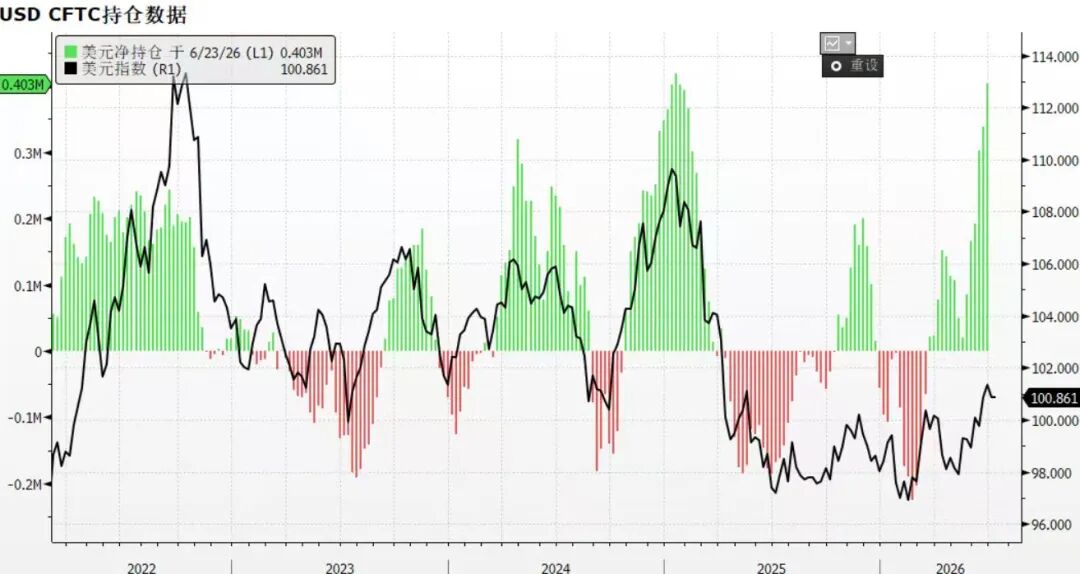
Chart: Crowded US dollar positions by the quarter
Mainstream investment banks are no longer talking about de-dollarization, a theme that has been hyped all year. Trump has already abandoned political pressure, worries about Federal Reserve independence have dissipated; the boom of artificial intelligence has highlighted the US advantage; and while Europe is considering slowing down rate hikes, the Federal Reserve has unexpectedly turned hawkish. These three factors have eased calls for diversifying away from US assets, causing funds to flow back from Europe and Japan.
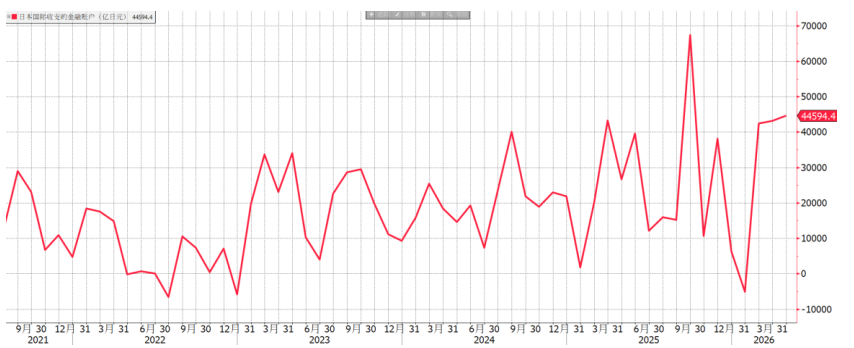
Chart: Japan's outbound investment flows
II. Divergent Logic in Emerging Market Currencies
Correlation in emerging market forex is weakening. Take Asian currencies as an example: the RMB benefits from a single current account surplus, creating a dual strength dynamic with the US dollar, and the currency basket index has reached a new high. The willingness to settle foreign currency for JPY and KRW is extremely weak, and with ongoing capital outflows, both continue to depreciate. The former is squeezed by high debt, with USDJPY climbing until intervention, while the latter is caught in a cycle where rising equities lead to foreign selling, KRW depreciation, and further selling.
The divergence between high-yield and low-yield currencies is also very pronounced. In the first half of this year, high-yielding currencies outperformed low-yielding ones significantly. Even as yield spreads narrow, carry trades remain firmly in play.
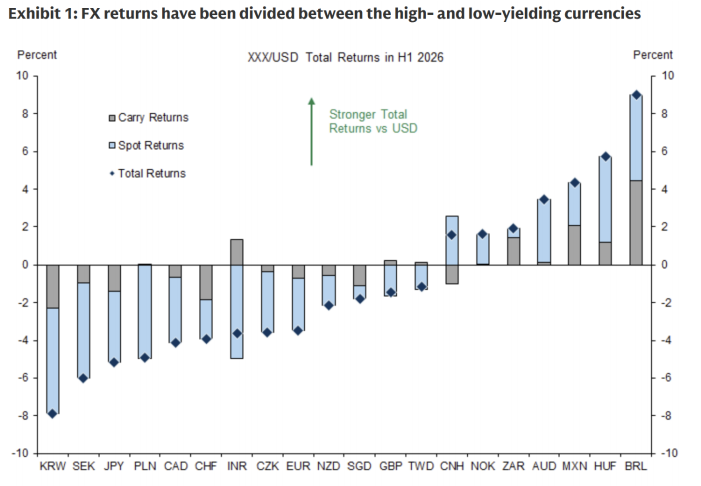
Chart: High-yield currencies significantly outperform low-yield counterparts
III. Summary
(1) The view on the US dollar has changed; the long-term logic of de-dollarization is wavering, shifting to a medium-term bullish outlook.
(2) K-shaped divergence also exists in emerging FX markets, with macro factors no longer effective. Among the three key Asian currencies, only the RMB is independently appreciating, and high-yield currencies continue to outperform their low-yield peers.
Disclaimer: The content of this article solely reflects the author's opinion and does not represent the platform in any capacity. This article is not intended to serve as a reference for making investment decisions.
You may also like
The script at the end of 2018: The Federal Reserve continued to raise interest rates, US stocks plunged 20% from the September highs, forcing the Federal Reserve to "pivot" in January.
Goldman Sachs' head of trading believes the current US stock market is repeating the scenario of late 2018, with monetary tightening and equity market pressure. The Goldman Sachs Financial Conditions Index has tightened by about 8 points in two weeks, reaching the highest level in a year. The selloff has broadened from tech stocks to defensive sectors. Gold and equities are declining simultaneously, possibly indicating investors are selling assets to raise cash, making gold a key indicator for observing liquidity stress.

Goldman Sachs Trader “Revisits the 2018 Playbook”: Still Clearly Remembers “On December 24th, Clients Asked Why the Market Dropped So Much—And I Had No Idea”
Brian Garrett pointed out that the current adjustment in the US stock market is similar to the sharp decline in Q4 2018: the S&P 500 has already experienced 42% of the corresponding drop, and the VIX is approaching its peak just before Christmas. If history repeats itself, the bottom of this cycle may appear in January next year. However, the credit market and Federal Reserve policy have yet to provide clear signals of a bottom.
Anthropic (ANT.US) nearly “broke issue price,” but Claude knocks on the doors of “the highest peak in mathematics”! 17 million lines of Lean code used to write a candidate proof for the Riemann Hypothesis
On November 20th, Eastern Time, on its second day of trading, Anthropic's intraday price dropped to a low of $83.05, just 5 cents above the offering price of $83, and finally closed at $88.91, a decline of 8.50%. On the same day, the company's mathematician Levant Alperg announced on his personal website that he and Claude had found a candidate proof for the Riemann hypothesis, which has puzzled the mathematics community for 167 years, and released about 17 million lines of Lean formalized code.

As US stocks plummet, the parent company of GTA 6 rises against the market! First-day sales hit a record $3.79 billion; Wall Street shifts focus to next-generation GTA Online.
According to Rentrak data, the global box office of "Grand Theft Auto VI" has also surpassed that of "Avengers: Endgame," the highest-grossing film of all time, which has a global box office of approximately $2.94 billion.

Crypto prices
More


