
Last week, hedge funds sold US tech stocks at a record pace: chip stocks sold off for 8 consecutive days, Mag 7 dumped for 5 straight weeks

Last week, hedge funds sold off U.S. technology stocks at the strongest pace in more than a decade, with the semiconductor sector experiencing net selling for eight consecutive trading days. The "Magnificent 7" stocks were net sold for the fifth straight week, pushing positions close to a three-year low. At the same time, U.S. tech stock funds saw the largest single-week net outflow on record, causing market sentiment to cool rapidly.
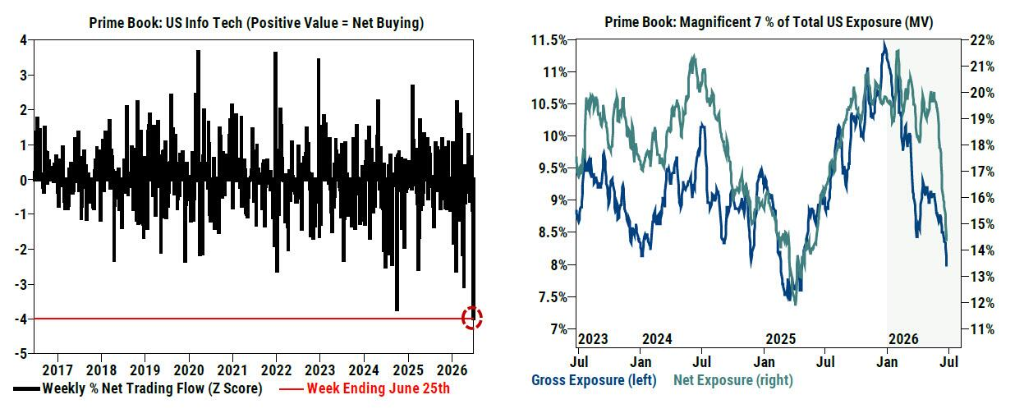
On June 29th, the latest data from Goldman Sachs Prime Brokerage showed that during the week ending June 25th, hedge funds’ net selling of the U.S. information technology sector—measured both in dollar terms and as a percentage—was the largest in the past decade, with a z-score of -4.0, representing an extreme event at the level of four standard deviations. Overall, U.S. equities saw net selling for the second consecutive week, with the pace of outflows being the fastest since the so-called "reciprocal tariffs" week last year.
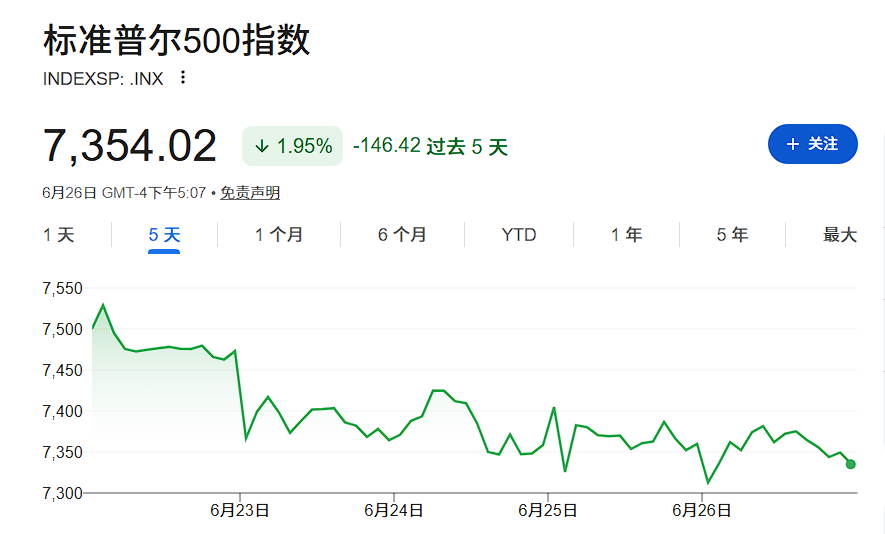
This round of selloffs has far-reaching impacts on market flows. U.S. equities saw a single-week net outflow of $8.5 billion, the first fund outflow since March 2026, following a record net inflow of $119.2 billion the previous week. The S&P 500 Index closed down about 2% for the week, large-cap tech stocks fell roughly 6%, and the semiconductor sector was particularly volatile.
Tech Stock Sell-off Hits Decade High
According to Goldman Sachs Trading Desk's latest weekly report, last week saw the most pronounced net selling in the U.S. information technology sector among all sectors. The deviation from the one-year average was -3.8 standard deviations, driven by both long and short selling, with a long to short sell ratio of 1.3 to 1.
Within the information technology sub-sectors, semiconductors and semiconductor equipment stocks contributed more than half of the net selling, followed by software, tech hardware, and communications equipment. Notably, the semiconductor sector has seen net selling for eight consecutive trading days, yet in terms of positions, the sector’s net exposure as a percentage of the U.S. prime brokerage book remains at the 98th percentile of the past five years, indicating overall positions are still relatively high.
Meanwhile, EPFR data shows that after several weeks of large net inflows, U.S. tech funds saw a massive net outflow last week, further confirming the concentrated withdrawal of institutional funds.
The "Magnificent 7" continued the reduction trend last week, marking five consecutive weeks of net selling. Goldman Sachs data shows that the total and net exposures of the portfolio are currently at the 4th and 6th percentiles of the past three years, respectively, both approaching three-year lows, reflecting a steady decline in hedge fund confidence in this core holding.
The backdrop to this selloff is the clear divergence between AI and hyperscaler cloud sectors and the semiconductor sector—the former is seen as the "payer" of computing power, while the latter acts as the "beneficiary." The market’s reassessment of the AI investment return cycle, combined with multiple company-level disruptions, has jointly accelerated capital outflows.
The materials sector also ranked among the largest net sold sectors last week, recording the biggest single-week net selling in over three months, deviating -1.9 standard deviations from the one-year average, with a short to long sell ratio of 1.5 to 1.
Within this sector, metals and mining were the biggest net-selling sub-sectors, and small net buys in containers, packaging, and chemicals only partially offset the pressure. Currently, the long/short ratio for U.S. metals and mining stocks has declined to 1.21 from a high of 1.69 in early June, ranking at the 7th percentile for the past year and the 3rd percentile for the past five years, with positions now extremely low.
From an overall structure perspective, eight of the 11 sectors saw net selling, with the largest net selling in dollar terms seen in information technology, communications services, industrials, and healthcare; consumer staples, energy, and real estate recorded net buying.
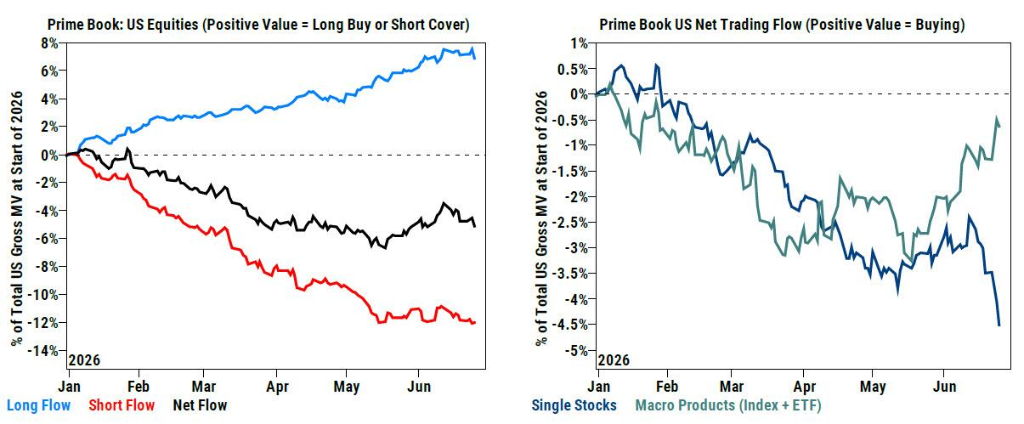
In contrast, macro products (indexes and ETFs combined) showed net buying, deviating +1.3 standard deviations from the one-year average, almost entirely driven by short covering, with limited long inflows.
This pattern is consistent with regular hedge fund practices—buying ETFs as market-neutral hedges while shorting individual stocks. U.S.-listed ETF short positions fell 2% during the week and 3.5% for the month, with most covering focused on corporate bonds, small caps and consumer discretionary ETFs.
Weekend Trading Volume Explodes, Russell Index Rebalancing Boosts Activity
Goldman Sachs equity sales desk noted that last weekend’s annual Russell Index rebalancing triggered an "explosive" increase in trading volume.
The S&P 500 Index closed down about 2% for the week, large-cap techs fell about 6%, and the semiconductor sector saw volatility driven by multiple factors, including weakness in the Korean market, concentrated leveraged trades, and individual company events related to Micron, ON Semiconductor, Qualcomm investor days, and OpenAI IPO reports.
Asset management companies overall showed net selling, mainly as part of rotating funds out of large-cap tech, but according to Goldman Sachs, the selling was "orderly," with no sign of excessive reaction or panic. Hedge fund flows were roughly balanced, and internal sector rotation continues in the market.
Crude oil prices fell about 9% over the week, while the 10-year U.S. Treasury yield dropped 8 basis points to 4.37%, providing some support to consumer-related sectors.
The materials sector also ranked among the largest net sold sectors last week, recording the biggest single-week net selling in over three months, deviating -1.9 standard deviations from the one-year average, with a short to long sell ratio of 1.5 to 1.
Within this sector, metals and mining were the biggest net-selling sub-sectors, and small net buys in containers, packaging, and chemicals only partially offset the pressure. Currently, the long/short ratio for U.S. metals and mining stocks has declined to 1.21 from a high of 1.69 in early June, ranking at the 7th percentile for the past year and the 3rd percentile for the past five years, with positions now extremely low.
Disclaimer: The content of this article solely reflects the author's opinion and does not represent the platform in any capacity. This article is not intended to serve as a reference for making investment decisions.
You may also like
No more mandatory retention! Anthropic launches EFS system, allowing enterprises to take control of their own AI data
Anthropic has launched the public beta of its Enterprise Frontier Security (EFS) system, allowing corporate clients to store AI data on their own cloud platforms, with clients holding their encryption keys. Anthropic only performs automated security scans and cannot access the data itself. The system retains the 30-day data retention requirement, but control over storage is returned to enterprises, addressing strong customer backlash sparked by the mandatory retention policy implemented in June.

Report: Samsung's storage capacity is nearly sold out for the next three years, clients rush to secure long-term contracts until 2031
According to media reports, most of Samsung Electronics' memory manufacturing capacity for the period from 2027 to 2029 has already been secured through contracts. Some customers are even seeking to extend long-term supply agreements until 2031. Currently, leading memory manufacturers can only meet about 60% to 70% of client demand, and the supply shortage may intensify further in 2027.

Anthropic commits to about $900 billion in computing power expenditure; bond market expects its bonds to be junk-rated
Despite Anthropic raising over $100 billion in its public offering and reaching a market capitalization of $1.18 trillion, the company is widely expected by the debt market to be rated as BB-level "junk bonds" due to its lack of profitability and approximately $900 billion in massive computing power expenditure commitments. Amid pressure on tech giants in the debt market and chip companies planning to reduce loan guarantees, Anthropic will still need to rely on structured financing in the short term, facing about a three-year window to strive for an investment-grade rating.
JPMorgan Trading Desk Abandons Tactical Bullish Stance on S&P 500: Rebound May Occur, Bottom Not Yet Reached
J.P. Morgan's trading division has shifted from a tactical bullish stance to a cautious one, expecting stock market volatility in the coming weeks, but emphasizes that market fundamentals—from the economy to earnings—remain solid.

Crypto prices
More


