
Goldman Sachs Warns About US Stocks: Geopolitical Momentum Stalling and Asymmetric Downside Risks for CTA Emerging

In this shortened four-day trading week, the US stock market ended with an aggressive upward move toward the Friday holiday and option expiration, with AI-related themes once again serving as the main driver of gains. However, the Goldman Sachs One-Delta trading desk warns that geopolitical momentum is stagnating, and structural risks within the market have quietly accumulated.
The US-Iran nuclear talks have faced a setback, as Switzerland confirmed that the planned meeting between the US and Iran scheduled for this Friday has been canceled, and US Vice President Vance also postponed related travel. Rich Privorotsky, head of the Goldman Sachs One-Delta trading desk, points out that geopolitical momentum is clearly slowing, and expectations for increased Iranian oil output, as priced in by the oil market, face growing uncertainty.
Meanwhile, the AI race narrative continues to strengthen. The launch of the open-source flagship model GLM-5.2 by Chinese AI star Zhipu did not dampen investor enthusiasm for tech stocks; instead, it further underscored the necessity for hyperscale cloud providers to increase spending, benefiting hardware suppliers continuously.
On the technical side, a combination of low-to-neutral sentiment indicators and leverage significantly amplified volatility in the AI and technology sectors this week. Goldman Sachs cautions that a downside-asymmetric structure has taken hold in CTA (Commodity Trading Advisor) strategies, and the uncertainty of the Federal Reserve's policy framework, along with rising bond market volatility, cannot be underestimated.
Setbacks in US-Iran Talks, Geopolitical Premium in Oil Prices Yet to Be Fully Priced In
The geopolitical landscape saw a significant shift this week. The Swiss foreign ministry confirmed that the US-Iran talks on nuclear issues and other matters, originally scheduled for Friday, have been canceled. Vance's delayed travel further confirms that negotiations have stalled. Israel's ongoing military actions in Lebanon remain a key friction point, while Iran is reportedly demanding that the US first fulfill commitments outlined in the memorandum of understanding signed on Wednesday before returning to talks.
The market is currently still pricing in an incremental return of Iranian crude, but the political backdrop is increasingly complex—domestic criticism from US Republicans and discontent from Israel are both pressuring the outlook for negotiations.
Rich Privorotsky pointed out:
“The core issue is a lack of trust: if Iran fully resumes exports and removes the oil risk premium, it would mean giving up its most significant bargaining chip.”
“The market is pricing physical crude but has not fully discounted this deficit of trust and the ongoing deterioration in (US-Iran) agreement momentum.”
This dynamic explains why the Iranian government is inclined to a slower, phased approach to implementation rather than a one-off action. At present, the market’s pricing of physical barrels does not adequately reflect this trust gap and the waning momentum in negotiations, meaning the associated risk premium could be underestimated.
Strengthening AI Race Logic, Hardware Vendors the Biggest Beneficiaries
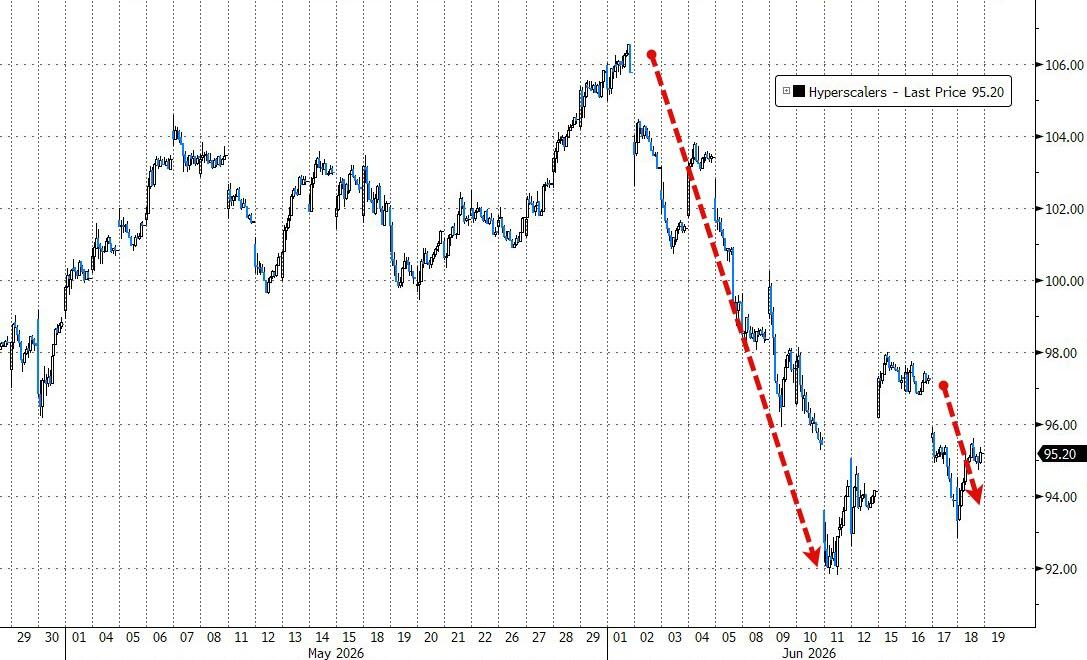
This week, the AI theme remains the market's most powerful driver. Thematic indices such as Goldman Sachs Robotics and Automation (GSXUROBO), Memory (GSTMTMEM), and AI Semiconductors (GSCBSMHX) all reached new highs, while the S&P ex-AI Index (SPXXAI Index) closed down 56 basis points on Thursday—underscoring the growing divergence between the two camps. Intel surged 10% in one day, triggered by unconfirmed reports about potentially receiving manufacturing orders from Apple.
Regarding the AI investment logic, Privorotsky offers an insightful perspective: the significance of new Chinese models like GLM-5.2 lies not just in reducing computing costs or intensifying competition; more fundamentally, they reinforce the necessity for American tech giants to ramp up investment. In fact, China’s competition is reinforcing the underlying need for all parties to scale up AI spending.
Although the new generation of models appears more reliant on reinforcement learning and post-training technology, and less on massive pre-training compute, the logic of the AI race remains unchanged. If the perceived gap between overseas and US leading-edge models shrinks from about a year to just a few months, the incentive to accelerate investment becomes significantly stronger.
Intensified competition may ultimately increase, rather than compress, total AI investment. In this sense, hyperscale cloud vendors remain the source of funding for this race, while hardware suppliers are the main beneficiaries.
Technical Setup Near “Perfection” but Approaching a Climax
From a technical perspective, this week saw a rare resonance pattern. Privorotsky notes that technically, the current environment for positioning is nearly perfect, and has arguably reached a climax.
Low-to-neutral sentiment indicators—the Bull-Bear Index remains in neutral territory, while the CNN Fear/Greed Index is hovering around 30 due to extremely narrow market breadth—combined with option expiration effects and sustained leverage, further amplify the price volatility in AI and technology stocks. The same set of market mechanisms that drove an accelerated decline a few weeks ago are now operating in reverse.
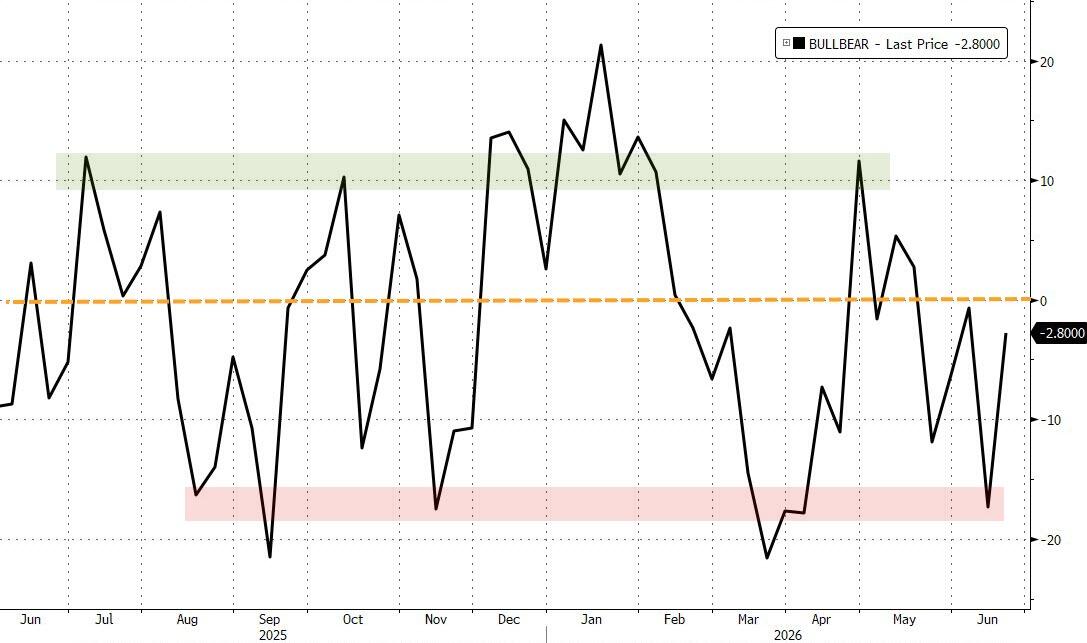
However, the structural support for this rally is not robust: there remains significant downside asymmetry in CTA positions, compounded by post-expiry gamma rolling... Institutional sentiment remains subdued, while retail leverage is extremely high. This means that if momentum reverses, downside risk could materialize quickly.
Fed Uncertainty Remains, Upward Risk for Bond Volatility
On the macro level, this week's Federal Reserve meeting should not be overlooked. While Middle Eastern geopolitics dominates the market narrative, it is hard to ignore the influence of the Fed this week as well.
The yield curve clearly flattened this week, with short-term SOFR pricing continuing to drift lower, and some cross-asset correlations have begun to break down—for example, the historical relationship between copper prices and the Nasdaq Index, and the divergence between US small-cap Russell 2000 and SFRZ6, i.e., the December 2026 3-month SOFR futures contract. These signals are worth paying attention to.
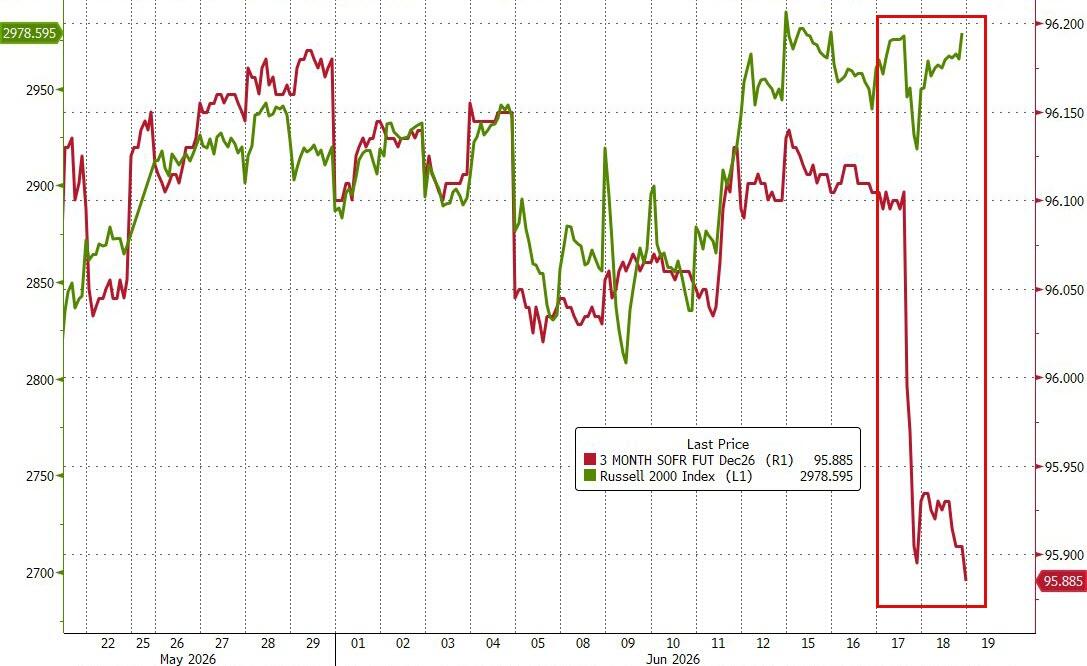
The more pivotal policy variable lies in the effectiveness of forward guidance. This week saw the first FOMC monetary policy meeting since Chair Walsh took office, and the FOMC statement following the meeting removed forward-looking rate guidance.
The removal of substantive forward guidance by the Fed introduces greater uncertainty to its policy framework and will ultimately drive higher bond market volatility. For fixed income investors, this means the logic for pricing rate risk is undergoing a structural change, and the ramifications of this shift have yet to be fully reflected in the market.
Disclaimer: The content of this article solely reflects the author's opinion and does not represent the platform in any capacity. This article is not intended to serve as a reference for making investment decisions.
You may also like
No more mandatory retention! Anthropic launches EFS system, allowing enterprises to take control of their own AI data
Anthropic has launched the public beta of its Enterprise Frontier Security (EFS) system, allowing corporate clients to store AI data on their own cloud platforms, with clients holding their encryption keys. Anthropic only performs automated security scans and cannot access the data itself. The system retains the 30-day data retention requirement, but control over storage is returned to enterprises, addressing strong customer backlash sparked by the mandatory retention policy implemented in June.

Report: Samsung's storage capacity is nearly sold out for the next three years, clients rush to secure long-term contracts until 2031
According to media reports, most of Samsung Electronics' memory manufacturing capacity for the period from 2027 to 2029 has already been secured through contracts. Some customers are even seeking to extend long-term supply agreements until 2031. Currently, leading memory manufacturers can only meet about 60% to 70% of client demand, and the supply shortage may intensify further in 2027.

Anthropic commits to about $900 billion in computing power expenditure; bond market expects its bonds to be junk-rated
Despite Anthropic raising over $100 billion in its public offering and reaching a market capitalization of $1.18 trillion, the company is widely expected by the debt market to be rated as BB-level "junk bonds" due to its lack of profitability and approximately $900 billion in massive computing power expenditure commitments. Amid pressure on tech giants in the debt market and chip companies planning to reduce loan guarantees, Anthropic will still need to rely on structured financing in the short term, facing about a three-year window to strive for an investment-grade rating.
JPMorgan Trading Desk Abandons Tactical Bullish Stance on S&P 500: Rebound May Occur, Bottom Not Yet Reached
J.P. Morgan's trading division has shifted from a tactical bullish stance to a cautious one, expecting stock market volatility in the coming weeks, but emphasizes that market fundamentals—from the economy to earnings—remain solid.

Crypto prices
More


