
Memory price surge impacts Nintendo: Switch 2 price in the US rises by $50, sales forecast lowered

The abnormal surge in memory chip prices is reshaping the cost logic of the gaming hardware market. Nintendo has announced an increase in the price of Switch 2 in the United States and several major markets, while also lowering its sales and profit forecast for this fiscal year. A supply chain shock originating from the expansion of AI data centers is profoundly affecting the business trajectory of this Japanese gaming giant.
On Friday, Nintendo announced that the retail price of Switch 2 in the US will be raised from $449.99 to $499.99 starting September 1, an increase of $50. The price in the Japanese market will be adjusted first, on May 25, rising from 49,980 yen to 59,980 yen. The Canadian and European markets will also follow suit with price hikes. Nintendo attributed this price adjustment to “changes in the market environment” and a comprehensive consideration of “global business prospects.”
At the same time, Nintendo's fiscal year performance outlook was significantly below analysts’ expectations, putting pressure on the market. The company expects Switch 2 sales for the fiscal year ending March 2027 to fall to 16.5 million units, down from 19.86 million units in the just-ended previous fiscal year. Net sales are forecast at 2.05 trillion yen, an 11.4% year-on-year decline and far below the 2.46 trillion yen expected by LSEG analysts; net profit is expected to fall 27% to 310 billion yen, also well below the market expectation of 418.5 billion yen.
Memory crisis drives up hardware costs, simultaneous price increases in multiple markets
The core driver of this price increase is the strong demand for memory chips caused by the global wave of AI data center construction, resulting in an unprecedented surge in memory component prices used in Switch 2. Nintendo pointed out in its fiscal year outlook that it will face around 100 billion yen (approximately $637.8 million) in cost impacts this fiscal year, mainly due to the price increases of memory and other core components, as well as “tariff measures.”
Nintendo is not alone. Previously, Sony announced in March this year that it would increase the price of its flagship product PlayStation 5 by up to $150. Facing similar supply chain pressures, both gaming console giants have passed the increased costs on to end consumers.
Full-year forecasts lag behind market expectations, first quarter revenue also below forecast
All financial forecasts for this fiscal year failed to meet analysts’ expectations. In terms of sales volume, gaming consoles have typically seen an increase in unit sales in the year following their release, but Nintendo’s forecast this time goes against the norm, predicting a decline compared to the previous fiscal year.
Serkan Toto, CEO of Kantan Games, commented, “Nintendo has been under pressure for months, but this impact is quite severe—traditionally, console sales in the second year should rise, not decline as Nintendo predicts this time.”
Nintendo’s first quarter revenue was 407.2 billion yen, lower than the 430.6 billion yen forecast by LSEG analysts; however, net profit was 65.2 billion yen, slightly beating the market expectation of 63.28 billion yen.
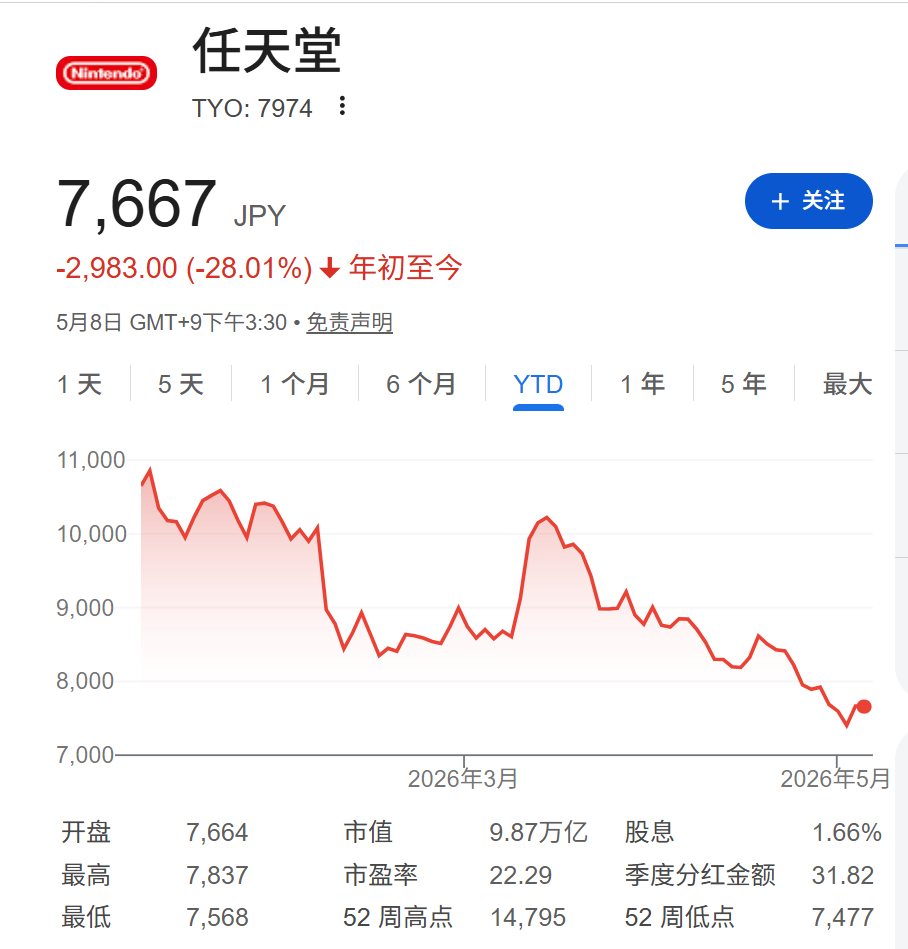
Nintendo’s share price has remained under pressure since reaching a historic high above 14,000 yen last August, with a cumulative decline of nearly 50% from its peak so far. Rising memory costs are seen as a key driver of this decline. The lower-than-expected full-year guidance released on Friday further heightened market concerns about the company’s near-term profitability.
IP portfolio provides buffer, first-party game lineup is key variable
Despite significant pressure at the hardware level, Nintendo’s strong IPs continue to provide some revenue support. The “Super Mario Galaxy Movie,” co-produced with Universal Pictures and Illumination, has already grossed nearly $900 million worldwide this year (according to Box Office Mojo). “Pokemon Pokopia” on the Switch 2 platform has become a surprise hit with positive user reviews, making it one of the best-selling games on the console so far.
Nintendo also plans to launch new entries in the “Splatoon” and “Star Fox” series this year, with two heavyweight Pokemon titles set for release next year.
Serkan Toto believes, “For Nintendo, the most crucial step now is to launch blockbuster first-party games as quickly as possible in order to drive console sales.” How to mitigate the demand pressure following hardware price increases by strengthening the software lineup will be the core test Nintendo faces this fiscal year.
Disclaimer: The content of this article solely reflects the author's opinion and does not represent the platform in any capacity. This article is not intended to serve as a reference for making investment decisions.
You may also like
The script at the end of 2018: The Federal Reserve continued to raise interest rates, US stocks plunged 20% from the September highs, forcing the Federal Reserve to "pivot" in January.
Goldman Sachs' head of trading believes the current US stock market is repeating the scenario of late 2018, with monetary tightening and equity market pressure. The Goldman Sachs Financial Conditions Index has tightened by about 8 points in two weeks, reaching the highest level in a year. The selloff has broadened from tech stocks to defensive sectors. Gold and equities are declining simultaneously, possibly indicating investors are selling assets to raise cash, making gold a key indicator for observing liquidity stress.

Goldman Sachs Trader “Revisits the 2018 Playbook”: Still Clearly Remembers “On December 24th, Clients Asked Why the Market Dropped So Much—And I Had No Idea”
Brian Garrett pointed out that the current adjustment in the US stock market is similar to the sharp decline in Q4 2018: the S&P 500 has already experienced 42% of the corresponding drop, and the VIX is approaching its peak just before Christmas. If history repeats itself, the bottom of this cycle may appear in January next year. However, the credit market and Federal Reserve policy have yet to provide clear signals of a bottom.
Anthropic (ANT.US) nearly “broke issue price,” but Claude knocks on the doors of “the highest peak in mathematics”! 17 million lines of Lean code used to write a candidate proof for the Riemann Hypothesis
On November 20th, Eastern Time, on its second day of trading, Anthropic's intraday price dropped to a low of $83.05, just 5 cents above the offering price of $83, and finally closed at $88.91, a decline of 8.50%. On the same day, the company's mathematician Levant Alperg announced on his personal website that he and Claude had found a candidate proof for the Riemann hypothesis, which has puzzled the mathematics community for 167 years, and released about 17 million lines of Lean formalized code.

As US stocks plummet, the parent company of GTA 6 rises against the market! First-day sales hit a record $3.79 billion; Wall Street shifts focus to next-generation GTA Online.
According to Rentrak data, the global box office of "Grand Theft Auto VI" has also surpassed that of "Avengers: Endgame," the highest-grossing film of all time, which has a global box office of approximately $2.94 billion.
Crypto prices
More


