
Researchers say quantum computers could, in theory, be ready by 2030

Researchers at the California Institute of Technology theorize that a functional quantum computer may require far fewer qubits than previously thought, making it feasible for the first quantum computer to be deployed before the end of the decade.
Caltech researchers, working with a Caltech-linked start-up, Oratomic, said that by reducing the errors that “riddle today’s rudimentary quantum computers,” a functional quantum computer could be built with as few as 10,000 to 20,000 qubits.
It was previously thought that millions of qubits were necessary for a quantum computer to function properly, said Caltech. A qubit is the basic unit of a quantum computer and the equivalent of a bit in a classical computer to encode information in binary.
“The need for fewer qubits means that quantum computers could, in theory, be operational by the end of the decade,” Caltech said.
Moving atoms with optical tweezers
The theoretical innovation is a proposed error-correction architecture that leverages “neutral-atom systems,” in which atoms can be physically moved and connected across large distances using lasers called “optical tweezers.”
“We are developing new architectures for neutral-atom quantum processors that dramatically reduce the resource estimates for fault-tolerant quantum computing,” said Caltech theoretical physicist John Preskill on Tuesday, adding:
“This progress makes me optimistic that broadly useful quantum computing will soon be a reality.”
Manuel Endres, a professor of physics at Caltech who recently created the largest qubit array ever assembled, said:
“Unlike other quantum computing platforms, neutral atom qubits can be directly connected over large distances. Optical tweezers can shuttle one atom to the other end of the array and directly entangle it with another atom.”
The new tech allows each logical qubit to be encoded with as few as five physical qubits instead of around a thousand required by conventional methods, said Caltech.
“It’s actually very surprising how well this works. It’s what we call ultra-efficient error correction,” Endres said.
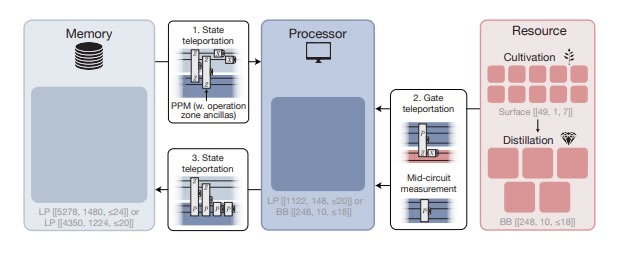
Layout and compilation procedure for the quantum computing logical architecture. Source: Caltech
Quantum frontiers closer than they appear
Oratomic said it will work in close collaboration with Caltech’s Advanced Quantum Computing Mission, with ongoing research into quantum information processing and the goal of building the world’s first utility-scale fault-tolerant quantum computer.
The research comes just a day after Google released a paper claiming that quantum computers could potentially break Bitcoin’s cryptography in nine minutes, needing much less computing power than originally thought.
Meanwhile, Google urged crypto developers in its paper this week to transition blockchains to post-quantum cryptography, or PQC, now rather than waiting for real threats to emerge.
Last week, the internet giant set a 2029 timeline for its PQC migration, warning that “quantum frontiers” could be closer than they appear.
Disclaimer: The content of this article solely reflects the author's opinion and does not represent the platform in any capacity. This article is not intended to serve as a reference for making investment decisions.
You may also like
The script at the end of 2018: The Federal Reserve continued to raise interest rates, US stocks plunged 20% from the September highs, forcing the Federal Reserve to "pivot" in January.
Goldman Sachs' head of trading believes the current US stock market is repeating the scenario of late 2018, with monetary tightening and equity market pressure. The Goldman Sachs Financial Conditions Index has tightened by about 8 points in two weeks, reaching the highest level in a year. The selloff has broadened from tech stocks to defensive sectors. Gold and equities are declining simultaneously, possibly indicating investors are selling assets to raise cash, making gold a key indicator for observing liquidity stress.

Goldman Sachs Trader “Revisits the 2018 Playbook”: Still Clearly Remembers “On December 24th, Clients Asked Why the Market Dropped So Much—And I Had No Idea”
Brian Garrett pointed out that the current adjustment in the US stock market is similar to the sharp decline in Q4 2018: the S&P 500 has already experienced 42% of the corresponding drop, and the VIX is approaching its peak just before Christmas. If history repeats itself, the bottom of this cycle may appear in January next year. However, the credit market and Federal Reserve policy have yet to provide clear signals of a bottom.
Anthropic (ANT.US) nearly “broke issue price,” but Claude knocks on the doors of “the highest peak in mathematics”! 17 million lines of Lean code used to write a candidate proof for the Riemann Hypothesis
On November 20th, Eastern Time, on its second day of trading, Anthropic's intraday price dropped to a low of $83.05, just 5 cents above the offering price of $83, and finally closed at $88.91, a decline of 8.50%. On the same day, the company's mathematician Levant Alperg announced on his personal website that he and Claude had found a candidate proof for the Riemann hypothesis, which has puzzled the mathematics community for 167 years, and released about 17 million lines of Lean formalized code.

As US stocks plummet, the parent company of GTA 6 rises against the market! First-day sales hit a record $3.79 billion; Wall Street shifts focus to next-generation GTA Online.
According to Rentrak data, the global box office of "Grand Theft Auto VI" has also surpassed that of "Avengers: Endgame," the highest-grossing film of all time, which has a global box office of approximately $2.94 billion.

Crypto prices
More


