
Coin Center urges SEC to prioritize rulemaking over no-action letters

Crypto lobby group Coin Center has urged the US Securities and Exchange Commission to stop addressing individual crypto cases reactively and instead start setting clear rules.
“Individualized relief can provide short-term clarity, but it risks fragmentation, implicit merit regulation, and uneven treatment across projects,” Coin Center said in a letter to the SEC, urging the regulator to "prioritize rulemaking wherever possible."
“The true value of crypto networks lies in their character as utility-like public goods rather than as services operated by private corporations or associations,” the letter read.
The letter, which was made public on Tuesday, was dated March 5.
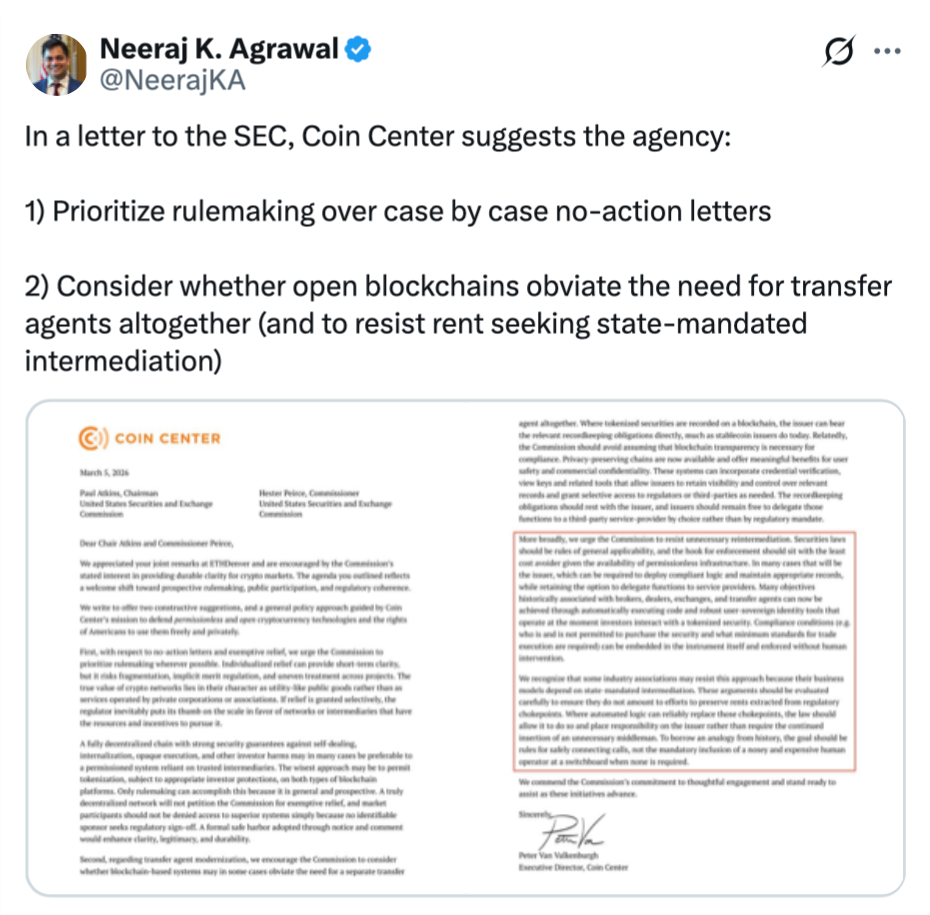 Source:
Neeraj K. Agrawal
Since then, the SEC has released a notice that interprets how “non-security crypto assets” fall under federal securities laws and provides a “coherent token taxonomy for digital commodities, digital collectibles, digital tools, stablecoins, and digital securities.”
The SEC and CFTC also signed a memorandum of understanding on Mar. 12 to better coordinate oversight of the financial markets, ending decades of “regulatory turf wars” between them.
Selective relief creates an unfair environment: Coin Center
Crypto-focused no-action letters have continued to trickle in, with the latest being a no-action letter addressed to crypto wallet provider Phantom Technologies by the Commodity Futures and Trading Commission’s Market Participants Division.
The CFTC notice, which was shared on Tuesday, said that the no-action letter would, under certain circumstances, stop the division from recommending that the regulator take an enforcement action against Phantom or its staff for failure to register as a broker.
The past few months have also seen the SEC hand out two no-action letters to decentralized physical infrastructure network (DePIN) crypto projects.
In late September, the SEC also issued a no-action letter that cleared the way for investment advisers to use state trust companies as crypto custodians.
However, Coin Center argued that relying on these case-by-case rulings creates uncertainty for the wider crypto market.
“If relief is granted selectively, the regulator inevitably puts its thumb on the scale in favor of networks or intermediaries that have the resources and incentives to pursue it,” it said.
Related: SEC will consider most crypto assets not securities under federal law
Meanwhile, US lawmakers are approaching the problem their own way.
The CLARITY Act, which aims to provide clearer regulatory oversight for the crypto industry, is moving through Congress.
The bill, if passed, would give the SEC and CFTC clearer guidance on which digital assets fall under their jurisdiction, helping reduce ambiguity and ensure more consistent treatment across the crypto industry.
Magazine: All 21 million Bitcoin is at risk from quantum computers
Disclaimer: The content of this article solely reflects the author's opinion and does not represent the platform in any capacity. This article is not intended to serve as a reference for making investment decisions.
You may also like
Nvidia falls to its lowest valuation in 14 years! "Super bull" Tom Lee calls for bottom fishing, retail investors are buying more as it drops, but Wall Street is divided
After the market opened on Thursday, retail investors went against the trend and bought up Nvidia, with net purchases reaching $111 million in just half an hour, setting a record for the same period. Investors such as Tom Lee have publicly supported the company, with institutions optimistic about strong order backlogs extending to 2028, robust revenue growth, and opportunities created by declining valuations. Meanwhile, institutions like Bernstein and Goldman Sachs have become more cautious about Nvidia's outlook, with concerns focusing on management succession and technological leadership following Jensen Huang's departure.

Jane Street boosts Fidelity Bitcoin ETF stake 8x in Q3, trims BlackRock IBIT

From SpaceX to Anthropic, the market has new strategies for dealing with tech giants' IPOs
The market's response strategies to major listings are currently centered around "index inclusion expectations": the new regulations allow mega IPOs to be included in the six major indices within 15 days, triggering concentrated buying by passive funds. Investors are positioning themselves in advance and using options to hedge and amplify buying power. However, Anthropic has a free float of only about 6%; shares available for sale by employees on the first day and privately placed shares with no lock-up period may create supply pressure. On the other hand, index arbitrageurs are facing a rare opportunity.

Nvidia Q3 Earnings Preview: Revenue Expectations and Key Metrics to Watch
Crypto prices
More


