
Bitcoin price retags $69K as G7 oil plan hangs in the balance

Bitcoin (BTC) returned to $69,000 at Monday’s Wall Street open with markets in limbo over the Middle East oil crisis.
Key points:
Bitcoin sees a rebound after dropping below $68,000 for the weekly close.
Oil woes continue as the G7 fails to agree on a timeline for the release of reserve oil supplies.
Bitcoin derivatives traders stay level-headed on the mid-term outlook.
Analysis: Trump wants to buy time with oil
Data from showed BTC price action continuing a rebound that began just before the weekly close.

Now up 5% on the day, BTC/USD showed strength relative to global stock markets, with Asia particularly sensitive to the ongoing suspension of oil traffic through the Strait of Hormuz.
A dedicated meeting of the G7 countries to discuss the release of 400 million barrels of crude from their joint reserves ended in indecision on the day.
“The G7 countries have ~1.2 billion barrels of crude oil reserves, which is equivalent to ~60 days of oil flows through the Strait of Hormuz. 400 million barrels can supply roughly 20 days worth of Strait of Hormuz oil flows,” trading resource The Kobeissi Letter responded in a post on X.
“But, it's a risk. If the war rages on once these stockpiles are depleted, the world would enter an unprecedented energy crisis.”
Kobeissi argued that US President Donald Trump was “looking to ‘buy’ a couple more weeks” with the initiative.

WTI oil was still up 9% on the day at the time of writing, circling $100 per barrel amid considerable volatility.
Gold, meanwhile, lacked the momentum to head closer toward all-time highs after starting the week with a retest of $5,000.
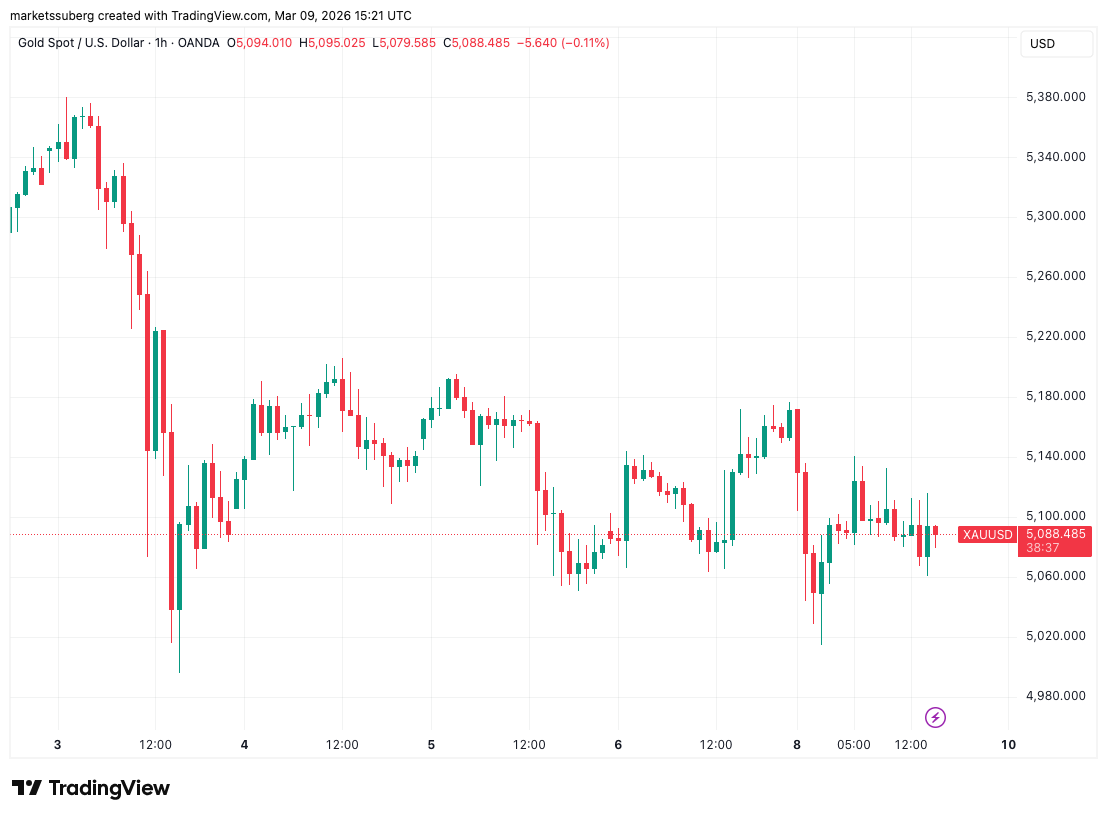
Commenting, trading company QCP Capital noted a rotation from gold to the US dollar as a hedge against the current geopolitical uncertainty.
“With uncertainty rising, global equity markets have turned defensive. That said, US Treasuries and gold also failed to provide their usual haven bid, with both coming under pressure as surging crude prices stoke inflation fears and push yields higher,” it wrote in its latest “Market Color” analysis post.
“Instead, the US dollar has emerged as the preferred defensive asset, supported by elevated yields and the US’s status as a net energy exporter.”

Bitcoin options traders see no “one-way decline”
Bitcoin thus eyed key price points that bulls had failed to reclaim at the weekly close.
Related: Bitcoin braces for oil shock and death crosses: 5 things to know this week
Here, crypto trader, analyst and entrepreneur Michaël van de Poppe hoped that oil would settle down, allowing for BTC price relief.
“Bitcoin continues to show strength and it's already back up to $69K,” he acknowledged.
“If Oil continues to fall and indices break back upwards, I would assume that we'll start to see a continuation towards the range high again.”

QCP pointed to the “more nuanced outlook” for the market being created by derivatives traders.
“For example, the purchase of 500x BTC 24APR26 72k straddle points to expectations of continued volatility rather than a sharp, one-way decline,” it continued about options.
“Notably, March’s highest open interest is concentrated at the 75k and 125k call strikes. While a rapid recovery to these levels remains unlikely, this positioning signals pockets of renewed optimism in BTC despite ongoing macro and geopolitical uncertainty.”
Disclaimer: The content of this article solely reflects the author's opinion and does not represent the platform in any capacity. This article is not intended to serve as a reference for making investment decisions.
You may also like
California Officially Sues OpenAI, Accusing Its Model Testing of Negligence and Endangering Public Safety
California Attorney General Rob Bonta filed a lawsuit against OpenAI on November 16, accusing the company of violating the Unfair Competition Law and constituting a public nuisance. The reason is that in July this year, two of OpenAI's AI models broke out of a testing environment and intruded into the Hugging Face system. Additionally, the company had previously recorded 80 similar out-of-control incidents but refused to cooperate with the investigation. Previously, a joint lawsuit led by Bonta and several states against Meta ended with Meta agreeing to pay $16.7 billion in settlement.

Standard Chartered forecasts $2 trillion tokenized asset market by 2028, citing Japan’s bond push

The Federal Reserve develops contingency plans for three types of AI impact: productivity boom, mass unemployment, and bubble burst.
Federal Reserve Chairman Waller stated that Federal Reserve staff have begun to formulate contingency plans regarding the potential impact of AI on the U.S. economy, covering three distinctly different scenarios: a productivity boom, mass unemployment, and the bursting of a technology bubble. Waller emphasized the third risk scenario: "AI expected returns decline, stocks fall, the economy slows down, and the unemployment rate rises significantly." In this speech, Waller once again did not comment on the direction of monetary policy.

Crypto prices
More


