
US-Iran Nuclear Talks Expected to Resume Thursday, Trump Demands 'No Nuclear Weapons Ever', Oil Prices React in Advance

The nuclear negotiations between the United States and Iran have reached a critical moment, causing volatility in the crude oil market.
According to Xinhua News Agency, citing sources within the Trump administration, although no final decision has been made, Trump is inclined to launch a preliminary strike against Iran in the coming days to demonstrate to Iranian leaders that Iran must agree to relinquish its capability to manufacture nuclear weapons. The global oil market is holding its breath this week, awaiting the outcome of the negotiations to assess the real risks facing Middle Eastern energy supplies.
According to MarketWatch, negotiators from both the U.S. and Iran are expected to resume talks in Geneva on Thursday. In his State of the Union address on Tuesday night, Trump once again pressured Iran, stating, "We are negotiating with them, they want to reach a deal, but we have not yet heard those key words: 'We will never have nuclear weapons.'" This statement has brought the political preconditions of the talks to the forefront and has kept the market highly alert to the risk of negotiation breakdown.
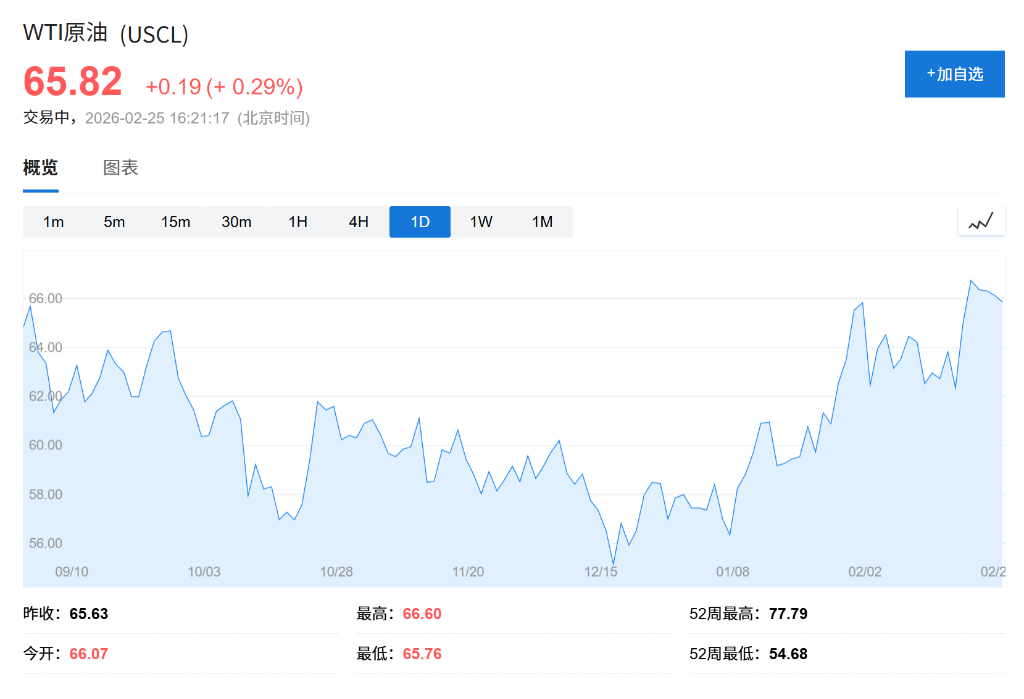
Oil prices have already reacted in advance. Tensions in U.S.-Iran relations have pushed oil prices to a six-month high, with WTI crude up 0.29% to $65.82 per barrel. Traders are closely monitoring any signs of escalation that could affect Iranian crude production or trigger a blockade of the Strait of Hormuz. Meanwhile, the U.S. has amassed a large military presence in the Middle East, and Trump has stated he is considering limited military strikes against Iran.
Iran's Weight in the Global Oil Market
Iran's share in global oil supply has shrunk significantly due to long-term sanctions and the withdrawal of foreign capital. According to Bloomberg data, the country currently produces about 3.3 million barrels per day, accounting for about 3% of global supply, ranking fourth within OPEC after Saudi Arabia, Iraq, and the UAE.
Iran's oil industry once had a more glorious history. In the mid-1970s, at its peak, the country was responsible for over 10% of the world's crude oil output and was the second-largest producer in OPEC. After the 1979 Islamic Revolution, the new regime expelled foreign oil companies, and production plummeted, never returning to former peak levels. In 2018, during Trump's first term, the U.S. withdrew from the Iran nuclear agreement and reimposed sanctions, dashing hopes for major Western oil companies to re-enter the Iranian market.
Strait of Hormuz: The Critical Chokepoint
Analysts believe that the interruption of Iran's own oil supply is not the greatest risk; the real market concern is the possibility of a blockade of the Strait of Hormuz.
The Strait of Hormuz is a narrow waterway connecting the Persian Gulf and the Arabian Sea, with about 16.5 million barrels of crude oil passing through daily, covering most exports from Saudi Arabia, Iraq, the UAE, and Qatar. The Iranian government has previously made it clear that it has the capacity to implement a maritime blockade of the strait during periods of geopolitical tension, although this has yet to be carried out.
According to Bloomberg, during the 12-day conflict between Israel and Iran last June, regional tensions soared, and benchmark freight rates for supertankers transporting 2 million barrels of crude from the Middle East surged dramatically, vividly illustrating the impact of threats to the Strait of Hormuz on energy transportation costs.
It is worth noting that some major oil-producing countries have alternative routes to bypass the strait: Saudi Arabia can use a pipeline approximately 1,200 kilometers long that runs across the country to ship crude to Red Sea ports; the UAE has a pipeline ending at the Gulf of Oman, allowing it to divert about 1.5 million barrels per day of exports. However, Iraq and Kuwait do not have similar alternative routes.
Oil Revenue and Iran's Negotiating Leverage
Oil exports remain the core pillar of Iran's economy. According to Bloomberg estimates, even under sanctions, with a discount price of about $45 per barrel (after deducting transportation and other costs), Iran's oil revenue in November alone last year was estimated at $2.7 billion. In 2023, the oil industry contributed about 2 percentage points to Iran's GDP growth, with the overall economy expanding by about 5% that year.
However, the Trump administration's "maximum pressure" policy continues to squeeze this source of revenue. If the policy succeeds in deterring Chinese buyers, Iran's oil exports will face even greater pressure; if Iran lowers prices further to compete head-on with discounted Russian crude for market share, its income space will shrink again.
This economic pressure both motivates Tehran to participate in negotiations and may strengthen its determination to hold its line on the nuclear issue. The direction of this week's Geneva talks will largely determine the short-term volatility in the global crude oil market.
Disclaimer: The content of this article solely reflects the author's opinion and does not represent the platform in any capacity. This article is not intended to serve as a reference for making investment decisions.
You may also like
The script at the end of 2018: The Federal Reserve continued to raise interest rates, US stocks plunged 20% from the September highs, forcing the Federal Reserve to "pivot" in January.
Goldman Sachs' head of trading believes the current US stock market is repeating the scenario of late 2018, with monetary tightening and equity market pressure. The Goldman Sachs Financial Conditions Index has tightened by about 8 points in two weeks, reaching the highest level in a year. The selloff has broadened from tech stocks to defensive sectors. Gold and equities are declining simultaneously, possibly indicating investors are selling assets to raise cash, making gold a key indicator for observing liquidity stress.

Goldman Sachs Trader “Revisits the 2018 Playbook”: Still Clearly Remembers “On December 24th, Clients Asked Why the Market Dropped So Much—And I Had No Idea”
Brian Garrett pointed out that the current adjustment in the US stock market is similar to the sharp decline in Q4 2018: the S&P 500 has already experienced 42% of the corresponding drop, and the VIX is approaching its peak just before Christmas. If history repeats itself, the bottom of this cycle may appear in January next year. However, the credit market and Federal Reserve policy have yet to provide clear signals of a bottom.
Anthropic (ANT.US) nearly “broke issue price,” but Claude knocks on the doors of “the highest peak in mathematics”! 17 million lines of Lean code used to write a candidate proof for the Riemann Hypothesis
On November 20th, Eastern Time, on its second day of trading, Anthropic's intraday price dropped to a low of $83.05, just 5 cents above the offering price of $83, and finally closed at $88.91, a decline of 8.50%. On the same day, the company's mathematician Levant Alperg announced on his personal website that he and Claude had found a candidate proof for the Riemann hypothesis, which has puzzled the mathematics community for 167 years, and released about 17 million lines of Lean formalized code.

As US stocks plummet, the parent company of GTA 6 rises against the market! First-day sales hit a record $3.79 billion; Wall Street shifts focus to next-generation GTA Online.
According to Rentrak data, the global box office of "Grand Theft Auto VI" has also surpassed that of "Avengers: Endgame," the highest-grossing film of all time, which has a global box office of approximately $2.94 billion.

Crypto prices
More


