
House Democrats press Treasury on World Liberty bank charter and UAE stake

Democrats in the US House of Representatives are pressing Treasury Secretary Scott Bessent over how regulators are handling World Liberty Financial’s bid for a national trust bank charter to issue a dollar-backed token.
In a Feb. 19 letter, 41 House Financial Services Committee Democrats led by Representative Gregory Meeks cited systemic risk, foreign ownership and potential political pressure on the bank chartering process.
They asked Bessent to explain what safeguards exist to prevent foreign government officials or politically connected investors from using the charter process to gain leverage over the US financial system.
The lawmakers pointed to reporting that a senior royal from the United Arab Emirates quietly acquired nearly half of World Liberty Financial for roughly $500 million, including a reported $187 million flowing to Trump-affiliated entities, while the company pursued a national trust bank charter with the Office of the Comptroller of the Currency (OCC).
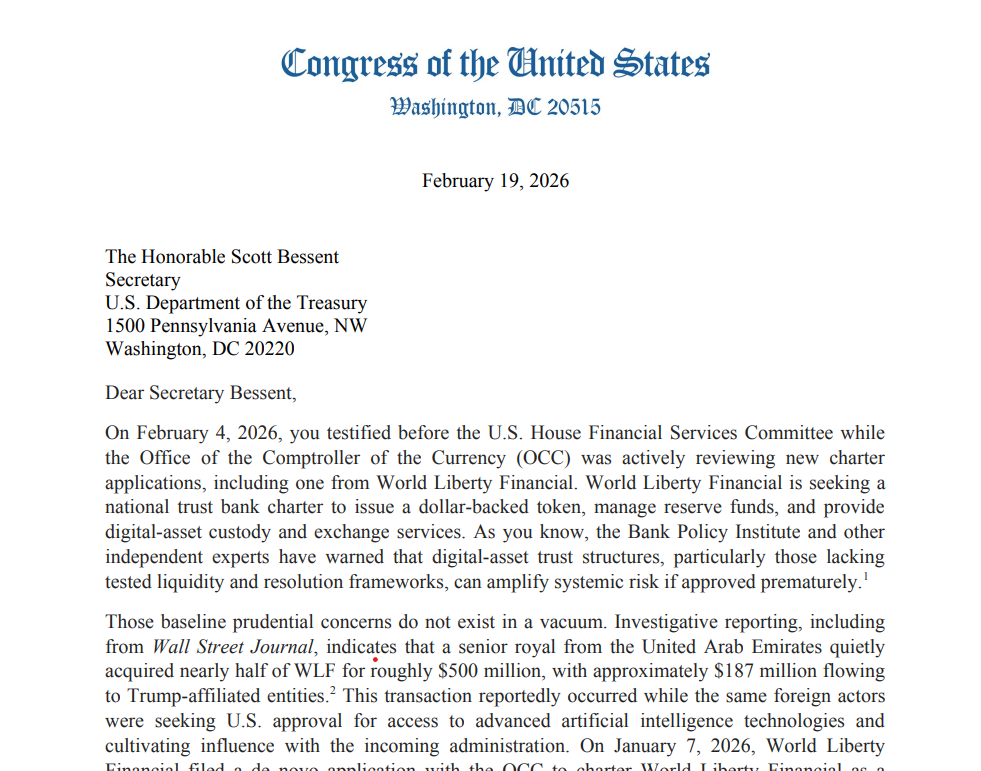 Democrats’ letter to Treasury Secretary Scott Bessent. Source:
Meeks.house.gov
They argued that the combination of digital asset trust structures, untested liquidity and resolution frameworks and foreign political interests raised questions that regulators “cannot afford to sidestep.”
Related: White House floats limited stablecoin rewards in third crypto, bank meeting
Democrats also questioned whether Executive Order 14215, which they say pulled traditionally independent financial regulators into closer White House oversight, could compromise the OCC’s autonomy in deciding on World Liberty’s application.
The letter asks Bessent to detail the role of the White House, the Office of Management and Budget, and the Treasury Department in OCC charter decisions, and to respond in writing by Feb. 26.
World Liberty Financial’s high profile
The letter arrives as World Liberty Financial and other Trump-aligned crypto initiatives raise their profile in Washington and on Wall Street, including through a well-attended crypto event at Trump’s Mar-a-Lago club on Wednesday that drew crypto and traditional finance executives, such as Coinbase CEO Brian Armstrong, Binance co-founder Changpeng Zhao and Goldman Sachs CEO David Solomon.
In the run-up to the event, the WLFI token associated with the Trump family-aligned platform recorded a 23% gain as organizers promoted the event as a venue to spotlight World Liberty’s roadmap and its role in the broader crypto market.
No bail out of “cryptocurrency billionaires”
Separately, Senate Banking Committee Democratic Senator Elizabeth Warren urged Bessent and Federal Reserve Chair Jerome Powell on Wednesday not to deploy taxpayer-backed support to stabilize crypto markets. She warned that any bailout of “cryptocurrency billionaires” would create a moral hazard and shift losses from large investors onto taxpayers.
Warren’s letter framed potential rescue measures for major crypto firms and investors as a test of whether policymakers would extend bank-style backstops to the digital asset sector, as regulators weigh new charters and oversight for crypto-linked institutions.
Big Questions: Is China hoarding gold so yuan becomes global reserve instead of USD?
Disclaimer: The content of this article solely reflects the author's opinion and does not represent the platform in any capacity. This article is not intended to serve as a reference for making investment decisions.
You may also like
No more mandatory retention! Anthropic launches EFS system, allowing enterprises to take control of their own AI data
Anthropic has launched the public beta of its Enterprise Frontier Security (EFS) system, allowing corporate clients to store AI data on their own cloud platforms, with clients holding their encryption keys. Anthropic only performs automated security scans and cannot access the data itself. The system retains the 30-day data retention requirement, but control over storage is returned to enterprises, addressing strong customer backlash sparked by the mandatory retention policy implemented in June.

Report: Samsung's storage capacity is nearly sold out for the next three years, clients rush to secure long-term contracts until 2031
According to media reports, most of Samsung Electronics' memory manufacturing capacity for the period from 2027 to 2029 has already been secured through contracts. Some customers are even seeking to extend long-term supply agreements until 2031. Currently, leading memory manufacturers can only meet about 60% to 70% of client demand, and the supply shortage may intensify further in 2027.

Anthropic commits to about $900 billion in computing power expenditure; bond market expects its bonds to be junk-rated
Despite Anthropic raising over $100 billion in its public offering and reaching a market capitalization of $1.18 trillion, the company is widely expected by the debt market to be rated as BB-level "junk bonds" due to its lack of profitability and approximately $900 billion in massive computing power expenditure commitments. Amid pressure on tech giants in the debt market and chip companies planning to reduce loan guarantees, Anthropic will still need to rely on structured financing in the short term, facing about a three-year window to strive for an investment-grade rating.
JPMorgan Trading Desk Abandons Tactical Bullish Stance on S&P 500: Rebound May Occur, Bottom Not Yet Reached
J.P. Morgan's trading division has shifted from a tactical bullish stance to a cautious one, expecting stock market volatility in the coming weeks, but emphasizes that market fundamentals—from the economy to earnings—remain solid.

Crypto prices
More


