
Retail Giant Beats Estimates Amid Tech-Driven Evolution

The fourth-quarter earnings season is winding down, but that doesn’t mean this week was lacking in headlines. Retail giant Walmart was front and center with another solid earnings announcement.
Walmart reported its fiscal fourth-quarter results this morning, capping a strong year with beats on both revenue and earnings amid resilient consumer demand and omnichannel execution.
The company delivered total revenues of $190.7 billion, up 5.6% year-over-year (4.9% in constant currency), exceeding the Zacks Consensus Estimate of $190.05 billion. Adjusted earnings per share reached $0.74, edging by expectations of $0.73 and reflecting a 12.1% increase from the prior-year quarter.
The results come amid Walmart’s broader AI push, including investments in supply chain optimization, predictive analytics, and personalized shopping tools, positioning the retailer more like a tech-enabled company rather than a traditional brick-and-mortar giant.
Digger Deeper into Walmart’s Release
This marks Walmart's second consecutive earnings beat, resuming its long history of outperformance with the U.S. segment leading through value pricing and convenience, while international markets contributed via Flipkart and Walmex.
Comparable sales growth remained solid, with Walmart U.S. comps rising 4.6% (ex-fuel), driven by a 2.6% increase in transactions and a 2% uptick in average ticket. Global e-commerce sales surged 24%, fueled by store-fulfilled orders, marketplace expansions, and global advertising growth of 37% (including VIZIO). Membership trends were a highlight with global membership fee revenue up 15.1%.
Walmart announced a new $30 billion share repurchase authorization program, further enhancing its goal of delivering shareholder value. The quarter also included a 5% dividend increase to $0.99 per share annually, marking the 53rd consecutive year of raises.
“Dividends continue to be a part of our diversified capital returns approach. We're proud to be increasing our annual dividend for the 53rd consecutive year. This decision is a proof point of our continued confidence in our business performance and forward momentum,” said John David Rainey, executive vice president and chief financial officer at Walmart.
Guidance updates provided optimism, with Q1 FY27 net sales projected up 3.5-4.5% and operating income up 4-6%, while full-year FY27 also calls for total net sales growth of 3.5-4.5% and adjusted operating income expansion of 6-8%—both raised from prior ranges. This reflects confidence in holiday momentum carrying forward, with e-commerce expected to grow in the mid-20% range and international segments contributing meaningfully.
These results underscore Walmart’s leading retail position, with its digital and membership momentum providing a competitive edge in a price-sensitive environment. The company’s approach prioritizes unmatched value combined with enhanced convenience, including accelerated same-day pickup and faster delivery.
Walmart’s Stock Performance
Walmart WMT experienced a minor dip in early trading on Thursday, but recovered by mid-day with shares trading back in positive territory. Today’s move appears more related to general market conditions, pointing to high expectations rather than underlying issues, and could present an entry point for long-term holders.
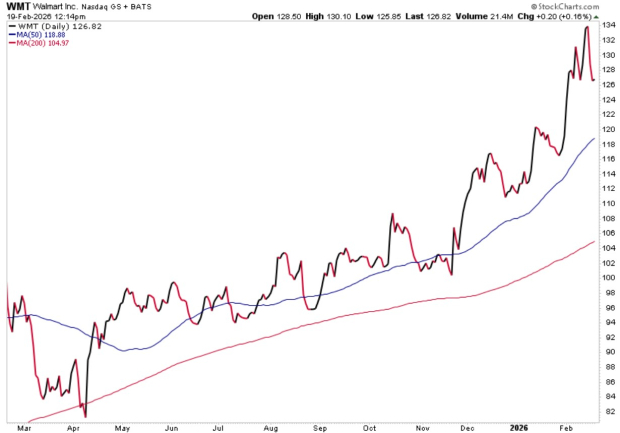
Image Source: StockCharts
The stock has been widely outperforming this year, up more than 13% while the broader market shows signs of rotation. Walmart is currently a Zacks Rank #3 (Hold), reflecting balanced expectations following the stock’s recent strength.
For the broader retail industry, Walmart's performance underscores a narrative of resilience, where omnichannel leaders thrive through convenience and affordability. Investments in AI for inventory management and personalization should further enhance efficiency, positioning Walmart to gain share from peers like Target in discretionary categories.
Bottom Line
The quarterly results bode well for Walmart moving forward, signaling its adaptability in a tiered consumer spending landscape where value-seeking persists across income levels. The emphasis on memberships and advertising—now multi-billion-dollar businesses—creates high-margin recurrence, buffering against potential tariff impacts or economic softness.
While discretionary weakness lingers, strength in essentials and e-commerce suggests a gradual consumer rebound, potentially lifting the sector if macro conditions stabilize. This could encourage competitors to accelerate digital investments and loyalty programs, fostering innovation across retail amid supply chain challenges and shifting preferences.
Overall, Walmart's report affirms its role as a retail bellwether, navigating uncertainties with steady execution.
Disclaimer: The content of this article solely reflects the author's opinion and does not represent the platform in any capacity. This article is not intended to serve as a reference for making investment decisions.
You may also like
The script at the end of 2018: The Federal Reserve continued to raise interest rates, US stocks plunged 20% from the September highs, forcing the Federal Reserve to "pivot" in January.
Goldman Sachs' head of trading believes the current US stock market is repeating the scenario of late 2018, with monetary tightening and equity market pressure. The Goldman Sachs Financial Conditions Index has tightened by about 8 points in two weeks, reaching the highest level in a year. The selloff has broadened from tech stocks to defensive sectors. Gold and equities are declining simultaneously, possibly indicating investors are selling assets to raise cash, making gold a key indicator for observing liquidity stress.

Goldman Sachs Trader “Revisits the 2018 Playbook”: Still Clearly Remembers “On December 24th, Clients Asked Why the Market Dropped So Much—And I Had No Idea”
Brian Garrett pointed out that the current adjustment in the US stock market is similar to the sharp decline in Q4 2018: the S&P 500 has already experienced 42% of the corresponding drop, and the VIX is approaching its peak just before Christmas. If history repeats itself, the bottom of this cycle may appear in January next year. However, the credit market and Federal Reserve policy have yet to provide clear signals of a bottom.
Anthropic (ANT.US) nearly “broke issue price,” but Claude knocks on the doors of “the highest peak in mathematics”! 17 million lines of Lean code used to write a candidate proof for the Riemann Hypothesis
On November 20th, Eastern Time, on its second day of trading, Anthropic's intraday price dropped to a low of $83.05, just 5 cents above the offering price of $83, and finally closed at $88.91, a decline of 8.50%. On the same day, the company's mathematician Levant Alperg announced on his personal website that he and Claude had found a candidate proof for the Riemann hypothesis, which has puzzled the mathematics community for 167 years, and released about 17 million lines of Lean formalized code.

As US stocks plummet, the parent company of GTA 6 rises against the market! First-day sales hit a record $3.79 billion; Wall Street shifts focus to next-generation GTA Online.
According to Rentrak data, the global box office of "Grand Theft Auto VI" has also surpassed that of "Avengers: Endgame," the highest-grossing film of all time, which has a global box office of approximately $2.94 billion.

Crypto prices
More


