
Samsara Plunges 57% in a Year: Should You Buy, Sell or Hold the Stock?

Samsara Inc. IOT shares have plunged 57.1% in the past year, underperforming the Zacks Internet - Software industry’s 20.1% decline and the Zacks Computer and Technology sector’s return of 18.1%.
Samsara One-Year Performance Chart
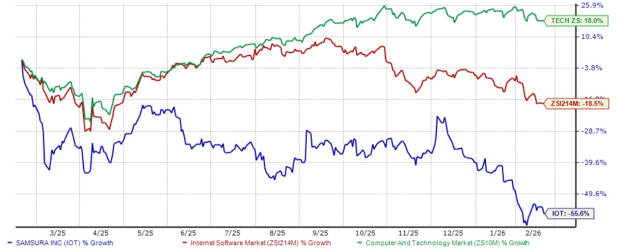
Image Source: Zacks Investment Research
Despite this decline in the share price, Samsara stock is trading at a premium valuation. IOT is trading at a forward price-to-sales ratio of 7.81, much higher than the industry’s valuation of 3.87. This is further supported by a Zacks Value Score of F.
Samsara Forward 12-Month (P/S) Valuation Chart
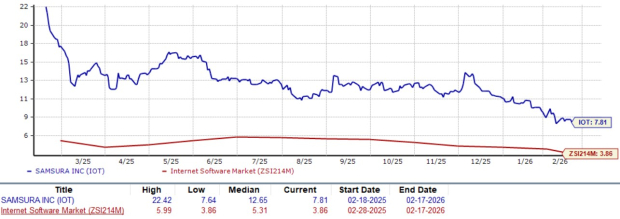
Image Source: Zacks Investment Research
Given these dynamics, the investors ask: Should they buy, sell or hold Samsara stock? Let’s dive into the fundamentals of the company to answer this question.
Samsara Gains From Strong Adoption of Connected Platform
Samsara is gaining from the adoption of its Connected AI Platform and IOT trackers, telematics and video monitoring devices and is gaining market share among vehicle OEMs and fleet management companies. Samsara added 133 new $100K+ ARR customers, bringing the total to 2,771 in the second quarter of fiscal 2026. The company ended the second quarter of fiscal 2026 with more than 147 customers contributing $1 million in ARR.
Samsara is set to gain from the global shift toward Industry 4.0 as manufacturing, industrial and transport processes are getting transformed with the integration of digital technologies. IOT is leveraging its deep expertise in physical operations digitization to connect people, devices, assets, transports and systems on its Connected Operations Platform.
Samsara's platform integrates IoT data, artificial intelligence and workflow tools to provide operational visibility and actionable insights. The fleet management space is one of the markets where Samsara operates, and this market alone is expected to witness a CAGR 13.3% from 2025 to 2030, per a report by MarketsAndMarkets.
The company is now enhancing its connected platform capabilities by implementing artificial intelligence throughout its platform. Samsara’s recent enhancements include Samsara Assistant for conversational assistance and Samsara Intelligent Experiences for embedded AI-based insights on its platform.
IOT is continuously improving its AI capabilities by training its models. Samsara processes more than 20 trillion operational data points from its IoT devices to train and improve its AI models. Through these data sets, Samsara can deliver more accurate predictions, smarter automation and stronger safety outcomes, gaining industry leadership. A new way of processing data to gain deeper insights into the fleet is keeping its customer churn low.
Samsara Grapples With Stiff Competition in Vehicle Telematics
Samsara operates in a highly competitive market. Players, including Motive, Lytx, Verizon VZ, Trimble TRMB and Geotab in the vehicle telematics space and PTC PTC in the industrial Internet of Things space. To compete with these companies, Samsara is investing heavily in its operations, such as sales and marketing and research and development.
Verizon offers products like Connect Reveal, Connect Fleet and Connect Asset Tracking to address GPS fleet tracking, driver behavior monitoring, compliance and reporting for enterprise fleet management, equipment and trailer tracking. Trimble offers Fleet Management, Asset Tracking and Transportation Management System coming head-on with Samsara’s offerings.
This is one of the reasons why, despite having a robust non-GAAP gross margin of 78% in the second quarter of fiscal 2026, its non-GAAP operating margin stood at a modest 19%. The rising competition is pressuring Samsara’s bottom line. The Zacks Consensus Estimate for Samsara’s third-quarter fiscal 2026 earnings suggests growth of 18.8% with net margin hovering around breakeven.
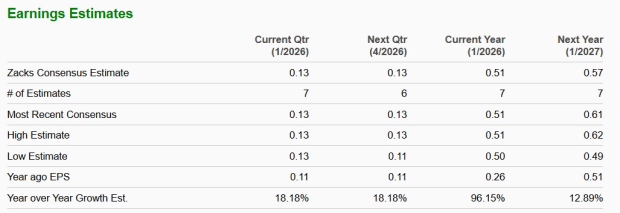
Image Source: Zacks Investment Research
Samsara still bets on the video telematics market, which is underpenetrated. However, Trimble Video Intelligence and Verizon’s dashcams & AI video telematics pose a threat to it. Moreover, in the industrial Internet of Things space, PTC has products like ThingWorx, Kepware, Vuforia and ServiceMax, making PTC a formidable competitor for Samsara. Despite intense competition, Samsara is targeting a vast, underpenetrated market, one where multiple players are positioned to capture meaningful share.
Conclusion: Hold Samsara for Now
Although the vehicle telematics and industrial Internet of Things space is highly competitive, the market remains highly underpenetrated, especially in the video telematics space, giving Samsara an opportunity to grab a meaningful share. The company has recently turned profitable, enabling it to prove its business strategy. Considering these factors, we suggest investors retain this Zacks Rank #3 (Hold) stock.
Disclaimer: The content of this article solely reflects the author's opinion and does not represent the platform in any capacity. This article is not intended to serve as a reference for making investment decisions.
You may also like
Cross River Bank enters Bitcoin-backed lending with $250K loans

 VIPIndiscriminate Selling Strikes, Igniting the Market's Black Friday
1. Global markets were caught in a liquidity squeeze and indiscriminate selling this week. Apart from natural gas, which surged 16.04%, and the US Dollar Index (DXY), which edged up 0.39%, major global equity indices, precious metals, industrial metals, and cryptocurrencies all fell sharply. Silver and the Nasdaq 100 led the decline, plunging 16.24% and 10.43%, respectively. 2. Minutes from the Federal Reserve's Federal Open Market Committee (FOMC) meeting warned that AI infrastructure is pushing up near-term inflation and adding to market concentration risk. The warning triggered a wave of profit-taking in tech heavyweights. The Nasdaq Composite fell 5.28% on Friday, erasing its gains for the year, and NVIDIA declined for a seventh straight week. At the same time, AI giant Anthropic raised $81.3 billion in the largest IPO on record globally. This massive draw on capital, combined with selling pressure in the secondary market, quickly spread the cooling in risk appetite to high-beta crypto assets. 3. Fed officials dissented in favor of a 25-basis-point rate hike, and Governor Waller went further, warning that an outsized 50-basis-point hike may be needed in December to curb inflation. Tightening expectations drove DXY to a 19-month high of 103.97 and tipped markets into a dash-for-cash liquidity squeeze. Spot gold plunged to a 14-month low, and US equities, commodities, and cryptocurrencies fell in tandem as institutions systematically cut their cross-asset risk exposure. 4. Caught between the tech rout and a strong dollar, Bitcoin briefly fell below $60,000, and market-wide liquidations jumped to $1.33 billion in 24 hours. Institutional flows saw a watershed reversal. BlackRock's IBIT posted a net outflow of $541 million on Thursday, its largest single-day outflow since launch, and cumulative net outflows from US spot Bitcoin ETFs have neared $3.5 billion so far in November. Looking ahead, the market is set to search for a bottom in both sentiment and valuations in the near term. 5. Assets in focus: BTC, ANT, and NVDA

5 Best VPNs Worth Using for Crypto
Ripple ETF Investors Hold On, But XRP Buyers Go Missing
Crypto prices
More


