
Magnificent 7, Bitcoin And Software: Why It's 'All One Trade,' Analyst Says

A tight correlation between mega-cap tech, software stocks and Bitcoin (CRYPTO: BTC) that fueled massive gains in 2024 and 2025 has now flipped into synchronized weakness, and one Wall Street technical analyst says the message is simple: it was always "one trade."
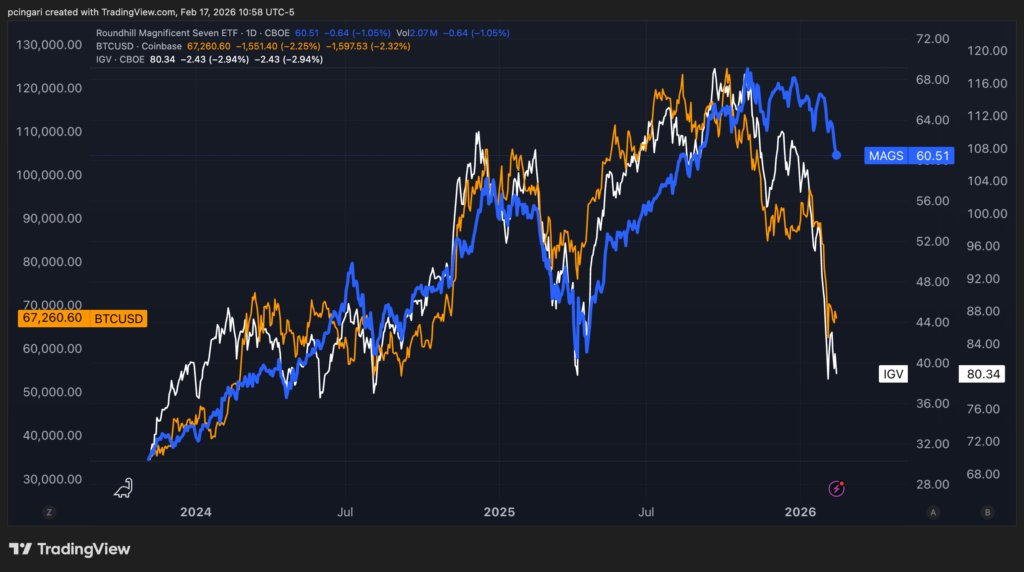
In a client webinar hosted on Tuesday, 22V Research analyst John Roque laid out charts showing the Magnificent Seven, the iShares Expanded Tech-Software Sector ETF (NYSE: IGV), and Bitcoin tracking one another closely over the past two years.
"It seems to me that the message is fairly clear. It's all one trade," Roque said.
"It was all one trade in 2024 and 2025, and then as it rallied into the coincident peaks in the autumn of 2025, and they've all been weak since, but of course, Bitcoin and the IGV have been weaker."
The iShares Expanded Tech-Software Sector ETF IGV recently traded near $80, well below its 40-week moving average around $106.
Roque said the ETF's technical score is zero, with risk toward $60 if oversold conditions fail to spark a bounce.
Chart: Magnificent Seven (Blue Line), Software Stocks IGV (White) and Bitcoin (Orange)
Bitcoin's $60,000 Break: What's Next?
Bitcoin recently hit Roque's $60,000 downside target before stabilizing. But he's not convinced the floor will hold.
"My target of 60,000 was hit on February 6th," Roque said. "It would not surprise me, and I actually am guessing that this is going to break $60,000, and 40,000 would be the next target."
He frames the current setup in historical context.
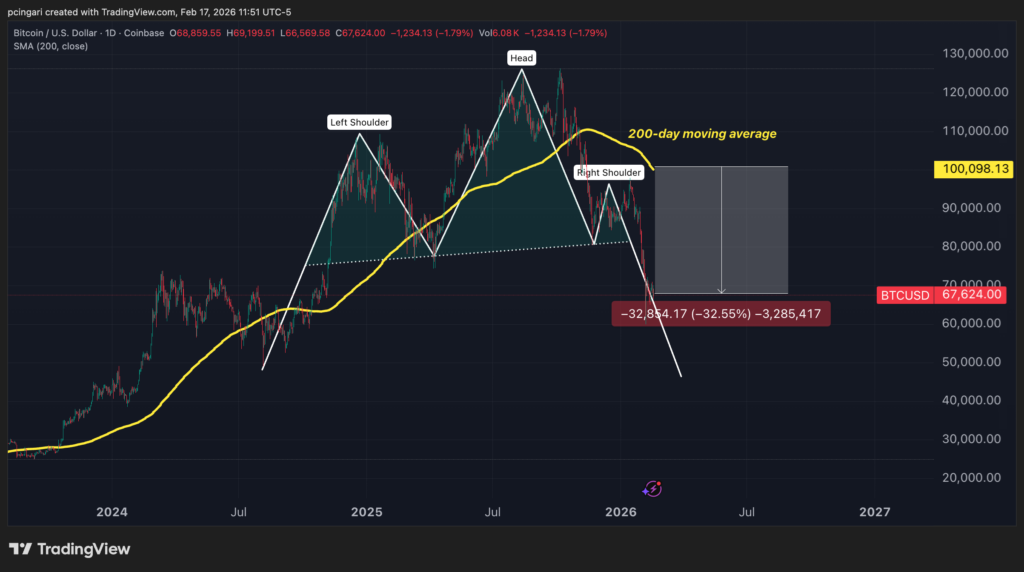
Since 2017, Bitcoin's major cyclical bottoms occurred when the asset traded 52%, 44% and 55% below its 200-day moving average. As of mid-February, Bitcoin was roughly 32% below that long-term trendline.
That gap suggests — at least by historical standards — that the drawdown may not yet be complete.
"It can bounce, but I'm a seller," Roque said, adding that the Bitcoin chart resembles a textbook head-and-shoulders top.
How Deep Could A Bitcoin Bear Market Go?
Bitcoin has suffered five major bear markets since 2011, with drawdowns of 82%, 86%, 84%, 72% and 75%. The average decline was roughly 80%. The smallest drop was 72%.
Applying a 72% decline from the most recent peak implies a potential downside near $35,000.
Roque is focused on $40,000 as a more practical level below $60,000 — but either way, the historical template suggests room for further weakness if the cycle plays out in similar fashion.
The bearish technical setup extends to Strategy Inc. (NASDAQ: MSTR), formerly MicroStrategy, which has become a leveraged proxy for Bitcoin.
Roque's initial downside target for the stock was $100. It reached an intraday low of $104 before bouncing.
"My initial downside target was 100," he said. "I think this figure is going to prove optimistic. It would not surprise me if this got to 20."
He acknowledged that $20 may sound extreme, but said the stock's relative performance versus the S&P 500 has turned sharply negative.
The last time Strategy showed similar relative weakness, the stock ultimately suffered a 90% absolute decline.
According to the company, Strategy holds more than 717,000 Bitcoins at an average purchase price of $76,000, representing roughly $54.5 billion in total cost.
At recent prices near $68,500, those holdings are worth just under $49 billion — implying an unrealized loss of approximately $5.5 billion.
If Bitcoin decisively breaks below $60,000 and trends toward $40,000, the pressure on Strategy's balance sheet — and equity valuation — could intensify quickly.
Photo: Shutterstock
Disclaimer: The content of this article solely reflects the author's opinion and does not represent the platform in any capacity. This article is not intended to serve as a reference for making investment decisions.
You may also like
Cross River Bank enters Bitcoin-backed lending with $250K loans

 VIPIndiscriminate Selling Strikes, Igniting the Market's Black Friday
1. Global markets were caught in a liquidity squeeze and indiscriminate selling this week. Apart from natural gas, which surged 16.04%, and the US Dollar Index (DXY), which edged up 0.39%, major global equity indices, precious metals, industrial metals, and cryptocurrencies all fell sharply. Silver and the Nasdaq 100 led the decline, plunging 16.24% and 10.43%, respectively. 2. Minutes from the Federal Reserve's Federal Open Market Committee (FOMC) meeting warned that AI infrastructure is pushing up near-term inflation and adding to market concentration risk. The warning triggered a wave of profit-taking in tech heavyweights. The Nasdaq Composite fell 5.28% on Friday, erasing its gains for the year, and NVIDIA declined for a seventh straight week. At the same time, AI giant Anthropic raised $81.3 billion in the largest IPO on record globally. This massive draw on capital, combined with selling pressure in the secondary market, quickly spread the cooling in risk appetite to high-beta crypto assets. 3. Fed officials dissented in favor of a 25-basis-point rate hike, and Governor Waller went further, warning that an outsized 50-basis-point hike may be needed in December to curb inflation. Tightening expectations drove DXY to a 19-month high of 103.97 and tipped markets into a dash-for-cash liquidity squeeze. Spot gold plunged to a 14-month low, and US equities, commodities, and cryptocurrencies fell in tandem as institutions systematically cut their cross-asset risk exposure. 4. Caught between the tech rout and a strong dollar, Bitcoin briefly fell below $60,000, and market-wide liquidations jumped to $1.33 billion in 24 hours. Institutional flows saw a watershed reversal. BlackRock's IBIT posted a net outflow of $541 million on Thursday, its largest single-day outflow since launch, and cumulative net outflows from US spot Bitcoin ETFs have neared $3.5 billion so far in November. Looking ahead, the market is set to search for a bottom in both sentiment and valuations in the near term. 5. Assets in focus: BTC, ANT, and NVDA

5 Best VPNs Worth Using for Crypto
Ripple ETF Investors Hold On, But XRP Buyers Go Missing
Crypto prices
More


