
Beyond NVIDIA: 4 AI & Quantum Plays Aiming Big Platform Upside in 2026

Most investors in 2026 agree on one thing- putting money into established AI leaders is the clearest way to tap into the ongoing tech boom. Companies such as NVIDIA NVDA continue to benefit directly from hyperscaler and enterprise AI infrastructure spending. Zacks Consensus Estimates points to fiscal 2026 revenue near $213 billion, supported by next-generation GPU platforms and a deeply embedded software ecosystem. Multi-billion-dollar AI data center expansions by major cloud providers reinforce demand visibility.
The debate now is where incremental capital should flow - toward emerging AI players with accelerating monetization, or toward speculative quantum computing firms offering asymmetric upside. In this article, we examine two AI-focused names — SoundHound AI SOUN and Marvell MRVL, along with 2 quantum computing stocks IonQ IONQ and D-Wave Quantum QBTS. Together, they represent distinct risk-reward pathways across AI software, AI semiconductor infrastructure and next-generation computing architectures.
Let’s delve deeper.
Budding AI or Quantum: Where to Rotate Money?
On the AI side, SoundHound AI and Marvell offer exposure to two different layers of the AI value chain with measurable growth trajectories.
SoundHound AI’s recent results show strong top-line momentum, with the last-reported third quarter 2025 revenue of up 68% year over year and 2025 guidance implying nearly 98% annual growth, albeit from a small base and with continued net losses as it invests in monetization and scaling products like its Amelia agentic AI platform. In 2026, this Zacks Rank #3 (Hold) stock is expected to report earnings growth of 56.9% on revenue growth of 38.3%.
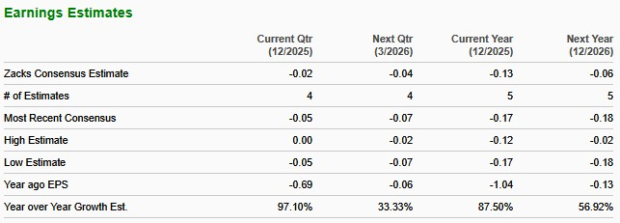
Image Source: Zacks Investment Research
Marvell’s infrastructure-focused model demonstrates much larger scale and robust demand from AI data centers, reporting $2.006 billion in revenue for the second quarter of fiscal 2026, up 58% year over year, with its data center segment alone accounting for roughly 74% of total revenue driven by custom AI silicon and high-bandwidth interconnect products tied to hyperscaler deployments. Marvell’s figures reflect firm scale and AI-driven revenue concentration, offering investors a contrast between early-stage AI software expansion and established AI infrastructure success within the broader ecosystem. In its fiscal 2027 (ending Jan 2027), this Zacks Rank #3 stock is expected to report earnings growth of 23.3% on revenue growth of 22.8%.
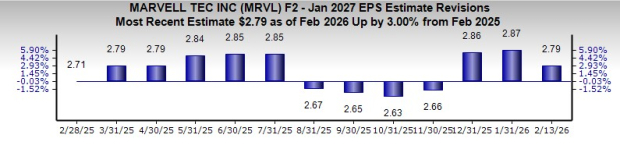
Image Source: Zacks Investment Research
By comparison, on the quantum front, in its third quarter 2025 earnings release, IonQ reported revenue of $39.9 million, marking a 222% year-over-year increase and exceeding the high end of its prior guidance by 37%. This sharp acceleration reflects expanded commercial engagements and strategic growth activities. The company also reported a pro-forma cash, cash equivalents and investments balance of $3.5 billion after completing a $2 billion equity offering, providing substantial runway for continued R&D and platform scaling. IonQ continues to operate at a net loss as it invests heavily in technology development and ecosystem expansion. In 2026, this Zacks Rank #3 stock is expected to report earnings growth of 65.8% on revenue growth of 38.3%.
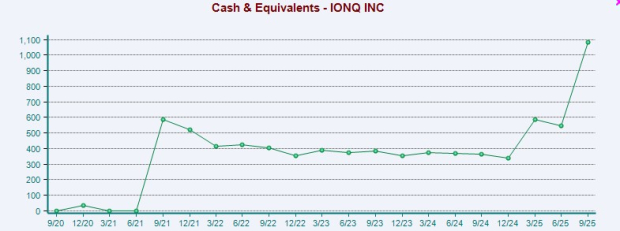
Image Source: Zacks Investment Research
D-Wave’s third quarter 2025 results show foundational revenue gains at an earlier stage of commercial traction. The company reported $3.7 million in revenue, representing a 100% increase year over year. Gross profit also expanded significantly and the company ended the quarter with a record cash balance of $836 million, reflecting strong liquidity following prior financing activity. Like IonQ, D-Wave reported net losses as it continues product development and market expansion efforts. In 2026, this Zacks Rank #3 stock is expected to report earnings growth of 8.7% on revenue growth of 67.8%.
D-Wave Quantum Inc. Price and EPS Surprise
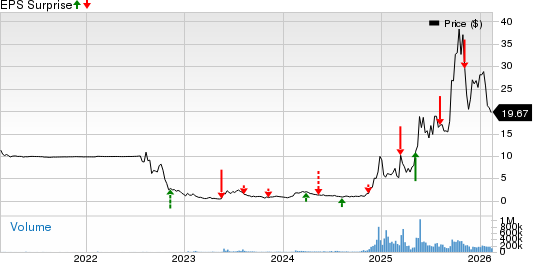
D-Wave Quantum Inc. price-eps-surprise | D-Wave Quantum Inc. Quote
The Contrast Remains Structural
SoundHound AI and Marvell are monetizing AI today, generating tens of millions to billions in quarterly revenue tied directly to enterprise deployments and data center expansion.
IonQ and D-Wave, by contrast, operate from a much smaller revenue base and remain heavily R&D-driven.
Valuation frameworks differ accordingly. AI infrastructure names are evaluated on revenue durability, backlog visibility and margin trajectory. Quantum companies are priced on technical milestones, qubit performance progress, commercialization inflection points and long-term TAM assumptions.
That said, if their respective technologies become foundational to next-generation AI or quantum workloads, all four companies have the potential to evolve into platform ecosystems, similar to NVIDIA, where developer adoption, infrastructure centrality and software integration drive exponential value creation. You can see the complete list of today’s Zacks Rank #1 (Strong Buy) stocks here.
Want the latest recommendations from Zacks Investment Research? Today, you can download 7 Best Stocks for the Next 30 Days.
Disclaimer: The content of this article solely reflects the author's opinion and does not represent the platform in any capacity. This article is not intended to serve as a reference for making investment decisions.
You may also like
One month before the IPOs of Anthropic and SpaceX, bitcoin fell 22%. How will liquidity dynamics drive the future market trend?
SBET's Chief Investment Officer attributes this phenomenon to a "liquidity event rapidly increasing correlations between assets"—investors sell crypto assets to participate in star IPOs. Following this logic, most brokerages require investors to wait 15 to 30 days after being allotted new shares before selling. After the SpaceX IPO, on the 31st day, ETH’s price surpassed its level on the IPO day, and by the 70th day, BTC's downward trend reversed.

WeRide Q3 revenue increased by 88% year-on-year, AI infrastructure revenue nearly doubled, Robotaxi single-quarter revenue surpassed 100 million yuan for the first time | Earnings Report Insights
WeRide's revenue for the third quarter reached 320 million yuan, surpassing the market expectation of 270 million yuan. Its net loss was 310 million yuan, lower than the expected 400 million yuan. Overseas income grew by 171.5% year-on-year, driving the gross margin up to 43%. The Guangzhou Robotaxi business achieved positive unit economics for the first time. However, increased R&D investment led to a larger adjusted loss, indicating profitability still needs improvement.
Wall Street technology veteran Niles is optimistic that Anthropic (ANT.US) will win the AI agent price war, but warns that its stock price may fall below the offering price.
Anthropic's IPO exceeded expectations, but Dan Niles warns of valuation risks, slowing growth in AI revenue, and price competition.
After Jensen Huang's resignation, Nvidia faces a new threat: losing its top engineers
Thousands of Nvidia employees have petitioned for Jensen Huang to return to his position, with some publicly criticizing the board's decision; some employees have already announced their resignation. Interim CEO Kress has issued early salary increases and stock rewards in an effort to stabilize the team, but AMD, Broadcom, and AI startups are poised to poach talent. Analysts warn that if five to ten key technology leaders leave, it could affect decisions on chip and software architecture, product iteration, and the planning of next-generation AI technologies.

Crypto prices
More


