
3 Reasons LEVI is Risky and 1 Stock to Buy Instead


Levi's has been treading water for the past six months, recording a small return of 4.8% while holding steady at $22.06.
Is now the time to buy Levi's, or should you be careful about including it in your portfolio?
Why Do We Think Levi's Will Underperform?
We don't have much confidence in Levi's. Here are three reasons you should be careful with LEVI and a stock we'd rather own.
1. Weak Constant Currency Growth Points to Soft Demand
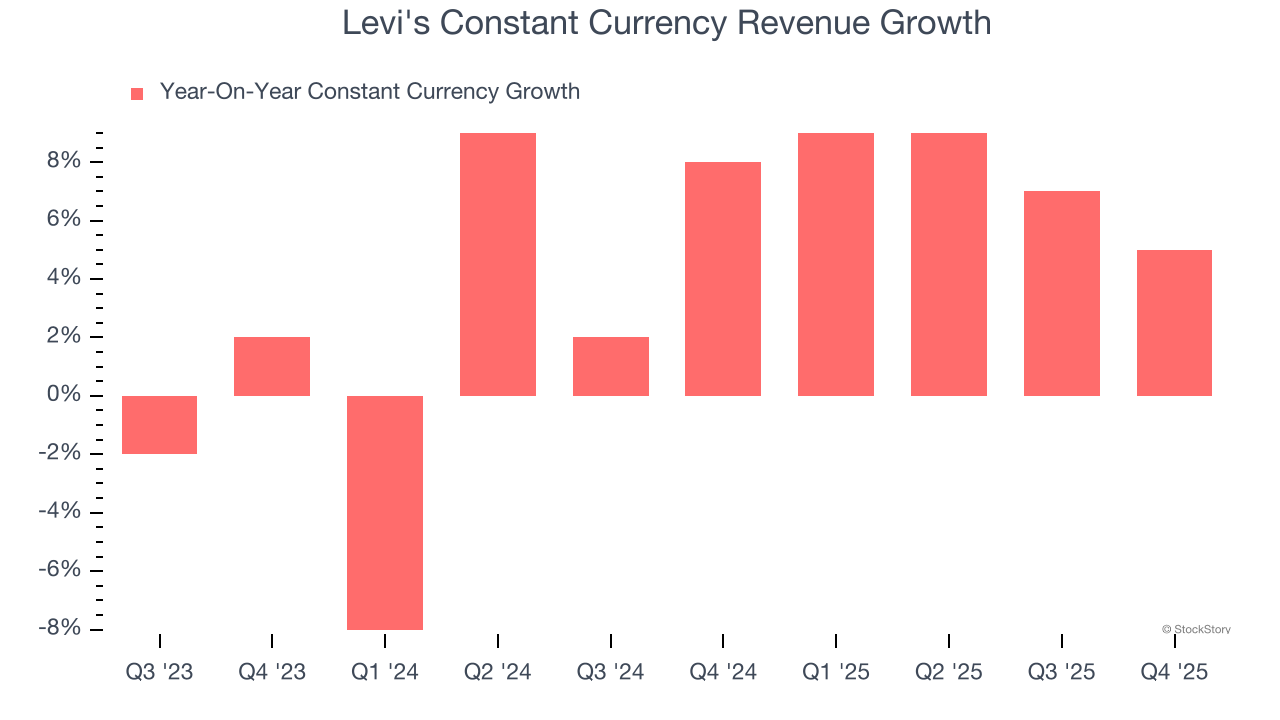
Investors interested in Consumer Discretionary - Apparel and Accessories companies should track constant currency revenue in addition to reported revenue. This metric excludes currency movements, which are outside of Levi’s control and are not indicative of underlying demand.
Over the last two years, Levi’s constant currency revenue averaged 5.1% year-on-year growth. This performance was underwhelming and suggests it might have to lower prices or invest in product improvements to accelerate growth, factors that can hinder near-term profitability.
2. Mediocre Free Cash Flow Margin Limits Reinvestment Potential
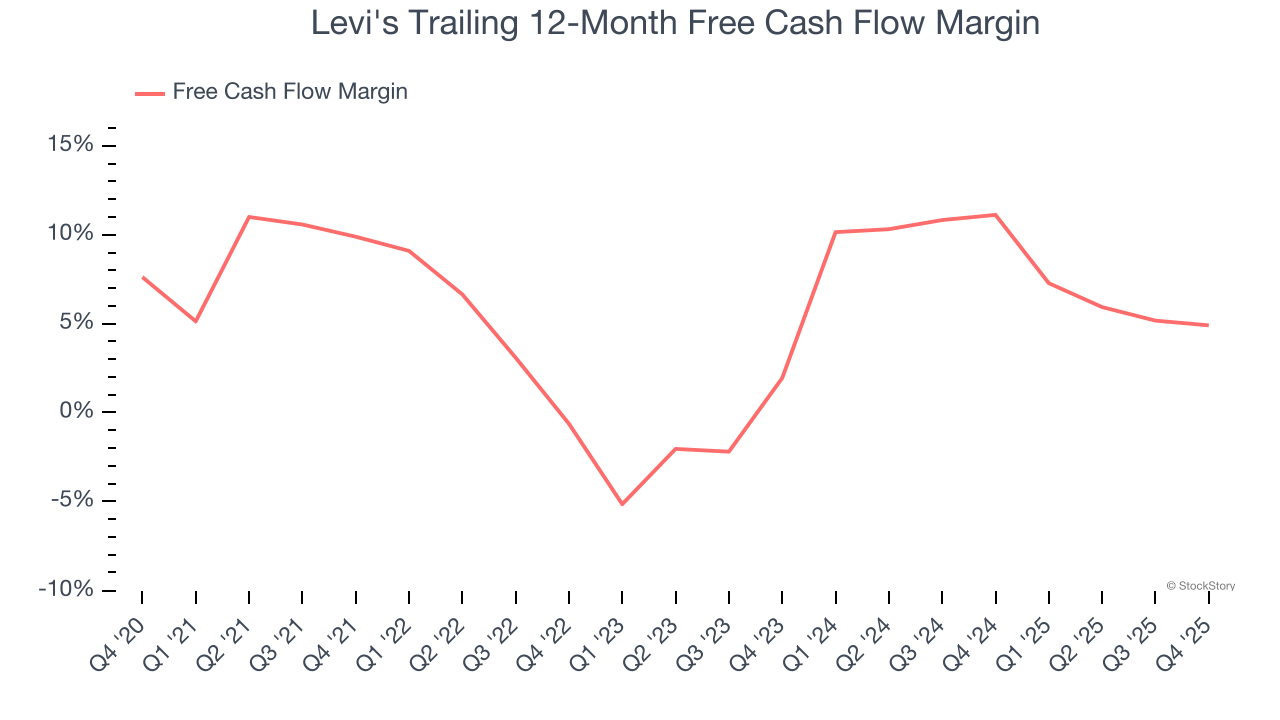
Free cash flow isn't a prominently featured metric in company financials and earnings releases, but we think it's telling because it accounts for all operating and capital expenses, making it tough to manipulate. Cash is king.
Levi's has shown poor cash profitability over the last two years, giving the company limited opportunities to return capital to shareholders. Its free cash flow margin averaged 8%, lousy for a consumer discretionary business.
3. New Investments Fail to Bear Fruit as ROIC Declines
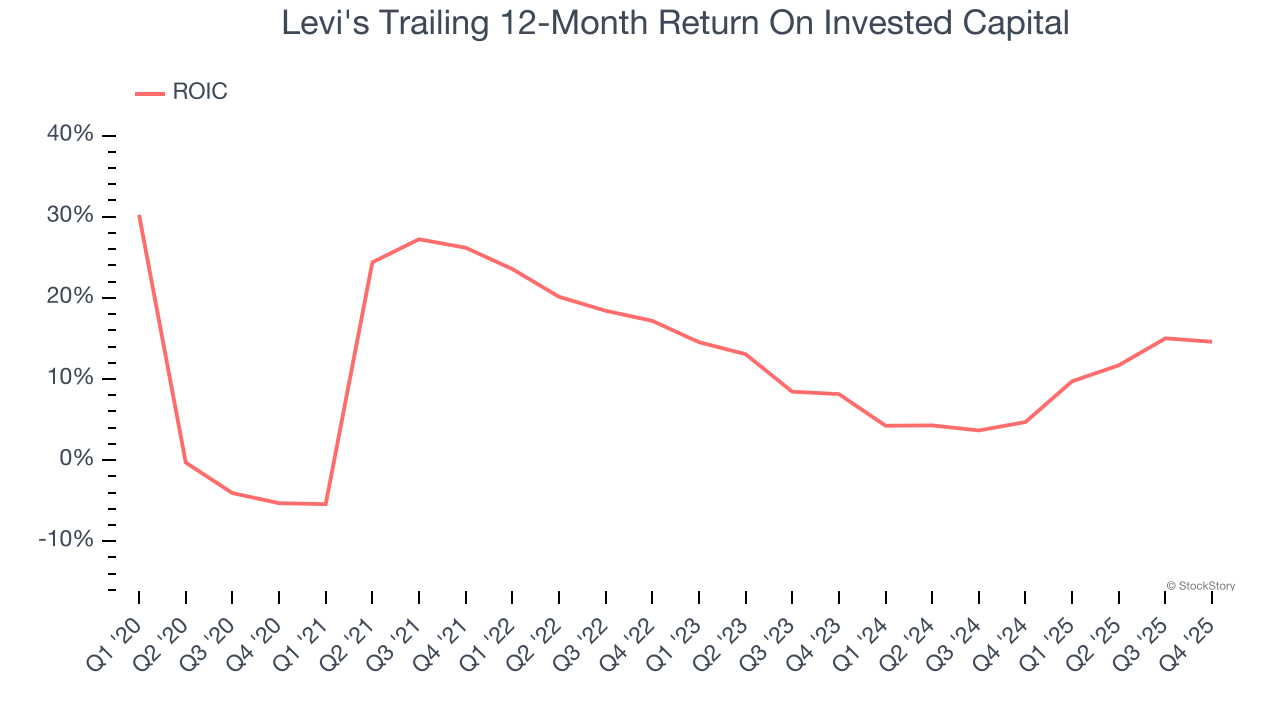
ROIC, or return on invested capital, is a metric showing how much operating profit a company generates relative to the money it has raised (debt and equity).
We like to invest in businesses with high returns, but the trend in a company’s ROIC is what often surprises the market and moves the stock price. Over the last few years, Levi’s ROIC has unfortunately decreased significantly. Paired with its already low returns, these declines suggest its profitable growth opportunities are few and far between.
Final Judgment
Levi's doesn’t pass our quality test. That said, the stock currently trades at 14.7× forward P/E (or $22.06 per share). This valuation multiple is fair, but we don’t have much confidence in the company. There are better stocks to buy right now. We’d suggest looking at the Amazon and PayPal of Latin America.
High-Quality Stocks for All Market Conditions
The market’s up big this year - but there’s a catch. Just 4 stocks account for half the S&P 500’s entire gain. That kind of concentration makes investors nervous, and for good reason. While everyone piles into the same crowded names, smart investors are hunting quality where no one’s looking - and paying a fraction of the price. Check out the high-quality names we’ve flagged in our Top 5 Growth Stocks for this month. This is a curated list of our High Quality stocks that have generated a market-beating return of 244% over the last five years (as of June 30, 2025).
Stocks that have made our list include now familiar names such as Nvidia (+1,326% between June 2020 and June 2025) as well as under-the-radar businesses like the once-micro-cap company Kadant (+351% five-year return). Find your next big winner with StockStory today.
Disclaimer: The content of this article solely reflects the author's opinion and does not represent the platform in any capacity. This article is not intended to serve as a reference for making investment decisions.
You may also like
Cross River Bank enters Bitcoin-backed lending with $250K loans

 VIPIndiscriminate Selling Strikes, Igniting the Market's Black Friday
1. Global markets were caught in a liquidity squeeze and indiscriminate selling this week. Apart from natural gas, which surged 16.04%, and the US Dollar Index (DXY), which edged up 0.39%, major global equity indices, precious metals, industrial metals, and cryptocurrencies all fell sharply. Silver and the Nasdaq 100 led the decline, plunging 16.24% and 10.43%, respectively. 2. Minutes from the Federal Reserve's Federal Open Market Committee (FOMC) meeting warned that AI infrastructure is pushing up near-term inflation and adding to market concentration risk. The warning triggered a wave of profit-taking in tech heavyweights. The Nasdaq Composite fell 5.28% on Friday, erasing its gains for the year, and NVIDIA declined for a seventh straight week. At the same time, AI giant Anthropic raised $81.3 billion in the largest IPO on record globally. This massive draw on capital, combined with selling pressure in the secondary market, quickly spread the cooling in risk appetite to high-beta crypto assets. 3. Fed officials dissented in favor of a 25-basis-point rate hike, and Governor Waller went further, warning that an outsized 50-basis-point hike may be needed in December to curb inflation. Tightening expectations drove DXY to a 19-month high of 103.97 and tipped markets into a dash-for-cash liquidity squeeze. Spot gold plunged to a 14-month low, and US equities, commodities, and cryptocurrencies fell in tandem as institutions systematically cut their cross-asset risk exposure. 4. Caught between the tech rout and a strong dollar, Bitcoin briefly fell below $60,000, and market-wide liquidations jumped to $1.33 billion in 24 hours. Institutional flows saw a watershed reversal. BlackRock's IBIT posted a net outflow of $541 million on Thursday, its largest single-day outflow since launch, and cumulative net outflows from US spot Bitcoin ETFs have neared $3.5 billion so far in November. Looking ahead, the market is set to search for a bottom in both sentiment and valuations in the near term. 5. Assets in focus: BTC, ANT, and NVDA

5 Best VPNs Worth Using for Crypto
Ripple ETF Investors Hold On, But XRP Buyers Go Missing
Crypto prices
More


