Bitget App
Trade smarter
Buy cryptoMarketsTradeFuturesStocksEarnInstitutionAI & more
Bitcoin’s quantum future – Saylor plays down risks as experts raise red flags

Bitcoin’s quantum future – Saylor plays down risks as experts raise red flags

AMBCryptoAMBCrypto2025/12/18 05:03
By:AMBCrypto

The urgency to upgrade Bitcoin to a more quantum-proof network has intensified. 

Consider this – Solana announced that it has deployed post-quantum signatures on the testnet, indicating its readiness to be more secure. Even Ethereum has a roadmap for achieving quantum security. 

Although the Bitcoin community is also actively discussing similar proposals, there is some doubt whether they can be implemented quickly enough before the quantum threat becomes a reality. 

However, Michael Saylor, the pioneer of BTC corporate treasury, doesn’t share a similar urgency. In fact, he recently noted that quantum computing will “harden BTC,” not break it. 
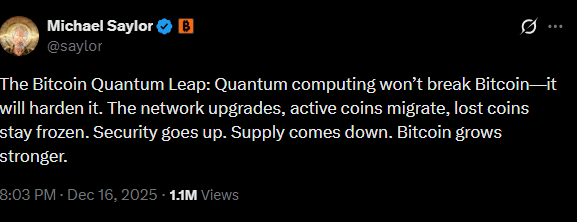
Bitcoin’s quantum future – Saylor plays down risks as experts raise red flags image 0

Source: X

Saylor elicits mixed reactions

For Saylor, the big tech firms will figure it out and can’t let the quantum tech go mainstream before governments update their systems. However, most experts disagree with his “simplistic” view and nonchalance. 

 Eli Ben-Sasson, founder of Starknet and Zcash, said that Saylor’s plans may be workable in theory, but impractical in real life due to the difficulty of reaching consensus. 

“Agree, in theory. Aren’t you worried code is by now so ossified, and simple fixes (like op_cat) so hard to push that in practice it just won’t happen?”

Mihailo Bjelic, a former co-founder of Polygon, also shared similar reservations and noted, 

“The upgrade takes ~2 years (~6 months if all regular txs stop, which is unrealistic). And this is assuming this major upgrade goes through smoothly, without contention (which is hard to imagine).”

Assessing the odds of quantum risk

Despite Google’s breakthrough in quantum computing, the tech is about 5-15 years or more away from becoming a real threat capable of cracking the Bitcoin network and wallets. 

For his part, Charles Edwards, founder of Capriole Investments, stated that there was a 34%-55% chance that BTC could be cracked by quantum computers by 2028-2030. 

Bitcoin’s quantum future – Saylor plays down risks as experts raise red flags image 1

Source: X

He added that Bitcoin will be devalued by similar odds if the upgrade doesn’t happen. 

“Given a 2-3 yr timeline to deploy fix, this is the current discount rate. And it is growing. Every. Single. Day.”

Bitcoin’s security relies on ECDSA (Elliptic Curve Digital Signature Algorithm) and SHA-256 (hashing mechanism). The former can easily be cracked, and both public and private keys can be retrieved with a powerful quantum computer. 

However, most old-format addresses (primarily from the Satoshi era) are now at risk, while new Segwit addresses are partially secure from long-range quantum attacks, according to experts. 

Bitcoin’s quantum future – Saylor plays down risks as experts raise red flags image 2

Source: X

Final Thoughts

  • Some experts are worried that Bitcoin may miss the window to upgrade to a quantum-secure network. 
  • The Satoshi era and a few other address formats are currently vulnerable to long-range quantum attacks. 

 

0
0

Disclaimer: The content of this article solely reflects the author's opinion and does not represent the platform in any capacity. This article is not intended to serve as a reference for making investment decisions.

Understand the market, then trade.
Bitget offers one-stop trading for cryptocurrencies, stocks, and gold.
Trade now!

You may also like

VIPIndiscriminate Selling Strikes, Igniting the Market's Black Friday

1. Global markets were caught in a liquidity squeeze and indiscriminate selling this week. Apart from natural gas, which surged 16.04%, and the US Dollar Index (DXY), which edged up 0.39%, major global equity indices, precious metals, industrial metals, and cryptocurrencies all fell sharply. Silver and the Nasdaq 100 led the decline, plunging 16.24% and 10.43%, respectively. 2. Minutes from the Federal Reserve's Federal Open Market Committee (FOMC) meeting warned that AI infrastructure is pushing up near-term inflation and adding to market concentration risk. The warning triggered a wave of profit-taking in tech heavyweights. The Nasdaq Composite fell 5.28% on Friday, erasing its gains for the year, and NVIDIA declined for a seventh straight week. At the same time, AI giant Anthropic raised $81.3 billion in the largest IPO on record globally. This massive draw on capital, combined with selling pressure in the secondary market, quickly spread the cooling in risk appetite to high-beta crypto assets. 3. Fed officials dissented in favor of a 25-basis-point rate hike, and Governor Waller went further, warning that an outsized 50-basis-point hike may be needed in December to curb inflation. Tightening expectations drove DXY to a 19-month high of 103.97 and tipped markets into a dash-for-cash liquidity squeeze. Spot gold plunged to a 14-month low, and US equities, commodities, and cryptocurrencies fell in tandem as institutions systematically cut their cross-asset risk exposure. 4. Caught between the tech rout and a strong dollar, Bitcoin briefly fell below $60,000, and market-wide liquidations jumped to $1.33 billion in 24 hours. Institutional flows saw a watershed reversal. BlackRock's IBIT posted a net outflow of $541 million on Thursday, its largest single-day outflow since launch, and cumulative net outflows from US spot Bitcoin ETFs have neared $3.5 billion so far in November. Looking ahead, the market is set to search for a bottom in both sentiment and valuations in the near term. 5. Assets in focus: BTC, ANT, and NVDA

Bitget•2026/11/23 06:38
Indiscriminate Selling Strikes, Igniting the Market's Black Friday

5 Best VPNs Worth Using for Crypto

DailyCoin•2026/11/22 12:28
