
Strategy Will Sell Its Bitcoins On One Condition Only

In 2025, bitcoin is no longer the marginal asset of cypherpunks. It has become a pillar of the balance sheets of listed companies, a treasury tool for institutional investors, and a financial lever for giants like Strategy. However, the recent announcement by its CEO reminds us of a harsh reality: even the most fervent BTC advocates could be forced to sell… as a last resort.
In brief
- Strategy will only sell its Bitcoins as a last resort: only if its mNAV ratio falls below 1, according to its CEO.
- 25% of the bitcoin supply is held by institutions and companies, while whales control 40% of the circulating supply.
- If large companies sell their bitcoin, the market could collapse, threatening Satoshi Nakamoto’s vision.
Strategy will not sell its bitcoins… except in case of force majeure
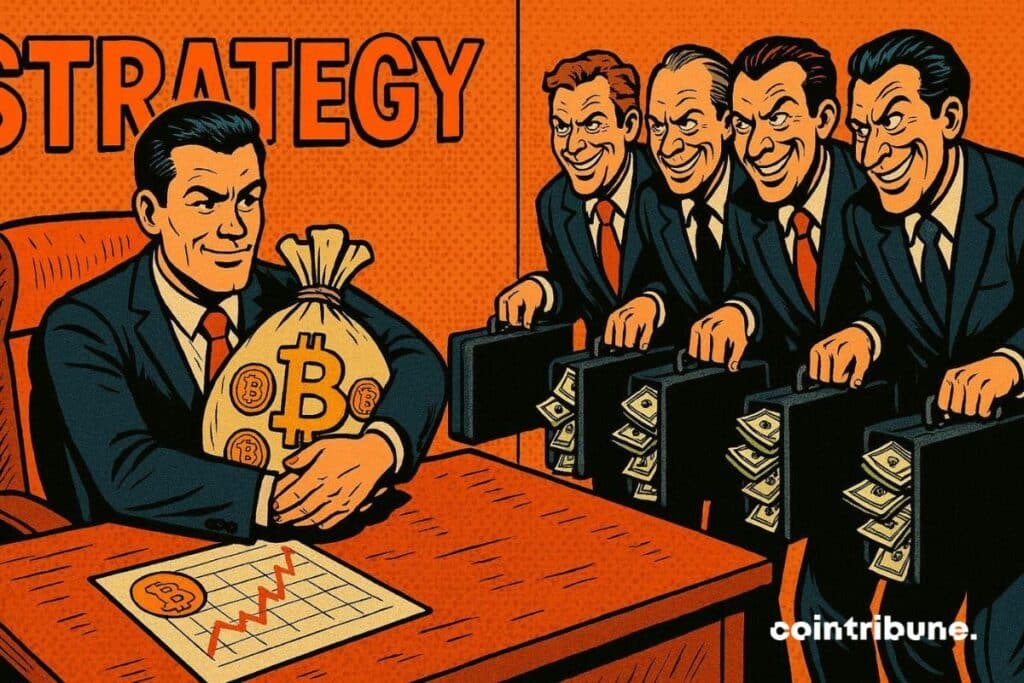
Strategy , one of the largest institutional bitcoin holders with over 640,000 BTC, has reaffirmed its desire to retain its holdings. In a recent interview, Strategy’s CEO, Phong Le, specified that the sale would only be considered if the mNAV ratio dropped below 1 and capital access dried up. A mathematically justified measure to protect the “Bitcoin yield per share”, but not a systematic policy.
Strategy relies on its ability to raise funds via share issuances as long as its stock trades at a premium. Despite an mNAV close to 0.93 in November 2025, Strategy continues to buy bitcoin, even accelerating its acquisitions. This strategy underlines a reality: selling BTC would be an admission of failure, but also an alarming signal for the market. Yet, this reassuring stance hides a broader question: what if other bitcoin giants had to do the same?
Bitcoin: 25% held by institutions, Satoshi’s dream betrayed?
In 2025, data shows that 25% of the bitcoin supply is held by companies, funds, and ETFs. Meanwhile, whales (addresses holding >1,000 BTC) control 40% of the circulating supply. Individuals remain the majority with 65.9% of the total supply. This increasing centralization contrasts with Satoshi Nakamoto’s original vision! He imagined bitcoin as a peer-to-peer currency, censorship-resistant and decentralized.
Today, the value of BTC largely depends on the decisions of a few centralized players, like Strategy, BlackRock, or states through their reserves. Bitcoin purists criticize this evolution. They believe BTC has become a speculative asset for the wealthy, far from its initial goal of financial freedom for all. If Satoshi saw this centralization, what would he think of the evolution of his creation?
What if all large companies sell their bitcoin… what would happen?
Imagine that Strategy, Tesla, Block, and ETFs decide to liquidate even 10% of their reserves simultaneously. The consequences would be immediate and devastating. Indeed, a massive supply on an already volatile market could drop the bitcoin price by 50 to 70% within a few days.
Companies with debts denominated in BTC would be forced to sell more to cover their margins, creating a downward spiral. Additionally, miners, under pressure, would also have to liquidate their reserves to pay operational costs, amplifying selling pressure.
Individual investors would panic, triggering massive withdrawals from platforms like Coinbase or Binance. This scenario recalls the Luna/Terra crash of 2022, but with a global and systemic impact. Regulators might impose selling limits for large holders, but is that compatible with bitcoin’s DNA?
Strategy will only sell its bitcoins as a last resort. But this simple possibility raises a question: is BTC still Satoshi’s rebellious asset, or a toy in the hands of financial giants? In a new era where bitcoin is dominated by companies , decentralization now seems to be nothing but an illusion. And you, do you think bitcoin can still embody Satoshi’s ideals?
Disclaimer: The content of this article solely reflects the author's opinion and does not represent the platform in any capacity. This article is not intended to serve as a reference for making investment decisions.
You may also like
IEA raises energy 'demand alert': Cooling surpasses heating to become the primary growth engine, AI data centers push the power grid to its limits
The International Energy Agency (IEA) annual flagship report "World Energy Outlook" points out that global cooling demand exceeds heating demand. Additionally, the rapid growth of data centers will push power grid loads to their limits.

The euro's decline shows no sign of stopping after falling below the 1.10 mark! France's 2027 election may become the biggest risk; the most pessimistic bet in more than six years emerges
The euro has fallen to its lowest point in 18 years, with little sign that the decline is easing. The market increasingly expects that, as France faces both intensified political division and fiscal pressure, next year's French elections will continue to exert pressure on the euro.

Goldman Sachs Discusses Christmas Rally: Down First, Then Up Before December 15, Retail Investors Are the Final Buyers
Goldman Sachs believes that the current buying structure of US stocks is highly dependent on retail investors. Last week, retail investors' net purchases of US stocks reached $6.2 billion, hitting an 11-week weekly peak, with funds concentrating on leading semiconductor companies such as Nvidia and AMD. As the market enters the year-end with "fear," volatility usually converges, resulting in limited index gains, and typically a round of adjustment is required first.

Crypto prices
More


