
Arthur Hayes Warns Tether ‘Macro Hedge’ Risks Equity Wipeout in 30% Bitcoin Correction

Critics noted Tether's high leverage but said its profitability and recent $12 billion dividend suggest it could be recapitalized if needed.
BitMEX co-founder Arthur Hayes has warned that Tether risks balance-sheet insolvency if its Bitcoin and gold reserves suffer a 30% drawdown.
His November 30 post targets the structural vulnerabilities in Tether’s latest asset allocation. He suggests the firm has tied its solvency to the performance of volatile risk assets rather than relying solely on the stability of government debt.
Hayes Critique Tether’s Gold and Stablecoin Holdings
Hayes’ assessment draws on Tether’s third-quarter 2025 attestation, which reveals a significant rotation into non-fiat collateral. The report shows the issuer now holds $12.9 billion in precious metals and $9.9 billion in Bitcoin.
According to Hayes, this allocation represents a deliberate “interest rate trade.” His thesis posits that Tether is preparing for Federal Reserve rate cuts that would compress the yield on its massive portfolio of US Treasury bills.
“[Tether] thinks the Fed will cut rates, which crushes their interest income. In response, they are buying gold and BTC that should in theory moon as the price of money falls,” Hayes noted.
However, Hayes argues this strategy introduces asymmetric risk to the company’s thin layer of equity.
Hayes contends that this figure exceeds Tether’s surplus capital, rendering the firm theoretically insolvent even if it remains operationally liquid.
He warned that such a scenario would likely force large holders and exchanges to demand a real-time view of the balance sheet to assess the safety of the peg. Notably, this warning aligns with S&P Global’s decision to assign USDT a ‘5’ rating, the lowest on its scale.
Industry Stakeholders Defend Tether
Industry proponents maintain that the insolvency thesis conflates balance sheet accounting with actual liquidity risk.
Tran Hung, CEO of UQUID Card, dismissed the warning as fundamentally flawed.
He noted that the vast majority of Tether’s $181.2 billion balance sheet remains parked in highly liquid, low-risk instruments. Indeed, the attestation confirms Tether holds $112.4 billion in US Treasury Bills and nearly $21 billion in repo agreements.
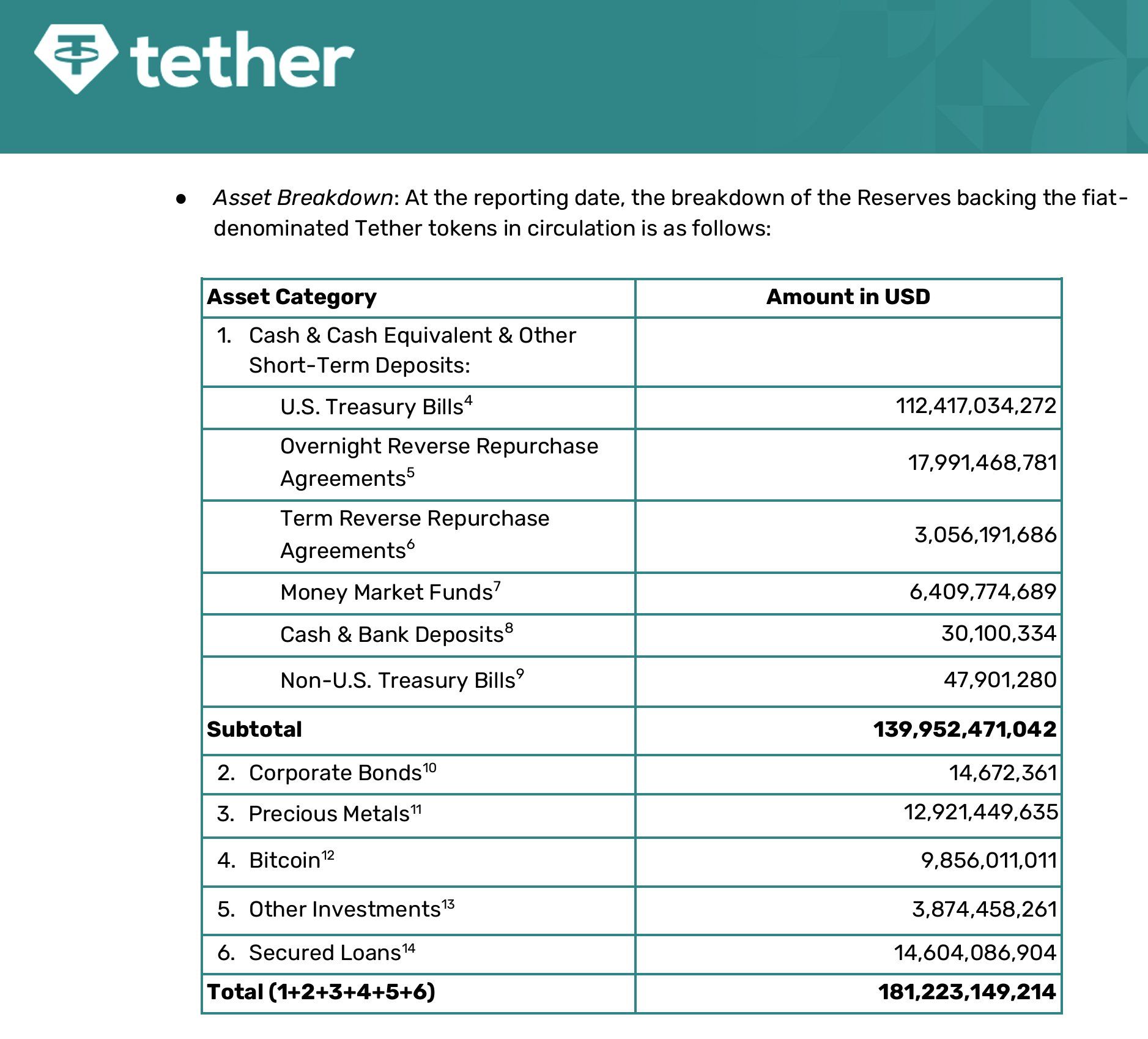 Tether USDT Stablecoin Reserves. Source:
Tether
Hung argues these “Cash and Cash Equivalents” provide a liquidity wall sufficient to cover the overwhelming majority of USDT in circulation.
Considering this, he argued that Tether would remain fully redeemable even if a market downturn eliminated its corporate equity buffer.
“Tether has consistently demonstrated strong redemption capacity, including $25 billion redeemed in just 20 days during the 2022 market crisis (FTX crisis), one of the largest liquidity ‘stress tests’ in financial history,” Hung noted.
Meanwhile, Cory Klippsten, CEO of Swan Bitcoin, pointed out that Tether’s leverage is more aggressive than that of traditional financial institutions.
Tether is running about 26x leverage with a 3.7% equity cushion. About three quarters of assets are short-term sovereign and repo; one quarter is a mix of BTC, gold, loans, and opaque investments,” Klippsten said.
According to him, a 4% portfolio loss would erase the common equity, while A 16% drop in the riskiest assets would have the same effect.
However, despite the structural leverage, he suggests the risk is mitigated by Tether’s sheer profitability. Indeed, the stablecoin issuer is on track to record a profit of more than $15 billion this year.
Moreover, Klippsten also noted that Tether’s owners recently withdrew a $12 billion dividend. Considering this, he argued they have the capacity to recapitalize the firm immediately if its buffer were ever breached.
Disclaimer: The content of this article solely reflects the author's opinion and does not represent the platform in any capacity. This article is not intended to serve as a reference for making investment decisions.
You may also like
 VIPIndiscriminate Selling Strikes, Igniting the Market's Black Friday
1. Global markets were caught in a liquidity squeeze and indiscriminate selling this week. Apart from natural gas, which surged 16.04%, and the US Dollar Index (DXY), which edged up 0.39%, major global equity indices, precious metals, industrial metals, and cryptocurrencies all fell sharply. Silver and the Nasdaq 100 led the decline, plunging 16.24% and 10.43%, respectively. 2. Minutes from the Federal Reserve's Federal Open Market Committee (FOMC) meeting warned that AI infrastructure is pushing up near-term inflation and adding to market concentration risk. The warning triggered a wave of profit-taking in tech heavyweights. The Nasdaq Composite fell 5.28% on Friday, erasing its gains for the year, and NVIDIA declined for a seventh straight week. At the same time, AI giant Anthropic raised $81.3 billion in the largest IPO on record globally. This massive draw on capital, combined with selling pressure in the secondary market, quickly spread the cooling in risk appetite to high-beta crypto assets. 3. Fed officials dissented in favor of a 25-basis-point rate hike, and Governor Waller went further, warning that an outsized 50-basis-point hike may be needed in December to curb inflation. Tightening expectations drove DXY to a 19-month high of 103.97 and tipped markets into a dash-for-cash liquidity squeeze. Spot gold plunged to a 14-month low, and US equities, commodities, and cryptocurrencies fell in tandem as institutions systematically cut their cross-asset risk exposure. 4. Caught between the tech rout and a strong dollar, Bitcoin briefly fell below $60,000, and market-wide liquidations jumped to $1.33 billion in 24 hours. Institutional flows saw a watershed reversal. BlackRock's IBIT posted a net outflow of $541 million on Thursday, its largest single-day outflow since launch, and cumulative net outflows from US spot Bitcoin ETFs have neared $3.5 billion so far in November. Looking ahead, the market is set to search for a bottom in both sentiment and valuations in the near term. 5. Assets in focus: BTC, ANT, and NVDA

5 Best VPNs Worth Using for Crypto
Ripple ETF Investors Hold On, But XRP Buyers Go Missing
--KKR in Talks to Buy EdgeCore at Valuation of Up to $10 Billion, Bloomberg Reports

Crypto prices
More


