
Bitcoin: A Relative Buying Opportunity Despite the Panic, According to k33

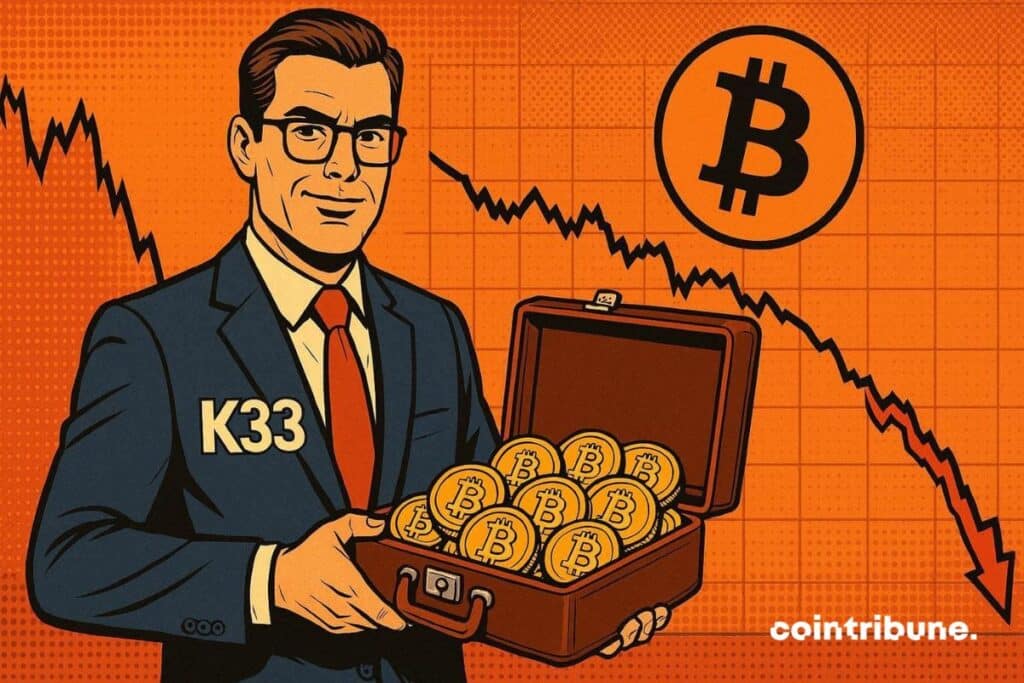
Bitcoin is undergoing a brutal correction phase, with a 36% drop since October 2025. However, according to K33 Research, this drop creates a relative buying opportunity, with the selling approaching saturation. Here is why this period could be ideal for investors.
In brief
- Bitcoin has dropped 36% since October 2025, reaching a floor at $80,500, signaling seller capitulation.
- K33 Research sees the current bitcoin correction as a relative buying opportunity.
- Bitcoin forecasts for 2026 range between $90,000 and $200,000, supported by ETFs and growing adoption.
The impact of bitcoin’s brutal drop
Bitcoin is currently experiencing a dizzying fall, even reaching a floor of $82,000 to $80,500 on November 21, 2025 ! An unprecedented level since early 2024. This drop is accompanied by record transaction volumes, exceeding $14.3 billion in a single day, and massive outflows from ETPs, with a peak of 13,302 BTC in 24 hours. These indicators reflect seller capitulation, often a sign of the end of a bear cycle.
K33 Research notes that the open interest on perpetual contracts reached an annual high of 325,000 BTC before falling back to 300,000 BTC, signaling a reduction in long positions and a market cleanup. Furthermore, the correlation between bitcoin and equity markets has strengthened, but bitcoin experiences sharper declines. This is a sign of persistent selling pressure in a risk-reduction environment.
According to Vetle Lunde, head of research at K33, this intense selling phase is nearing saturation . Panic signals, such as high volumes and massive outflows, suggest the market might soon find a floor, paving the way for bitcoin stabilization or gradual recovery.
Why is bitcoin a strong relative buy despite volatility?
Bitcoin’s recent drop has created a disconnect between its price and fundamentals. This underperformance, especially compared to the Nasdaq where bitcoin is now 30% weaker than in October, makes it a relative buying opportunity for long-term investors. Several structural factors support this thesis:
- Growing adoption of bitcoin by financial institutions, facilitated by regulations like the Clarity Act that reinforce its legitimacy as a safe haven asset;
- Upcoming political catalysts, such as integrating bitcoin into the portfolios of leading banks, which could widen access and stimulate demand;
- Finally, derivative data shows reduced leverage and declining open interest, which limits risks of cascading liquidations.
K33 Research believes this combination of factors makes bitcoin a strong relative buy, despite current volatility. Institutional investors and long-term holders could use this phase to accumulate BTC at attractive levels.
What price for BTC in 2026?
Forecasts for bitcoin in 2026 vary among analysts, but most agree on a medium-term uptrend. Some anticipate a price range between $88,403 and $98,000 for 2026, with potential growth of 11.45% if BTC reaches its high target.
Others, however, forecast a wider range between $150,000 and $230,000, due to institutional adoption. These optimistic forecasts rest on two pillars:
- The continuous influx of capital through ETFs;
- Growing adoption by institutions.
The recent bitcoin drop, though brutal, offers a relative buying opportunity according to K33 Research. With forecasts up to $200,000 in 2026, are the conditions for a future BTC bull run already in place?
Disclaimer: The content of this article solely reflects the author's opinion and does not represent the platform in any capacity. This article is not intended to serve as a reference for making investment decisions.
You may also like
One month before the IPOs of Anthropic and SpaceX, bitcoin fell 22%. How will liquidity dynamics drive the future market trend?
SBET's Chief Investment Officer attributes this phenomenon to a "liquidity event rapidly increasing correlations between assets"—investors sell crypto assets to participate in star IPOs. Following this logic, most brokerages require investors to wait 15 to 30 days after being allotted new shares before selling. After the SpaceX IPO, on the 31st day, ETH’s price surpassed its level on the IPO day, and by the 70th day, BTC's downward trend reversed.
WeRide Q3 revenue increased by 88% year-on-year, AI infrastructure revenue nearly doubled, Robotaxi single-quarter revenue surpassed 100 million yuan for the first time | Earnings Report Insights
WeRide's revenue for the third quarter reached 320 million yuan, surpassing the market expectation of 270 million yuan. Its net loss was 310 million yuan, lower than the expected 400 million yuan. Overseas income grew by 171.5% year-on-year, driving the gross margin up to 43%. The Guangzhou Robotaxi business achieved positive unit economics for the first time. However, increased R&D investment led to a larger adjusted loss, indicating profitability still needs improvement.
Wall Street technology veteran Niles is optimistic that Anthropic (ANT.US) will win the AI agent price war, but warns that its stock price may fall below the offering price.
Anthropic's IPO exceeded expectations, but Dan Niles warns of valuation risks, slowing growth in AI revenue, and price competition.
After Jensen Huang's resignation, Nvidia faces a new threat: losing its top engineers
Thousands of Nvidia employees have petitioned for Jensen Huang to return to his position, with some publicly criticizing the board's decision; some employees have already announced their resignation. Interim CEO Kress has issued early salary increases and stock rewards in an effort to stabilize the team, but AMD, Broadcom, and AI startups are poised to poach talent. Analysts warn that if five to ten key technology leaders leave, it could affect decisions on chip and software architecture, product iteration, and the planning of next-generation AI technologies.

Crypto prices
More


