
US September CPI falls short of expectations across the board, Fed rate cut is a certainty

CPI confirms the trend! U.S. core inflation unexpectedly eased in September, making an October rate cut almost certain. Traders are increasingly betting that the Federal Reserve will cut rates two more times this year...
The report released by the U.S. Bureau of Labor Statistics on Friday showed that both overall and core inflation indicators for September were lower than expected, paving the way for the Federal Reserve to further advance interest rate cuts. This is the first major data released since the government shutdown.
The unadjusted annual CPI in the U.S. for September recorded 3%, a slight increase from last month's 2.9% and the highest since January 2025, but the increase was slightly below the market's general expectation of 3.1%. The seasonally adjusted monthly CPI for September came in at 0.3%, lower than both the market expectation and the previous value of 0.4%. The unadjusted annual core CPI for September recorded 3%, lower than both the market expectation and the previous value of 3.1%. The seasonally adjusted monthly core CPI for September was 0.2%, also lower than the market expectation and the previous value of 0.3%.
After the release of the U.S. CPI data, traders increased their bets that the Federal Reserve will cut rates twice more this year. Futures contracts linked to the Fed's policy rate also show that market expectations for another rate cut at the Fed's January meeting next year are rising.
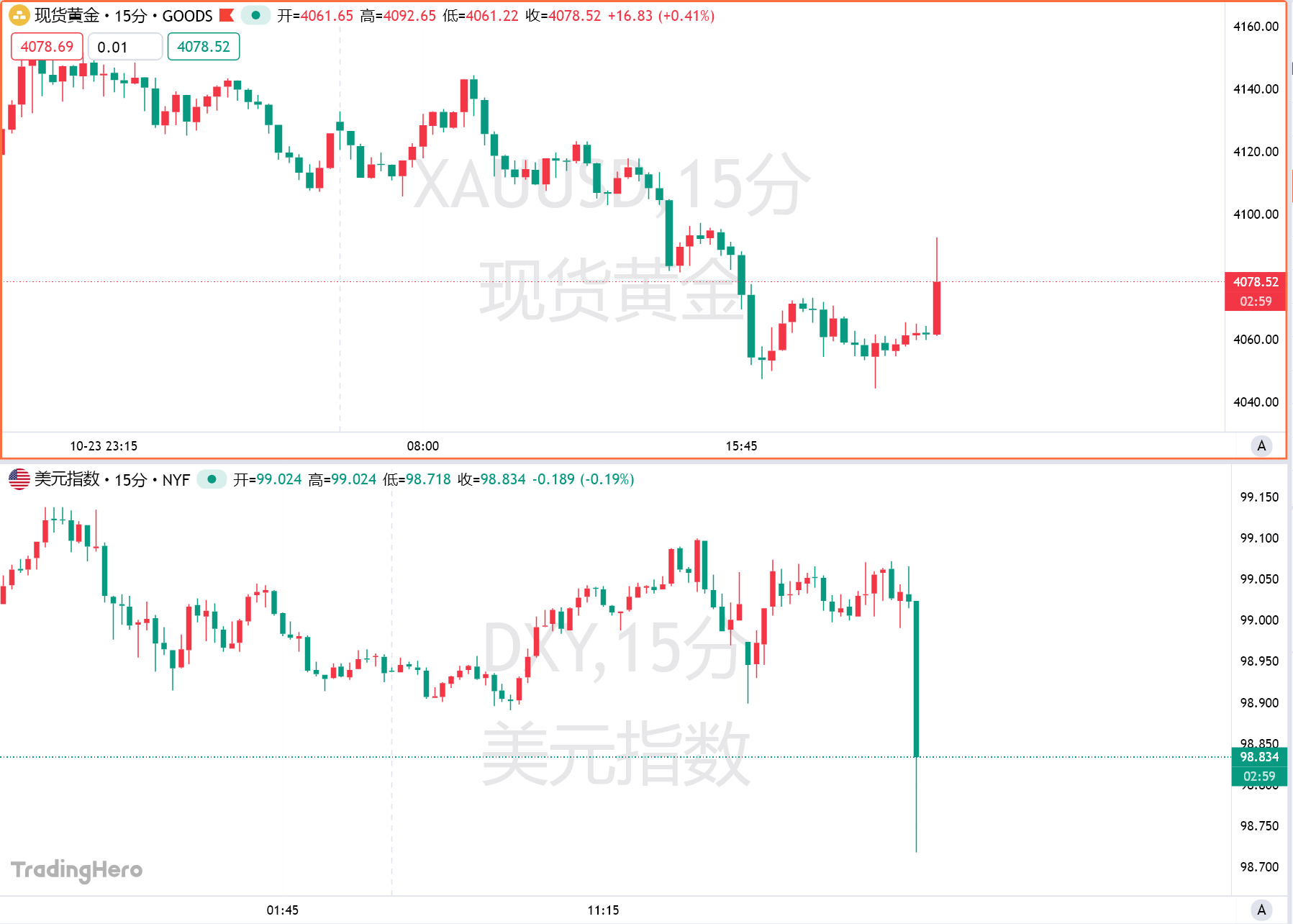
Spot gold surged more than $20 in the short term, rising above $4,080/ounce. The U.S. dollar index plunged more than 30 points in the short term. Non-U.S. currencies generally rose, with the EUR/USD rising 40 points in the short term; the GBP/USD rising about 45 points in the short term; and the USD/JPY falling nearly 60 points in the short term.
Despite the government shutdown causing a halt in the release of economic data, the CPI report was still published in order to assist the Social Security Administration in calculating the cost-of-living adjustment for millions of retirees and other benefit recipients for 2026. This data was originally scheduled for release on October 15. The U.S. Bureau of Labor Statistics stated that the September CPI data was collected before the funding suspension.
As companies digested inventories accumulated before the broad implementation of Trump’s tariffs and bore part of the tax burden themselves, the pass-through effect of import tariffs has been relatively gradual. Economists pointed out that companies achieved this at the expense of hiring, and estimated that consumers have so far borne about 20% of the tariff costs.
Analyst Chris Anstey stated that the latest CPI report means that the Federal Reserve is almost certain to cut rates again next week, and the data also supports the Trump administration's view that inflation is under control and tariffs will not trigger a surge in living costs.
Anstey also pointed out that one key reason why overall inflation is higher than core inflation is the rise in gasoline prices: in September, the gasoline price index rose by 4.1%, the largest factor in the monthly increase for all items.
Institutional analysis believes that since the Federal Reserve has entered a blackout period before the October 29 policy decision, its officials will not comment on Friday’s inflation data before making a decision. Although overall inflation has warmed slightly, this seems unlikely to prevent the widely priced-in 25 basis point rate cut. The Federal Reserve is currently in a data blind spot—due to the government shutdown, the September PPI data is missing, forcing the central bank to rely on imperfect PCE estimates for judgment, and it has not received any official employment data since the government shutdown earlier this month. Federal Reserve Chairman Powell has not expressed any objection to expectations of a rate cut in October in his recent public remarks.
“This is one of the things that should reassure the Federal Reserve: apart from some pass-through effects related to tariffs, inflationary pressures are currently quite mild,” Graffeo said.
Ian Lyngen of BMO Capital Markets pointed out the impact of the government shutdown on the Fed’s rate path after next week: “Given that the government shutdown is a persistent factor, we suspect that expectations for a rate cut in December will also be solidified as a result. The broad tone of the U.S. interest rate market has already been set, and we expect rates to slowly decline from current levels.”
Disclaimer: The content of this article solely reflects the author's opinion and does not represent the platform in any capacity. This article is not intended to serve as a reference for making investment decisions.
You may also like
No more mandatory retention! Anthropic launches EFS system, allowing enterprises to take control of their own AI data
Anthropic has launched the public beta of its Enterprise Frontier Security (EFS) system, allowing corporate clients to store AI data on their own cloud platforms, with clients holding their encryption keys. Anthropic only performs automated security scans and cannot access the data itself. The system retains the 30-day data retention requirement, but control over storage is returned to enterprises, addressing strong customer backlash sparked by the mandatory retention policy implemented in June.

Report: Samsung's storage capacity is nearly sold out for the next three years, clients rush to secure long-term contracts until 2031
According to media reports, most of Samsung Electronics' memory manufacturing capacity for the period from 2027 to 2029 has already been secured through contracts. Some customers are even seeking to extend long-term supply agreements until 2031. Currently, leading memory manufacturers can only meet about 60% to 70% of client demand, and the supply shortage may intensify further in 2027.

Anthropic commits to about $900 billion in computing power expenditure; bond market expects its bonds to be junk-rated
Despite Anthropic raising over $100 billion in its public offering and reaching a market capitalization of $1.18 trillion, the company is widely expected by the debt market to be rated as BB-level "junk bonds" due to its lack of profitability and approximately $900 billion in massive computing power expenditure commitments. Amid pressure on tech giants in the debt market and chip companies planning to reduce loan guarantees, Anthropic will still need to rely on structured financing in the short term, facing about a three-year window to strive for an investment-grade rating.
JPMorgan Trading Desk Abandons Tactical Bullish Stance on S&P 500: Rebound May Occur, Bottom Not Yet Reached
J.P. Morgan's trading division has shifted from a tactical bullish stance to a cautious one, expecting stock market volatility in the coming weeks, but emphasizes that market fundamentals—from the economy to earnings—remain solid.

Crypto prices
More


