
October Crypto Crash Shows Stark Contrast to 2021 Selloffs, Analyst Finds

Investor resilience after the recent crash suggests the bull run is intact. Exchange balances are at all-time lows, and smaller Bitcoin holders are showing strong accumulation, analysts report.
Investor behavior following last Friday’s crypto flash crash reveals a significant divergence from the panic-driven sell-offs seen in previous cycles, particularly in 2021.
Analysts suggest the current downturn is not the end of the bull run but rather a sign of retail investor conviction regaining strength.
Exchange Balances Hit Record Lows
An analyst at the on-chain data platform CryptoQuant posted an analysis on Friday detailing the shift.
“Bitcoin has once again faced a sharp drawdown, yet today’s market structure is fundamentally different from 2020 or 2021,” the analyst stated.
The most notable difference is crypto balances on centralized exchanges (CEXs). During the sharp drops of 2020 and 2021, CEX crypto balances surged as panic set in, indicating an accumulation of tokens ready to be sold.
In contrast, the analyst reports that exchange balances remain near all-time lows following the latest crash. This low inventory of sellable coins on exchanges suggests limited potential for a sustained, deep price decline.
The analyst also deems the likelihood of a long-term bearish trend as low.
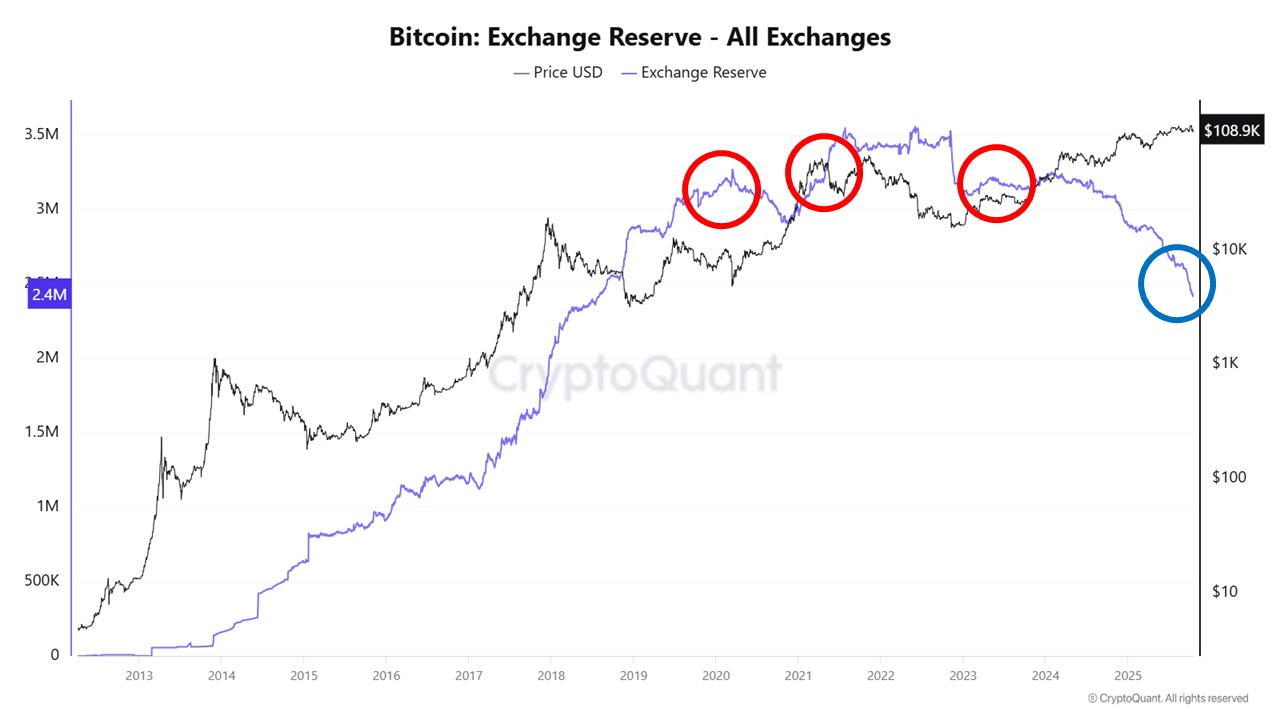 Bitcoin: Exchange Reserve – All Exchanges. Source:
CryptoQuant
Long-term holder behavior also tells a different story. In 2020 and 2021, the Long-Term Holder SOPR (LTH-SOPR) plunged below 1 for several months, signaling capitulation and realized losses. The ratio remains near neutral this time.
This stability suggests long-term investors are engaging in prudent profit-taking rather than fear-based selling. These established holders are maintaining their positions amidst volatility, thereby enhancing the network’s resilience.
Analyzing major drawdowns over the past five years, the Cryptoquant analyst noted that a V-shaped recovery typically follows a leverage washout, often driven by whale accumulation.
For example, during the 30% drop in May 2021 following news related to Tesla and Chinese regulation, whales sold approximately 50,000 BTC but re-purchased 34,000 BTC near the bottom.
Similarly, the 15% correction in August 2023 caused by the US debt rating downgrade saw a brief dip in SOPR, followed quickly by a rebound. Each event resolved excess leverage and ushered in a new accumulation phase.
Smaller Holders Step Up
This sentiment is further reinforced by Glassnode’s “Bitcoin Trend Accumulation Score by Cohort” data.
This metric tracks whether different investor groups (whales, retail, intermediate holders) are accumulating (buying and holding) or distributing (selling). A strong blue color indicates strong buying, while red signifies strong selling.
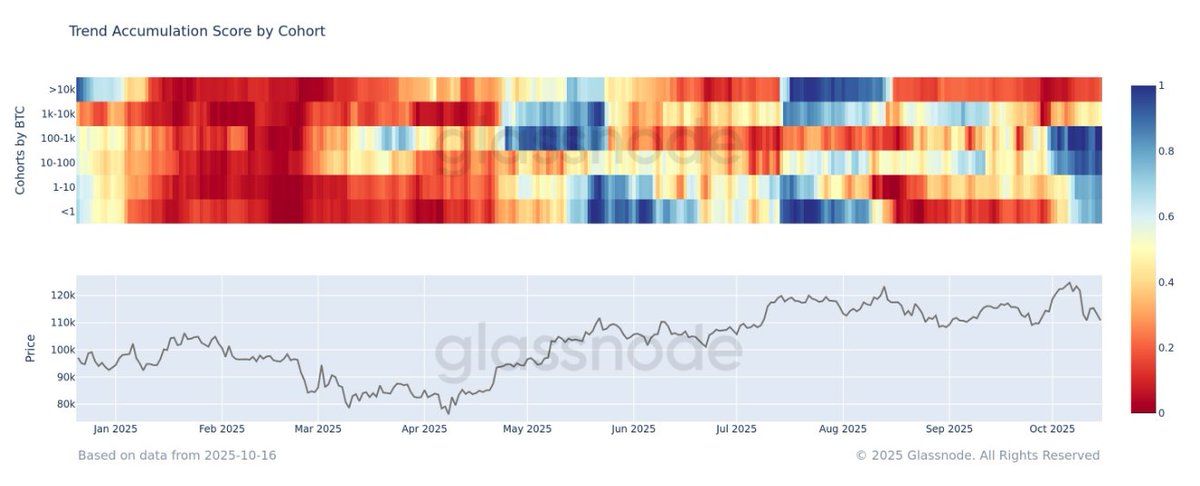 Bitcoin Trend Accumulation Score by Cohort” data. Source:
Glassnode
Glassnode noted, “Smaller $BTC holders are stepping up.” Strong accumulation is now evident among the cohorts holding between 1 and 1,000 BTC.
Meanwhile, whale investors holding over 1,000 BTC, who were previously leading the strong selling, appear to be slowing their distribution.
Disclaimer: The content of this article solely reflects the author's opinion and does not represent the platform in any capacity. This article is not intended to serve as a reference for making investment decisions.
You may also like
BankChain Alliance forms, UOB and HSBC launch tokenized Hong Kong-dollar pilot

Bank of America Hartnett: Strong US dollar impacts global liquidity, risk assets remain difficult to enter, turning point postponed to next spring
Bank of America's chief strategist Hartnett maintains a risk-averse stance, pushing the entry window back to next spring. The US Dollar Index has hit a new yearly high, and combined with high oil prices and persistent inflation, none of his three entry conditions have been met. He now expects the US dollar to peak between February and March next year, with the end of the global rate hike cycle delayed until the Federal Reserve's meeting in April. Currently, risk assets are "too expensive to go long, but also difficult to short due to protective measures."

US Stock IPO Analysis | Juneng Technology (NENG.US): The "Middleman" in the Short Video Advertising Boom, How Long Can the Long-Tail Traffic Dividend Last?
After the fundraising scale was increased, the valuation of JN Tech grew by about 13%.

Nvidia reduces customer collateral size

Crypto prices
More


