
Brevis releases Pico Prism, enabling real-time Ethereum proofs on consumer-grade hardware

Pico Prism (zkVM) has improved its performance efficiency by 3.4 times on the RTX 5090 GPU.
Original source: Brevis
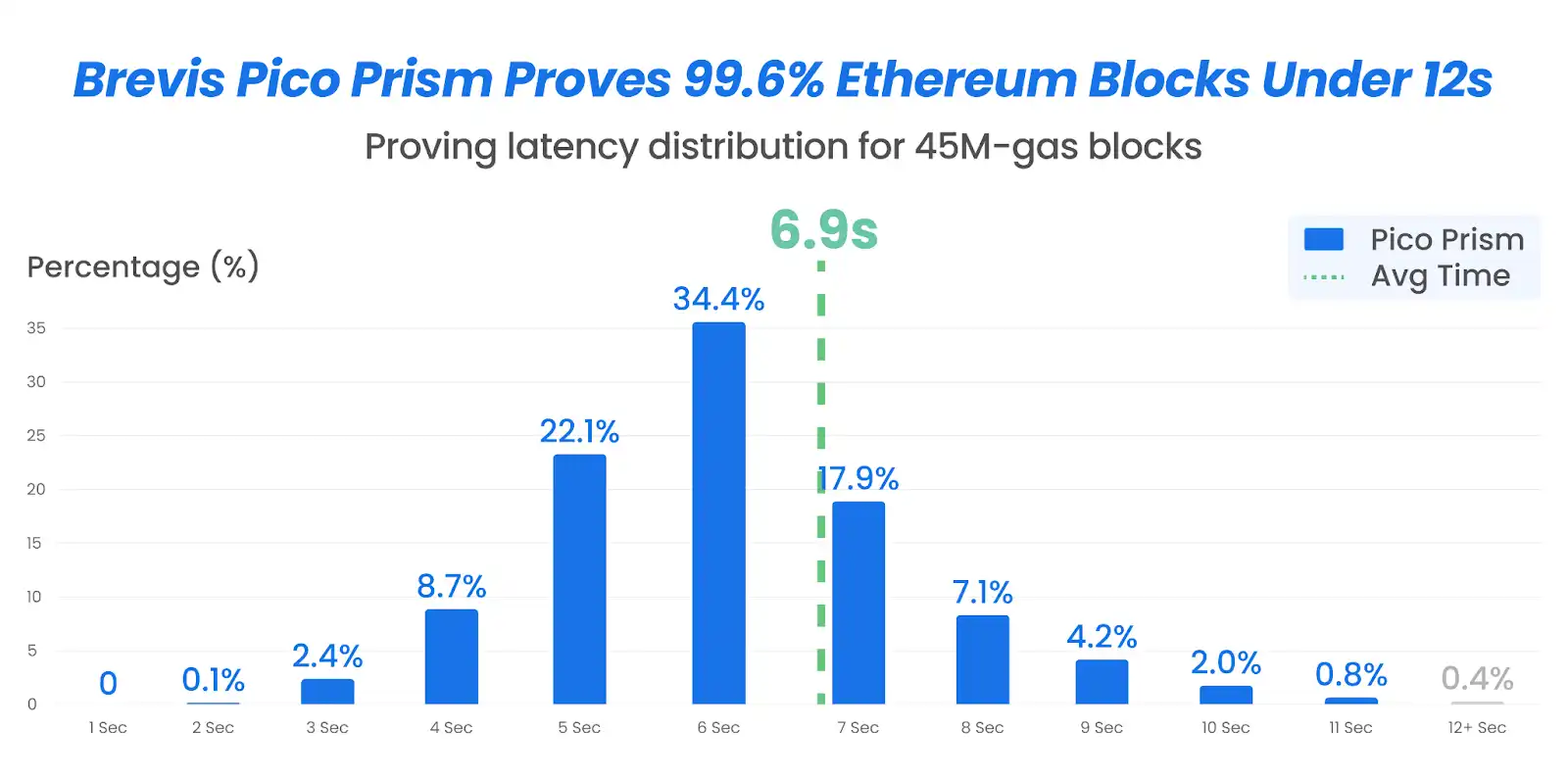
Leading zero-knowledge proof infrastructure provider Brevis has announced that its Pico Prism has achieved real-time proof coverage of 99.6% for current Ethereum mainnet blocks (45M Gas limit) on consumer-grade hardware (within 12 seconds), and 96.8% coverage within 10 seconds.
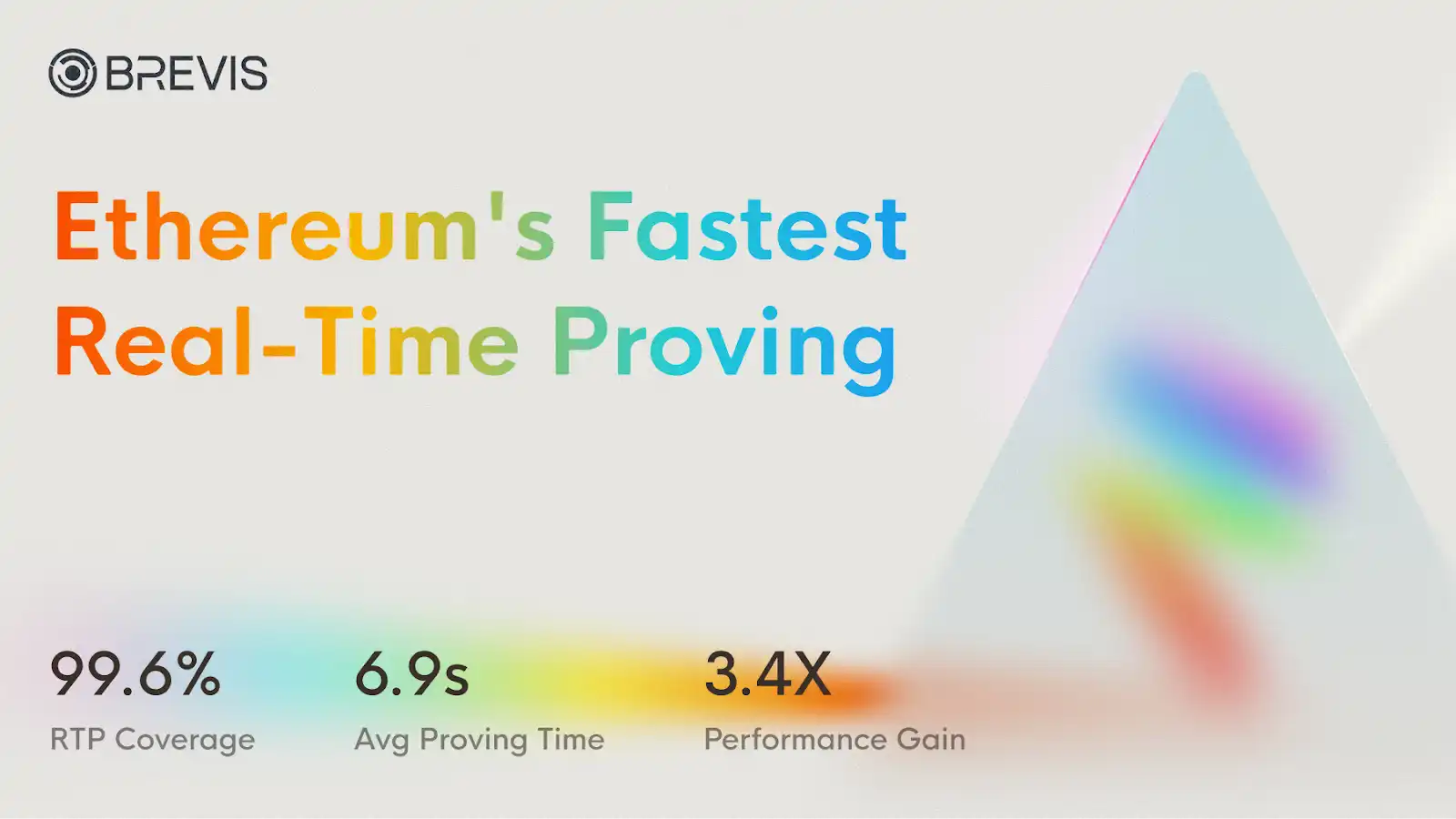
This breakthrough demonstrates that real-time proof can be achieved using accessible RTX 5090 GPUs, without the need for expensive data center equipment. This makes the technology economically viable for broader deployment, while supporting Ethereum's decentralization goals.
Performance Surpasses Previous Solutions
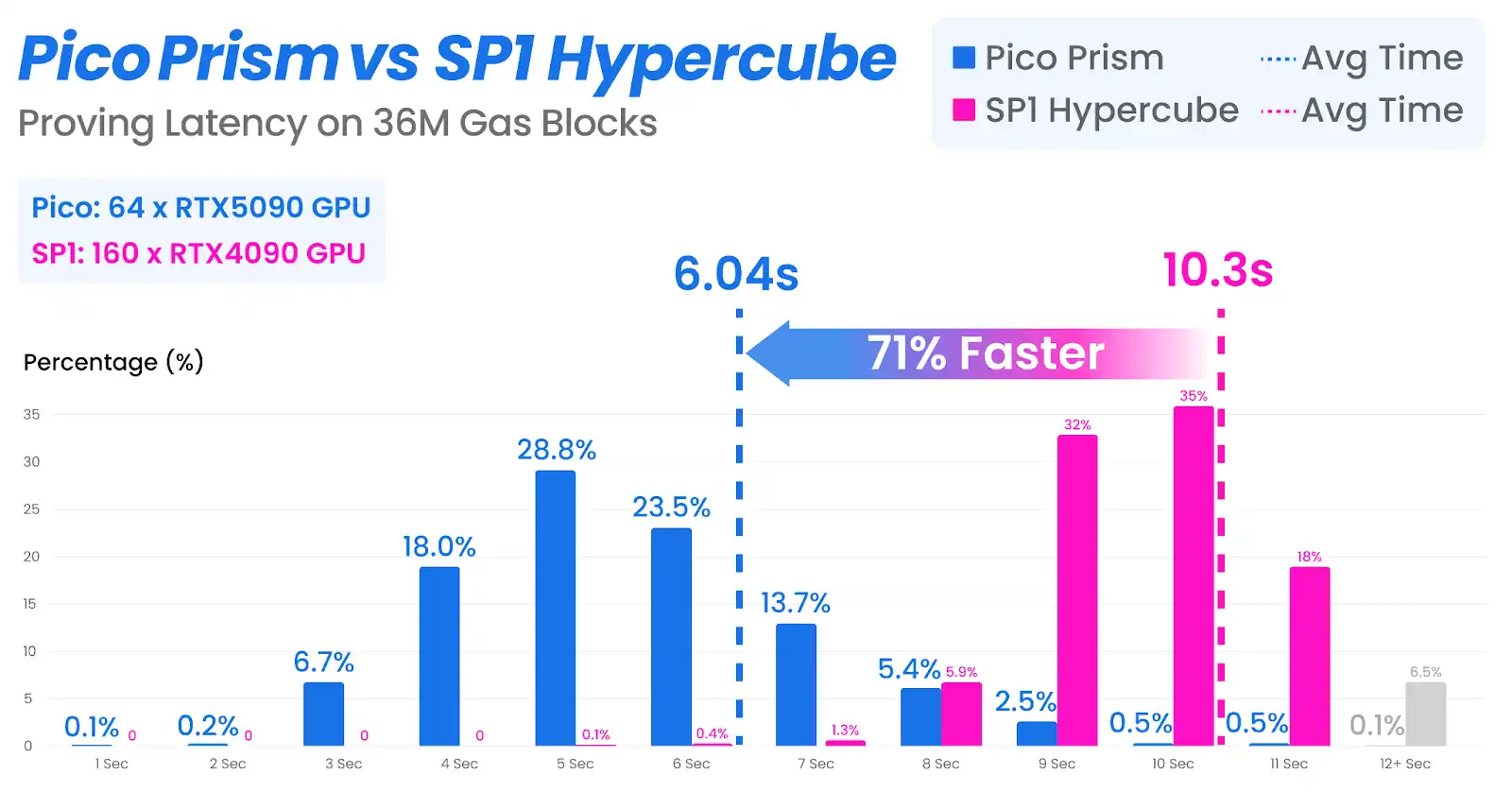
When tested on the same 36M Gas block as previous benchmarks, Pico Prism significantly outperformed across all metrics:
· <10 seconds coverage: 98.9% vs. 40.9%
· Hardware cost: $128K vs. $256K (50% reduction)
· Average proof time: 6.04 seconds vs. 10.3 seconds (71% faster)
· GPU requirement: 64 RTX 5090 vs. 160 RTX 4090
· Performance efficiency (speed and cost combined): 3.4x improvement
For 45M Gas Ethereum blocks, Pico Prism achieved:
· 99.6% coverage (within 12 seconds)
· 96.8% coverage (within 10 seconds)
· Average proof time of 6.9 seconds
Brevis co-founder and CEO Michael stated: "The data speaks for itself. We have built infrastructure capable of handling the current Ethereum block production volume, all using consumer-grade hardware accessible to the masses. This performance perfectly aligns with Ethereum's decentralization goals."
Technical Innovation: Distributed Architecture
Pico Prism's outstanding performance stems from a complete architectural overhaul, moving from single-machine proofs to distributed multi-GPU clusters. The system leverages Pico's modular design, assigning compute-intensive tasks to GPUs for parallel processing, while CPUs handle task setup. Highly parallelized pipelines maximize GPU utilization within the cluster, and multi-machine scaling achieves near-linear acceleration. This enables excellent hardware efficiency on RTX 5090 consumer-grade hardware, offering advantages over solutions requiring expensive or specialized data center equipment.
Advancing Ethereum's Scaling Vision
Traditional Ethereum transactions require over 800,000 validators worldwide to independently recalculate. Pico Prism enables scalable verification through cryptographic proofs—where a single prover generates a mathematical proof, and the rest of the validators complete verification in milliseconds.
In July 2025, the Ethereum Foundation set a roadmap goal for real-time proofs: 99% coverage, completion within 10 seconds, hardware cost under $100,000, and power consumption below 10kW. Pico Prism's achievements on consumer hardware are an important step toward this goal. While the $128K hardware cost is slightly above $100,000, the widespread availability of consumer-grade GPUs greatly enhances accessibility.
Reproducible Benchmarking
Brevis benchmarked Pico Prism on 8 servers (each equipped with 8 RTX 5090 GPUs, totaling 64 GPUs) and compared it with previous state-of-the-art solutions. All tests are reproducible, and all parties are welcome to verify the experimental results. Brevis is committed to promoting open and reproducible benchmarking to support Ethereum's transparency and technical excellence.
Production-Ready Infrastructure
Pico Prism is the distributed, multi-GPU evolution of the Brevis Pico zkVM architecture. Brevis has already validated its zero-knowledge infrastructure in production environments through ZK Data Coprocessor technology, currently providing verifiable computation support for major DeFi protocols such as PancakeSwap, Usual, Frax, Linea, and MetaMask. In the coming months, Pico Prism plans to achieve 99% real-time proof with fewer than 16 RTX 5090 GPUs, further approaching the Ethereum Foundation's accessibility goals.
About Brevis
Brevis is an efficient, verifiable off-chain computing engine that provides unlimited computing power for existing smart contract blockchains. Through zero-knowledge proofs, Brevis offloads data-intensive and high-cost computations from on-chain to low-cost off-chain engines, enabling Web3 applications to scale seamlessly while maintaining L1 security and trust.
This article is a submission and does not represent the views of BlockBeats
Disclaimer: The content of this article solely reflects the author's opinion and does not represent the platform in any capacity. This article is not intended to serve as a reference for making investment decisions.
You may also like
One month before the IPOs of Anthropic and SpaceX, bitcoin fell 22%. How will liquidity dynamics drive the future market trend?
SBET's Chief Investment Officer attributes this phenomenon to a "liquidity event rapidly increasing correlations between assets"—investors sell crypto assets to participate in star IPOs. Following this logic, most brokerages require investors to wait 15 to 30 days after being allotted new shares before selling. After the SpaceX IPO, on the 31st day, ETH’s price surpassed its level on the IPO day, and by the 70th day, BTC's downward trend reversed.

WeRide Q3 revenue increased by 88% year-on-year, AI infrastructure revenue nearly doubled, Robotaxi single-quarter revenue surpassed 100 million yuan for the first time | Earnings Report Insights
WeRide's revenue for the third quarter reached 320 million yuan, surpassing the market expectation of 270 million yuan. Its net loss was 310 million yuan, lower than the expected 400 million yuan. Overseas income grew by 171.5% year-on-year, driving the gross margin up to 43%. The Guangzhou Robotaxi business achieved positive unit economics for the first time. However, increased R&D investment led to a larger adjusted loss, indicating profitability still needs improvement.
Wall Street technology veteran Niles is optimistic that Anthropic (ANT.US) will win the AI agent price war, but warns that its stock price may fall below the offering price.
Anthropic's IPO exceeded expectations, but Dan Niles warns of valuation risks, slowing growth in AI revenue, and price competition.
After Jensen Huang's resignation, Nvidia faces a new threat: losing its top engineers
Thousands of Nvidia employees have petitioned for Jensen Huang to return to his position, with some publicly criticizing the board's decision; some employees have already announced their resignation. Interim CEO Kress has issued early salary increases and stock rewards in an effort to stabilize the team, but AMD, Broadcom, and AI startups are poised to poach talent. Analysts warn that if five to ten key technology leaders leave, it could affect decisions on chip and software architecture, product iteration, and the planning of next-generation AI technologies.

Crypto prices
More


