Bitget App
Trade smarter
Buy cryptoMarketsTradeFuturesStocksEarnInstitutionAI & More
What does the Federal Reserve's interest rate cut mean for on-chain lending?

What does the Federal Reserve's interest rate cut mean for on-chain lending?

深潮深潮2025/09/22 16:05
Show original
By:深潮TechFlow

Enhanced liquidity does not necessarily indicate a bullish crypto market.

Enhanced liquidity does not necessarily mean a bullish crypto market.

Authors: Ethan Chan & Hannah Zhang

Translation: TechFlow

This week, the Federal Reserve cut interest rates and hinted at further policy easing in the future. Almost all mainstream crypto news headlines are conveying the same message:

Lower capital costs → Increased liquidity → Bullish crypto.

But the reality is more complex. The market has long priced in expectations of a rate cut, and there has not been an immediate surge in capital inflows into BTC and ETH.

Therefore, let’s not stay on the surface, but instead examine how rate cuts affect a part of DeFi—lending.

On-chain lending markets like Aave and Morpho dynamically price risk rather than relying on regulatory directives. However, the Federal Reserve’s policies provide important context for this backdrop.

When the Federal Reserve cuts rates, two opposing forces are at play:

1) Reverse effect: Fed rate cuts → On-chain yields rise as people seek uncorrelated assets

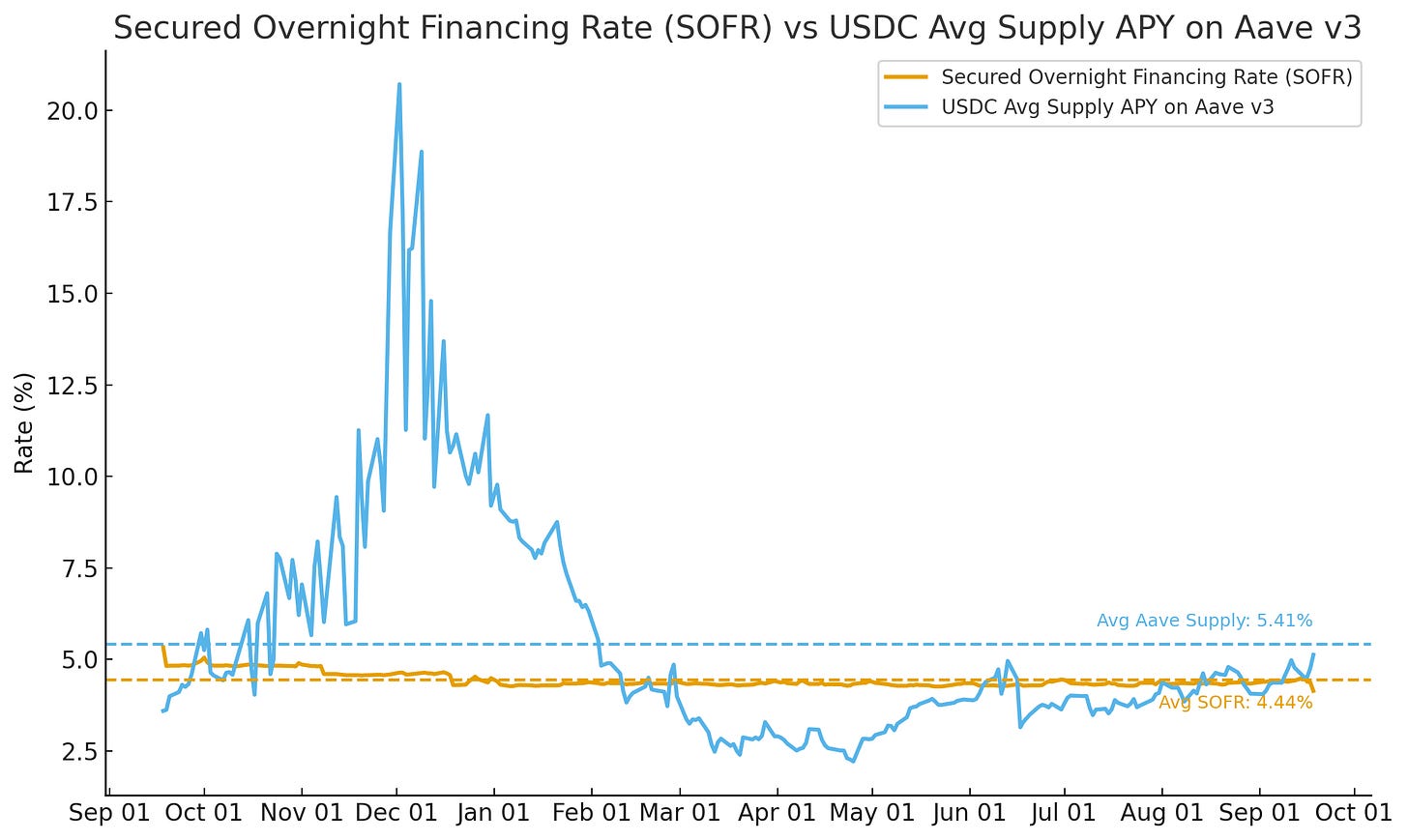
As capital seeks returns outside of traditional government bonds and money market funds, it may flow into DeFi, thereby driving up utilization and causing on-chain rates to rise. If we compare the supply annual percentage yield (Supply APY) of USDC on Aave with SOFR (Secured Overnight Financing Rate), we can see this trend gradually emerging before the Fed’s September rate cut.
What does the Federal Reserve's interest rate cut mean for on-chain lending? image 0

Source: Allium

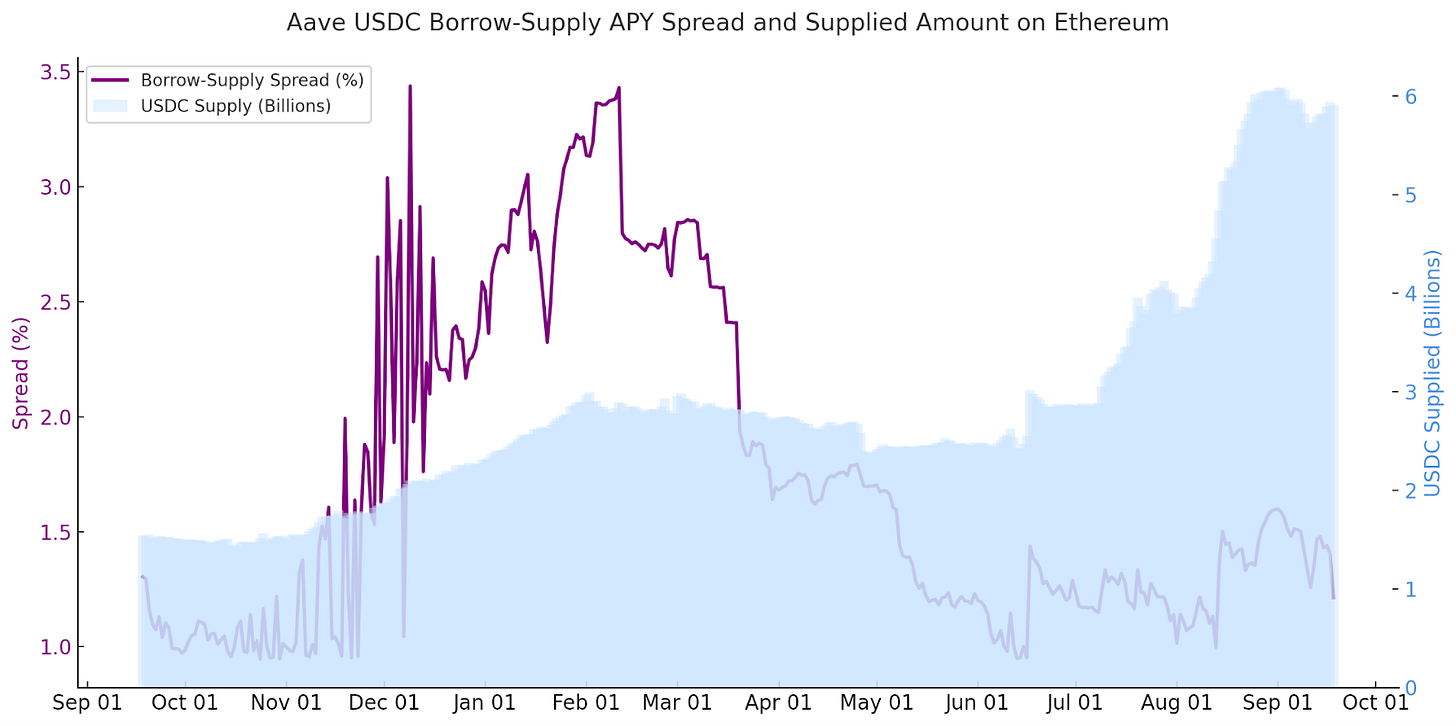
We also see this happening as the DeFi lending-supply yield spread narrows.

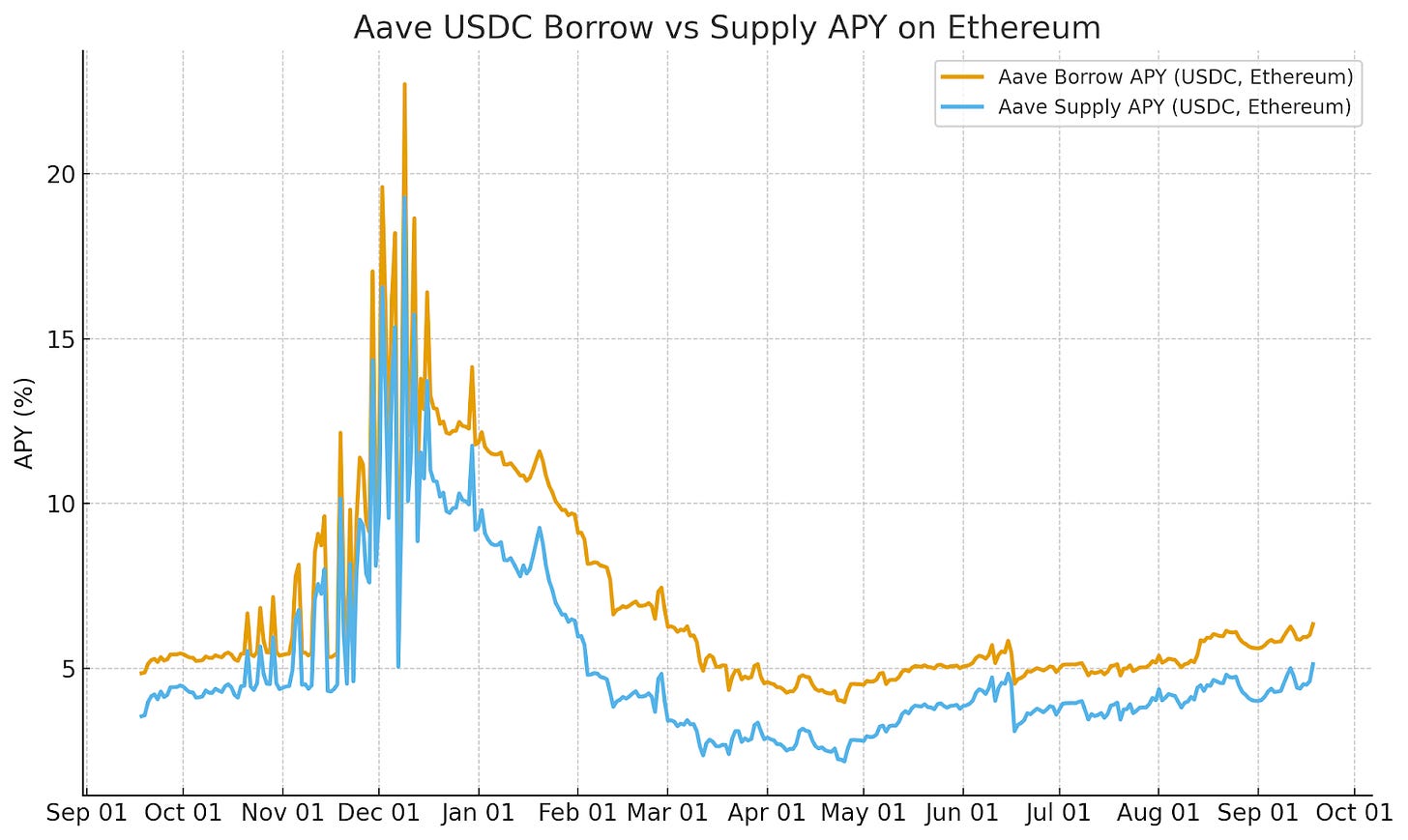
Taking the example of USDC lending on Aave on Ethereum, in the days leading up to the Fed’s rate cut announcement, the lending-supply yield spread gradually narrowed. This was mainly due to more capital chasing yields, supporting the short-term reverse effect.
What does the Federal Reserve's interest rate cut mean for on-chain lending? image 1

What does the Federal Reserve's interest rate cut mean for on-chain lending? image 2

Source: Allium

2) Direct correlation: Fed rate cuts → On-chain yields also fall as alternative liquidity sources become cheaper

As the risk-free rate falls, the cost of alternative liquidity sources such as crypto also declines. Borrowers can refinance or leverage at lower costs, thereby pushing down both on-chain and off-chain lending rates. This dynamic typically persists in the medium to long term.

We can see signs of this in the forward yield market data.

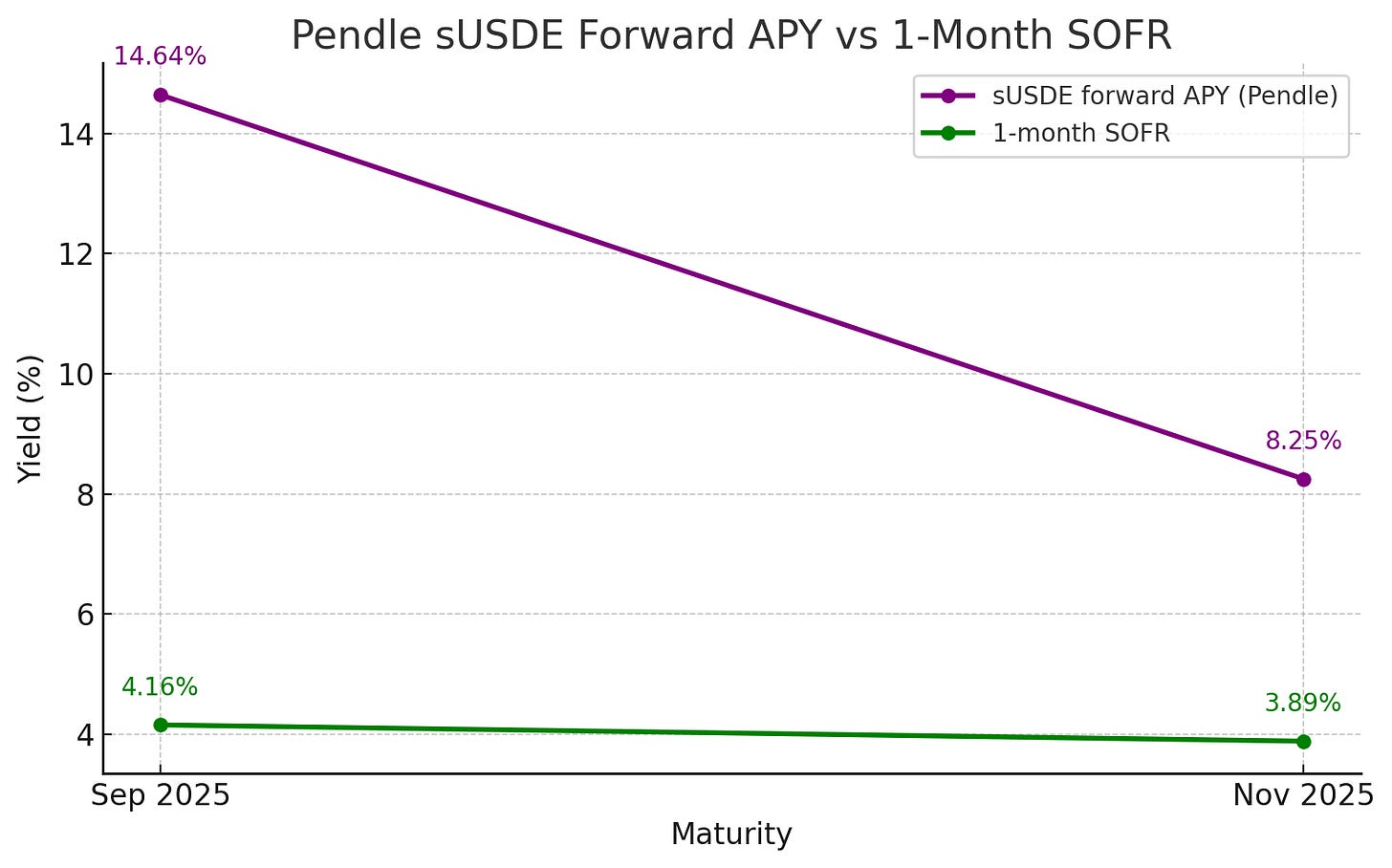
Pendle is DeFi’s forward yield market, where traders can lock in or speculate on future DeFi annual percentage yields (APY). Although Pendle’s maturities do not perfectly match traditional benchmark rates, its maturities are very close to SOFR, making for a valuable comparison—for example, in late September and late November.

On these dates, the 1-month SOFR rate was about 4.2% (September) and 3.9% (November). The implied sUSDe yields for similar Pendle maturities were much higher in absolute terms (14.6% and 8.3%, respectively). But the shape of the yield curve says it all. Like SOFR, as expectations of further Fed easing are priced in, Pendle’s forward yields are also declining.
What does the Federal Reserve's interest rate cut mean for on-chain lending? image 3

Source: Allium

Key point: Pendle’s trend is consistent with the direction of traditional rate markets, but with a higher benchmark. Traders expect on-chain yields to fall as macro policy changes.

Conclusion: The impact of Fed rate cuts on the crypto market is not as simple as the headlines suggest

Rate cuts do not only affect the crypto market (just as in traditional capital markets, rate cuts usually impact the stock market). Rate cuts also bring various effects—on-chain yields fall, rate spreads narrow, and forward yield curves shift—all of which ultimately shape liquidity conditions.

Beyond lending, we can further understand the impact of Fed rate cuts on the crypto market, such as how the circulation of stablecoins might change as issuer yields fall or as real yields decline, leading to increased ETH staking inflows.

By combining real on-chain data, we can go beyond news headlines and truly see how macro policy permeates the crypto market.


0
0

Disclaimer: The content of this article solely reflects the author's opinion and does not represent the platform in any capacity. This article is not intended to serve as a reference for making investment decisions.

Understand the market, then trade.
Bitget offers one-stop trading for cryptocurrencies, stocks, and gold.
Trade now!

You may also like

The script at the end of 2018: The Federal Reserve continued to raise interest rates, US stocks plunged 20% from the September highs, forcing the Federal Reserve to "pivot" in January.

Goldman Sachs' head of trading believes the current US stock market is repeating the scenario of late 2018, with monetary tightening and equity market pressure. The Goldman Sachs Financial Conditions Index has tightened by about 8 points in two weeks, reaching the highest level in a year. The selloff has broadened from tech stocks to defensive sectors. Gold and equities are declining simultaneously, possibly indicating investors are selling assets to raise cash, making gold a key indicator for observing liquidity stress.

华尔街见闻•2026/11/21 05:31
The script at the end of 2018: The Federal Reserve continued to raise interest rates, US stocks plunged 20% from the September highs, forcing the Federal Reserve to "pivot" in January.

Goldman Sachs Trader “Revisits the 2018 Playbook”: Still Clearly Remembers “On December 24th, Clients Asked Why the Market Dropped So Much—And I Had No Idea”

Brian Garrett pointed out that the current adjustment in the US stock market is similar to the sharp decline in Q4 2018: the S&P 500 has already experienced 42% of the corresponding drop, and the VIX is approaching its peak just before Christmas. If history repeats itself, the bottom of this cycle may appear in January next year. However, the credit market and Federal Reserve policy have yet to provide clear signals of a bottom.

华尔街见闻•2026/11/21 03:51

Anthropic (ANT.US) nearly “broke issue price,” but Claude knocks on the doors of “the highest peak in mathematics”! 17 million lines of Lean code used to write a candidate proof for the Riemann Hypothesis

On November 20th, Eastern Time, on its second day of trading, Anthropic's intraday price dropped to a low of $83.05, just 5 cents above the offering price of $83, and finally closed at $88.91, a decline of 8.50%. On the same day, the company's mathematician Levant Alperg announced on his personal website that he and Claude had found a candidate proof for the Riemann hypothesis, which has puzzled the mathematics community for 167 years, and released about 17 million lines of Lean formalized code.

智通财经•2026/11/21 03:21
Anthropic (ANT.US) nearly “broke issue price,” but Claude knocks on the doors of “the highest peak in mathematics”! 17 million lines of Lean code used to write a candidate proof for the Riemann Hypothesis

As US stocks plummet, the parent company of GTA 6 rises against the market! First-day sales hit a record $3.79 billion; Wall Street shifts focus to next-generation GTA Online.

According to Rentrak data, the global box office of "Grand Theft Auto VI" has also surpassed that of "Avengers: Endgame," the highest-grossing film of all time, which has a global box office of approximately $2.94 billion.

智通财经•2026/11/21 02:41
As US stocks plummet, the parent company of GTA 6 rises against the market! First-day sales hit a record $3.79 billion; Wall Street shifts focus to next-generation GTA Online.
