
Solana cross-chain swaps go live on PancakeSwap

PancakeSwap’s cross-chain swap feature not supports Solana. Users can swap tokens across the blockchain directly through the PancakeSwap interface using only one transaction.
- PancakeSwap expands its cross-chain swap feature to include Solana, adding the blockchain to its range.
- Users can swap between Solana assets without needing to bridge through other assets or through other platforms.
- Solana fell by 7.19% after the recent crypto crash and has been unable to climb back to previous levels.
On Sept. 22, the Solana cross-chain swap feature goes live on the PancakeSwap ecosystem, enabling instant swaps between select blockchains without the need to bridge assets. Users can now swap between tokens directly through the interface on one single transaction, without having to switch apps or go through a third-party.
With the latest update, the integration lets users swap their Solana ( SOL ) tokens with BNB Chain, Arbitrum, Ethereum, ZKsync and other tokens as well as vice versa.
The integration is built into PancakeSwap’s existing swap page, meaning users will not have to leave the platform to make swaps between assets. In addition, the new feature also makes use of PancakeSwap’s liquidity pools.
PancakeSwap claims that transactions usually settle instantly, within a matter of seconds. For transfers between SOL and EVM-compatible chains, the feature uses Relay, a multichain payment network.
Launched in 2024, Relay has facilitated over 55 million transactions for more than 5 million users, moving $6 billion across 75 blockchains. On Ethereum ( ETH ), it has processed about three transactions per block, representing around 0.7% of network activity.
Solana price analysis
Solana experienced a sharp decline in the early trading hours on September 22, 2025, with the price dropping from around $228 to as low as $213 in a matter of minutes. This steep sell-off appears to have been triggered by a wave of forced liquidations, as most of the crypto market suffered from this phenomenon.
After the initial plunge, SOL was able to bounce back toward the $221–223 range, suggesting that buyers stepped in to absorb the selling pressure. However, the recovery lacked strong momentum, as price action stabilized but failed to reclaim pre-crash levels. This indicates that while impact of the liquidation crash has faded, traders remain cautious and are reluctant to push the price higher
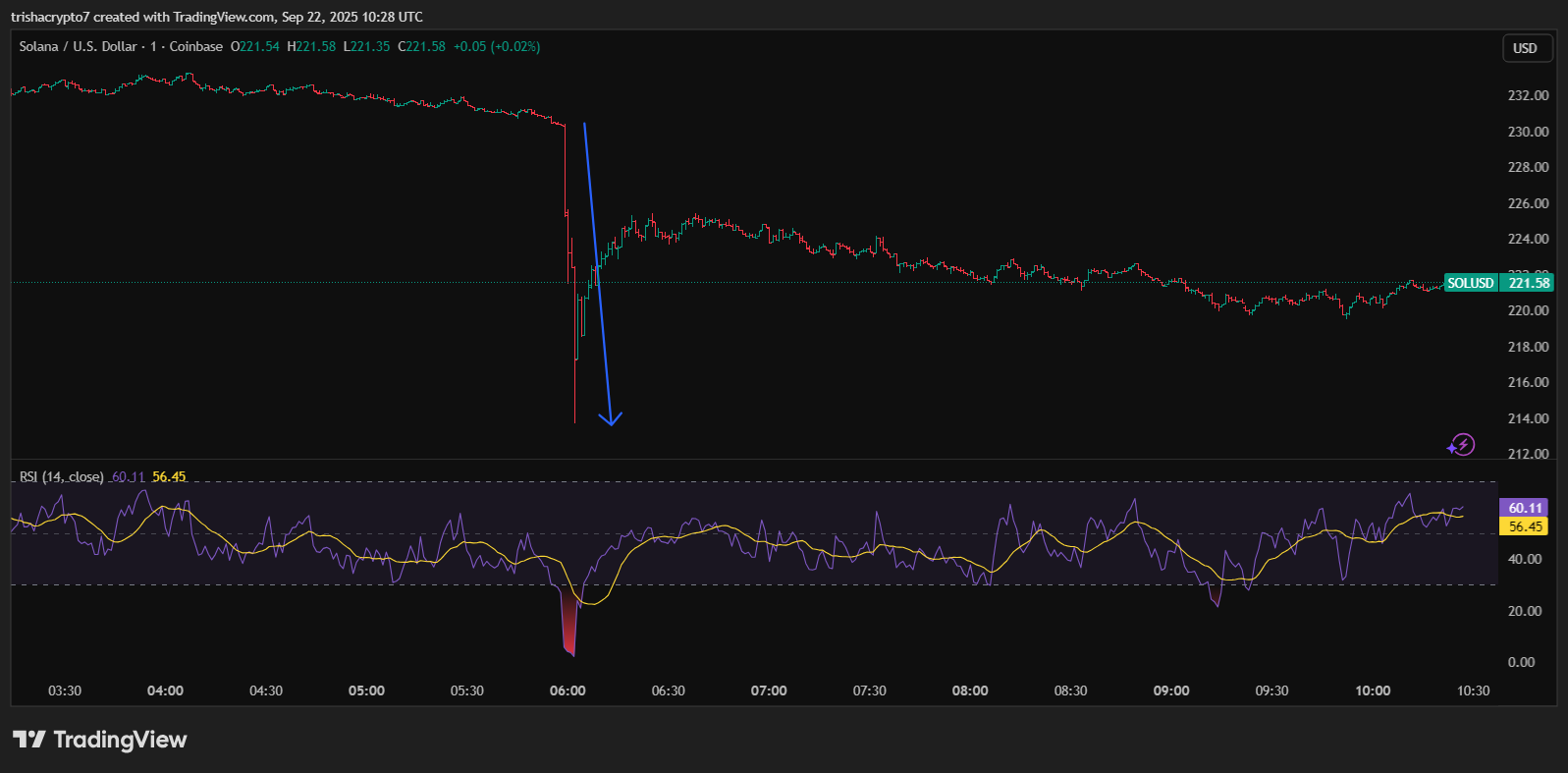 Solana’s price fell in the first few hours of trading | Source: TradingView
Meanwhile, the Relative Strength Index also briefly fell into oversold territory, confirming the intensity of the downward pressure fueled by today’s crypto crash. Since then, the RSI has recovered to a neutral zone around 56 to 60, signaling that the market has regained balance after the oversold dip.
Moreover, the absence of a strong follow-through buying suggests that the market is still in its wait-and-see phase, with participants monitoring whether SOL can sustain this range or if further downside could emerge.
Disclaimer: The content of this article solely reflects the author's opinion and does not represent the platform in any capacity. This article is not intended to serve as a reference for making investment decisions.
You may also like
Goldman Sachs Global Stock Market Outlook: AI Capital Expenditure to Peak Next Year, Earnings Growth to "Slow Down Significantly", Cloud Giants Become "Defensive Assets"
Goldman Sachs’ 2027 Global Equity Strategy points out that the AI capital expenditure boom is nearing its peak, and global profit growth will slow significantly. S&P 500 earnings growth is expected to drop from 36% to 11%, with depreciation pressures gradually emerging. However, cloud giants’ valuations have adjusted to a forward P/E of 19.7, lower than the staples sector, and are classified as “relatively defensive” assets. Goldman Sachs predicts an S&P 500 target of 8,700 points and suggests overweighting the US and Japan, while underweighting Europe.
With $135 billion worth of Nvidia stock, will Jensen Huang cash out?
After Jensen Huang stepped down, his Nvidia holdings of approximately 812 million shares, valued at $135 billion, became a major pressure on the stock price. Any reduction in holdings is subject to both legal and market constraints: shares can only be sold compliantly after the disclosure of any undisclosed negative information, and the volume is equivalent to six trading days’ total market transactions, meaning large-scale cashouts would have to be spread over several months.
Will the traditional Christmas rally still happen in the US stock market this year?
After a simultaneous technical and position-based recovery in the US stock market, Goldman Sachs, Morgan Stanley, and JPMorgan have successively signaled a year-end rebound. Extremely light positions, mean reversion of valuations, and seasonal support together create conditions for a short squeeze. However, global manufacturing import price inflation has annualized at around 24%, surpassing the pandemic peak, and the inflation bill will come due intensively in the first quarter of next year. Goldman Sachs warns that once the year-end rally materializes, it may exhaust future upside potential.

Anthropic IPO Roadshow: CEO Says "Doesn't Care About Market Conditions", Hopes to "Underpromise and Overdeliver"
As Anthropic gears up for its IPO, CEO Amodei remains deliberately low-key during the roadshow, emphasizing "under-promise and over-deliver," and appears calm regarding market volatility at the time of listing. In response to fluctuations in the AI sector and the Nvidia situation, Amodei stated he is not particularly concerned about the specific month of listing or market conditions, and frankly admits that allocation of computing power is "the most fundamental business challenge."
Crypto prices
More


