
Will XRP Price Really Crash to Zero?

The latest warning from Moody’s Analytics has rattled global market and the crypto market : the probability of a U.S. recession within the next year has risen to 48%. Historically, every time this metric has climbed into the mid-40s, a downturn has followed. This context matters for crypto investors, particularly those holding XRP, because economic stress often drains liquidity and reduces appetite for speculative assets. The key question is whether such macroeconomic headwinds could push XRP price to catastrophic levels, even down to zero .
XRP Price Prediction: Why Recession Risk Matters for XRP Price?
Mark Zandi’s analysis highlights structural pressures weighing on the U.S. economy—weak job growth, fragile manufacturing, and policy headwinds like tariffs and reduced immigration. These conditions create a risk-off environment where investors retreat from volatile markets. Cryptocurrencies are among the first assets to be sold during economic contractions.
If recession fears materialize, institutional and retail flows into crypto could dry up. For XRP price , which already faces regulatory uncertainties and fierce competition from other blockchain projects, a recession would magnify pressure. But does that automatically mean a path to zero? Unlikely. XRP’s utility in payments and its deep liquidity base mean that while downside risks are real, a total collapse is not the base case.
Technical Analysis of XRP Daily Chart
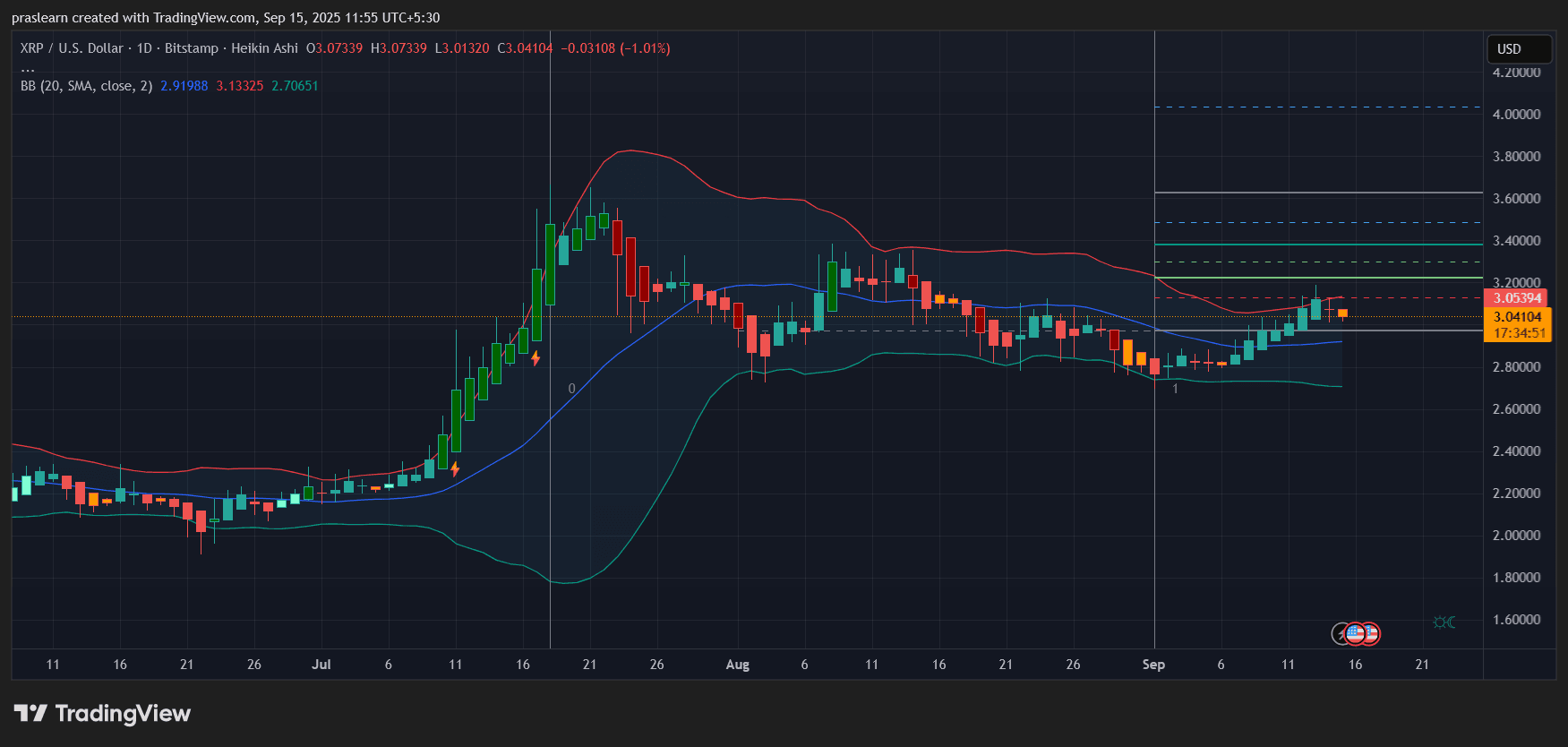 XRP/USD Daily Chart- TradingView
Looking at the XRP price daily chart:
- Current price: around 3.04 USD, slightly below resistance at 3.05 USD.
- Bollinger Bands: The price has tested the upper band near 3.13 and pulled back, signaling short-term overextension. The middle band at 2.91 is acting as a support pivot.
- Trend context: After a strong July rally that pushed XRP above 3.50, the coin consolidated sideways through August and September. The recent uptick shows momentum returning, but sellers remain active at resistance.
- Support zones: Key support lies near 2.70 (lower Bollinger band) and 2.90 (middle band). A break below these levels could open downside to 2.40.
- Resistance zones: First resistance sits at 3.20, with stronger caps at 3.40 and 3.60. A sustained breakout above 3.60 would revive the bull case.
The technical setup suggests consolidation rather than collapse. Unless macro conditions spark panic selling, XRP has enough support to avoid a freefall.
XRP Price Prediction: Could XRP Actually Go to 0?
From both a macro and chart perspective, the idea of XRP going to zero looks more like fear than reality. For XRP price to collapse completely, it would require a black swan—such as Ripple losing all regulatory cases, exchanges delisting it globally, or blockchain utility vanishing. Even in a severe recession, XRP’s liquidity and established adoption make such a scenario remote.
That said, a U.S. downturn could trigger significant volatility. If recession fears spike, XRP could revisit sub-2.50 levels, especially if Bitcoin leads a broader crypto selloff. Traders should brace for higher volatility, with whipsaws between 2.70 and 3.40 likely in the short term.
The balance of forces suggests that XRP will not crash to zero, but risks are tilted to the downside if the U.S. recession probability continues to climb. In the near term:
- If XRP holds above 2.90 support, it could rebound toward 3.20–3.40.
- A break below 2.70 could confirm bearish control, sending the price closer to 2.40.
- Zero remains off the table unless an unprecedented regulatory or systemic collapse occurs.
In short, $XRP is at risk of deeper corrections, but total collapse is not in play. Investors should monitor both U.S. economic data and technical support zones to gauge whether the current consolidation breaks higher or slips lower.
Disclaimer: The content of this article solely reflects the author's opinion and does not represent the platform in any capacity. This article is not intended to serve as a reference for making investment decisions.
You may also like
New York Federal Reserve President: Overall price increases remain too high, inflation may not reach the Fed's target level until 2028
John Williams, President of the New York Federal Reserve, stated on Monday that although some inflationary pressures in the United States have shown signs of easing, the overall rise in prices remains too high.
No more mandatory retention! Anthropic launches EFS system, allowing enterprises to take control of their own AI data
Anthropic has launched the public beta of its Enterprise Frontier Security (EFS) system, allowing corporate clients to store AI data on their own cloud platforms, with clients holding their encryption keys. Anthropic only performs automated security scans and cannot access the data itself. The system retains the 30-day data retention requirement, but control over storage is returned to enterprises, addressing strong customer backlash sparked by the mandatory retention policy implemented in June.

Report: Samsung's storage capacity is nearly sold out for the next three years, clients rush to secure long-term contracts until 2031
According to media reports, most of Samsung Electronics' memory manufacturing capacity for the period from 2027 to 2029 has already been secured through contracts. Some customers are even seeking to extend long-term supply agreements until 2031. Currently, leading memory manufacturers can only meet about 60% to 70% of client demand, and the supply shortage may intensify further in 2027.

Anthropic commits to about $900 billion in computing power expenditure; bond market expects its bonds to be junk-rated
Despite Anthropic raising over $100 billion in its public offering and reaching a market capitalization of $1.18 trillion, the company is widely expected by the debt market to be rated as BB-level "junk bonds" due to its lack of profitability and approximately $900 billion in massive computing power expenditure commitments. Amid pressure on tech giants in the debt market and chip companies planning to reduce loan guarantees, Anthropic will still need to rely on structured financing in the short term, facing about a three-year window to strive for an investment-grade rating.
Crypto prices
More


