
Fee switch activation and weekly buybacks, Resolv is worth putting on your investment watchlist

Resolv is sacrificing part of the revenue that could have been earned by the team to instead buy back project tokens.
Resolv is sacrificing a portion of the income that could have been earned by the team in order to buy back project tokens.
Written by: Castle Labs
Translated by: AididiaoJP, Foresight News
What is Resolv
Resolv is an over-collateralized interest-bearing stablecoin protocol that can mint USR and RLP. The stablecoin USR earns interest through delta-neutral strategies; RLP is a liquidity token that earns leveraged returns by taking on the inherent risks of these strategies.
The yields for USR and RLP users come from the liquidity staking yields generated by ETH liquid staking tokens (LST), as well as the funding rates earned from shorting ETH on centralized exchanges.
Resolv now has its own governance token, RESOLV, which can be staked to earn rewards. The airdrop of this token did not attract much market attention, and many long positions were quickly closed, causing TVL to drop by more than 50% from its all-time high (ATH) within a few months.
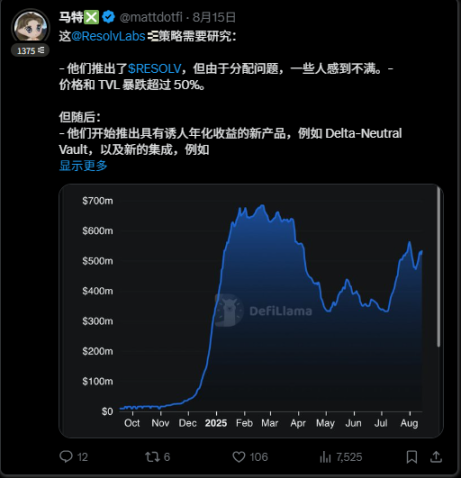
Then, the Resolv team began announcing new partnerships, strategies, and protocol integrations, as well as the fee switch (and token buybacks), with both price and TVL rebounding from recent lows.
Resolv's Buyback Plan
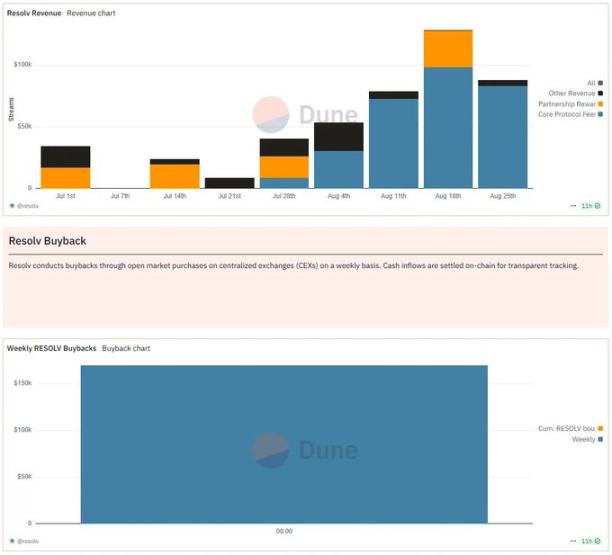
Last week, the Resolv Foundation launched a plan to buy back RESOLV tokens, using protocol revenue for weekly buybacks.
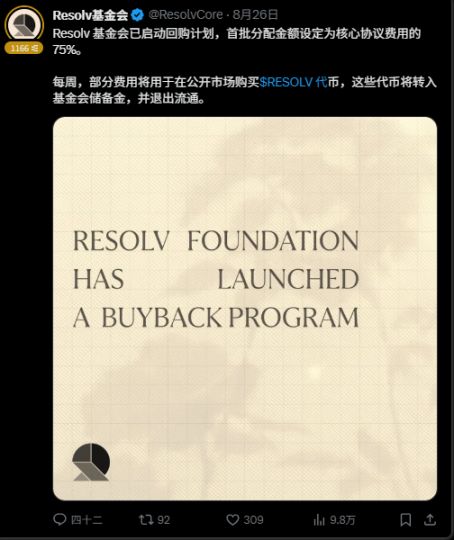
But where does this revenue come from? The protocol earns 10% of the interest paid to the staking pool, as well as incentives from external participants such as EtherFi, thanks to the fee switch enabled in July.
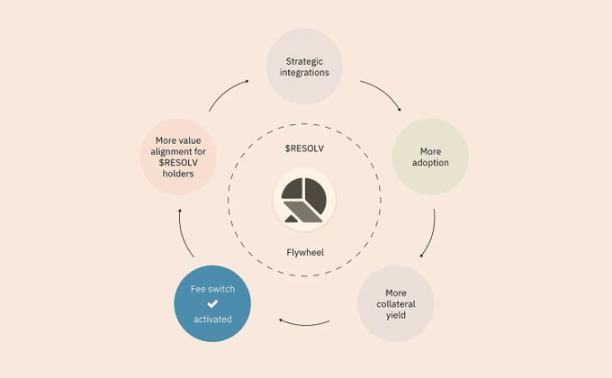
Currently, the project has generated over $22 million in interest for its depositors, and since the fee switch was enabled, the protocol has accumulated $226,000 in fees, 75% of which has been used to buy back RESOLV.
Benefits of the Plan
Buybacks are effective for token price appreciation not only because they reduce circulating supply, but also for what they represent to the community: the protocol is sacrificing a portion of income that could have gone to the team in order to support the project's token.
The tokens bought back through these buybacks will then be allocated to future plans to drive ecosystem development, effectively re-entering the protocol's economic system.
By buying back and supporting its token in the long term, it is a reliable way to increase community members' trust and plan for the token's future, effectively retaining more supply in the long run.
Final Thoughts
Redirecting a small portion of revenue to staking and buybacks is a necessary step to support a token that has yet to find its use case, as stakeholders currently have no say in the protocol's future.
While this move makes sense, I have some concerns about how these buybacks are executed. Weekly buybacks do not always align with market conditions such as liquidity, trading volume, and spreads, so they may end up fulfilling limit orders during price increases and provide limited support when needed.
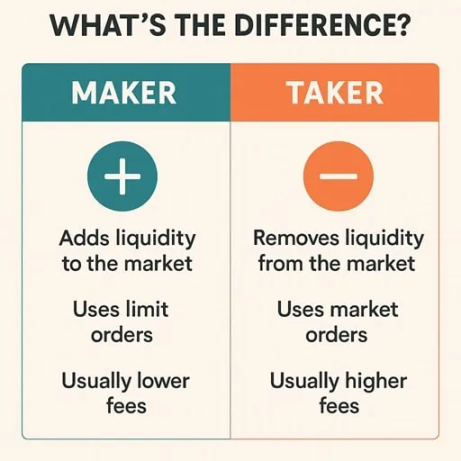
On the other hand, there are ways to improve this, such as planning a strategy that uses market maker (limit) orders to support the price when necessary, for example during cyclical downturns, prolonged slumps, or when low liquidity leads to price drops. Fluid and Raydium have already used this strategy.
Disclaimer: The content of this article solely reflects the author's opinion and does not represent the platform in any capacity. This article is not intended to serve as a reference for making investment decisions.
You may also like
WeRide Q3 revenue increased by 88% year-on-year, AI infrastructure revenue nearly doubled, Robotaxi single-quarter revenue surpassed 100 million yuan for the first time | Earnings Report Insights
WeRide's revenue for the third quarter reached 320 million yuan, surpassing the market expectation of 270 million yuan. Its net loss was 310 million yuan, lower than the expected 400 million yuan. Overseas income grew by 171.5% year-on-year, driving the gross margin up to 43%. The Guangzhou Robotaxi business achieved positive unit economics for the first time. However, increased R&D investment led to a larger adjusted loss, indicating profitability still needs improvement.
Wall Street technology veteran Niles is optimistic that Anthropic (ANT.US) will win the AI agent price war, but warns that its stock price may fall below the offering price.
Anthropic's IPO exceeded expectations, but Dan Niles warns of valuation risks, slowing growth in AI revenue, and price competition.
After Jensen Huang's resignation, Nvidia faces a new threat: losing its top engineers
Thousands of Nvidia employees have petitioned for Jensen Huang to return to his position, with some publicly criticizing the board's decision; some employees have already announced their resignation. Interim CEO Kress has issued early salary increases and stock rewards in an effort to stabilize the team, but AMD, Broadcom, and AI startups are poised to poach talent. Analysts warn that if five to ten key technology leaders leave, it could affect decisions on chip and software architecture, product iteration, and the planning of next-generation AI technologies.

Singapore and German Central Banks Successfully Test Cross-Border CBDC Settlements
Crypto prices
More


