
Bank of China Shares Surge 6.7% on Stablecoin License Buzz

Bank of China shares soared after reports of a Hong Kong stablecoin license application. Hong Kong’s strict regime, drawing interest from global firms, highlights Asia’s push toward non‑USD stablecoins and booming investor appetite.
Bank of China’s Hong Kong-listed shares jumped 6.7% on Monday to close at HKD 37.580, after local reports suggested the lender’s city unit is preparing to apply for a stablecoin issuer license. The move comes just weeks after Hong Kong rolled out one of the world’s first dedicated licensing frameworks for fiat-referenced stablecoins on August 1.
The development has fueled speculation that one of China’s largest state-owned banks could launch its stablecoin, potentially creating a commercial rival to Beijing’s centrally controlled digital yuan.
Bank of China Moves Toward Stablecoin Application
According to the Hong Kong Economic Journal, the Bank of China (Hong Kong) has set up a dedicated task force to explore stablecoin issuance and prepare application materials. The bank did not respond to requests for comment, but recently told investors it is researching digital asset applications and related risk management.
Market analysts say Bank of China would be among the most significant applicants, given the scale of its operations and the government’s parallel rollout of the digital yuan. Some observers believe a licensed Bank of China token could provide a regulated, internationally accessible counterpart to the central bank’s CBDC.
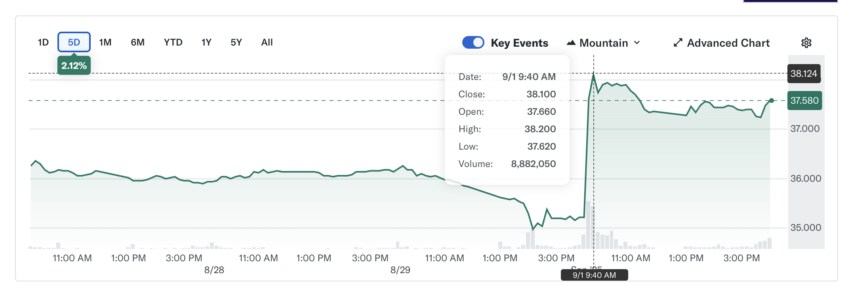 BOC Hong Kong stock performance YTD / Source: Google Finance
This news pushed BOC Hong Kong shares up 6.7% to close at HKD 37.580. The stock has risen 50.62% year-to-date, underscoring a strong upward trend in investor confidence. The stock’s historic high remains HKD 40.850, recorded in April 2018, leaving just HKD 3 until a new peak.
Hong Kong’s New Stablecoin Framework and Global Expansion
Hong Kong’s new ordinance requires any entity issuing stablecoins in the city—or those linked to the Hong Kong dollar abroad—to obtain approval from the Hong Kong Monetary Authority (HKMA). Licensed issuers must follow strict reserve management rules, segregate client funds, guarantee redemption at par, and comply with disclosure, audit, and anti-money laundering requirements.
— Real World Asset Watchlist (@RWAwatchlist_) September 1, 2025
BREAKING
Bank of China (Hong Kong) surged over 7% today after announcing plans to apply for a stablecoin issuer license. POWER OF #RWA
pic.twitter.com/FSN4gNDegB
The HKMA began accepting expressions of interest on August 1 and set September 30 as the application deadline. Officials said more than 40 companies, including Standard Chartered, Circle, and Animoca Brands, have already inquired. On August 8, Animoca confirmed a joint venture with Standard Chartered Hong Kong and HKT to pursue the city’s first license.
Chinese tech giants JD.com and Ant Group also announced plans to seek stablecoin licenses abroad. JD.com founder Richard Liu said in June that the company aims to cut cross-border payment costs through stablecoins, starting with business-to-business transfers before expanding to consumers. Vincent Chok, CEO of Hong Kong-based First Digital, highlighted efficiency as a driver.
“Blockchain technology reduces settlement times and bypasses the traditional intermediary fees of banks. The opportunity is especially pronounced in emerging markets where stablecoins hedge against currency volatility.” He added that regulation is accelerating adoption: “The current trajectory suggests exponential growth in the next two to five years.”
Stablecoin Rally Drives Investor Interest in Asia
Investor activity in Hong Kong’s digital asset sector has surged alongside the new licensing regime. In July, listed companies raised about $1.5 billion for stablecoin and blockchain ventures. OSL—one of the city’s largest licensed digital asset platforms—secured $300 million through a share placement supported by sovereign wealth and hedge funds.
A sector index tracking stablecoin-related equities has gained more than 60% this year, far ahead of the Hang Seng. Bank of China’s rally underscores strong appetite but highlights the volatility regulators repeatedly caution against.
However, in mid-August, Hong Kong’s SFC and HKMA warned that sharp market swings tied to licensing rumors may mislead investors, urging vigilance.
Analysts note that Hong Kong’s strict regime could accelerate the rise of non‑USD stablecoins in Asia, providing alternatives to the dollar in regional trade and settlement.
At this stage, the HKMA has not issued any licenses. Investors are urged to verify issuer credentials through official channels, as regulators maintain that rumors alone will not translate into approvals.
Disclaimer: The content of this article solely reflects the author's opinion and does not represent the platform in any capacity. This article is not intended to serve as a reference for making investment decisions.
You may also like
What happened? AI trading crash! Nasdaq drops over 5%, Anthropic IPO nearly breaks on the second day, Nvidia falls over 10%
Investors are not doubting the prospects of AI technology, but are beginning to question whether current valuations have fully priced in future growth. Anthropic's popularity does not prove the investment logic for the entire industry. Since Jensen Huang resigned as CEO, NVIDIA has experienced seven consecutive declines, falling nearly 28% in seven days. After Huang was investigated, news of a SEC accounting investigation added further pressure, causing its market value to evaporate by $2.65 trillion compared to the October peak. AMD closed down more than 10%, plunging for two consecutive days after a short-selling report, and the entire AI industry chain is undergoing widespread sell-off. The return on AI capital expenditure is being questioned, and the unwinding of crowded trades is amplifying the downward trend.
AI Trading Crash! Gold, Silver, and Copper Plunge Across the Board; Full-cycle Gold Falls Over 9%, New York Copper Down Nearly 10%, Crude Oil Drops 20% in Three Weeks
Expectations for a Fed rate hike are rising, and the wave of AI sell-offs has triggered cross-asset deleveraging. Precious metals faced intensive selling: New York gold futures closed down nearly 5% on Friday, marking the largest weekly drop in eight months; silver futures fell more than 7% and dropped 17% for the week. AI demand expectations are being repriced, leading to seven consecutive days and six consecutive weeks of decline for New York copper, the longest weekly losing streak in over four years. Geopolitical risks supported a rebound in US crude oil on Friday, but concerns about oversupply continued to weigh on its overall weekly performance, with both US crude and Brent falling for three consecutive weeks.
The cybersecurity industry may witness the largest merger in history: CrowdStrike is in talks to acquire Zscaler, and the combined market value could reach $265 billion.
According to media reports, the two companies are discussing a potential merger, but it is still uncertain whether a deal will be reached. Details regarding the transaction price, payment method, and acquisition premium have not been disclosed. If the integration is successful, both parties are expected to unify their endpoint, identity, network, and cloud security capabilities into a more cohesive platform, expanding their reach to enterprise clients. Following the news, Zscaler surged 16% after hours, while CrowdStrike dropped 7.4% after hours.
One month before the IPOs of Anthropic and SpaceX, bitcoin fell 22%. How will liquidity dynamics drive the future market trend?
SBET's Chief Investment Officer attributes this phenomenon to a "liquidity event rapidly increasing correlations between assets"—investors sell crypto assets to participate in star IPOs. Following this logic, most brokerages require investors to wait 15 to 30 days after being allotted new shares before selling. After the SpaceX IPO, on the 31st day, ETH’s price surpassed its level on the IPO day, and by the 70th day, BTC's downward trend reversed.
Crypto prices
More


