
HBAR Price Leans Bullish Despite 3% Dip, Yet A Key Level Could Flip the Trend

HBAR slipped 3% but still held key support. Social attention cooled, open interest grew, and money flow showed buyers active at the dip.
HBAR price slipped more than 3% in the past 24 hours, dropping to $0.239. The weekly chart has now turned nearly 2% red, erasing most of the recent upside. Still, yearly gains remain above 300%, proving the broader trend is not yet broken.
The catch is that the bullish structure is hanging by a thread, and one breach could change it all.
Social Attention Drops Sharply
One reason for caution comes from HBAR’s fading visibility in the market. Since mid-July, HBAR’s social dominance has fallen nearly 90%, dropping from a high of 2.41% on July 13 to 0.93% now. That is a steep decline in chatter and attention.
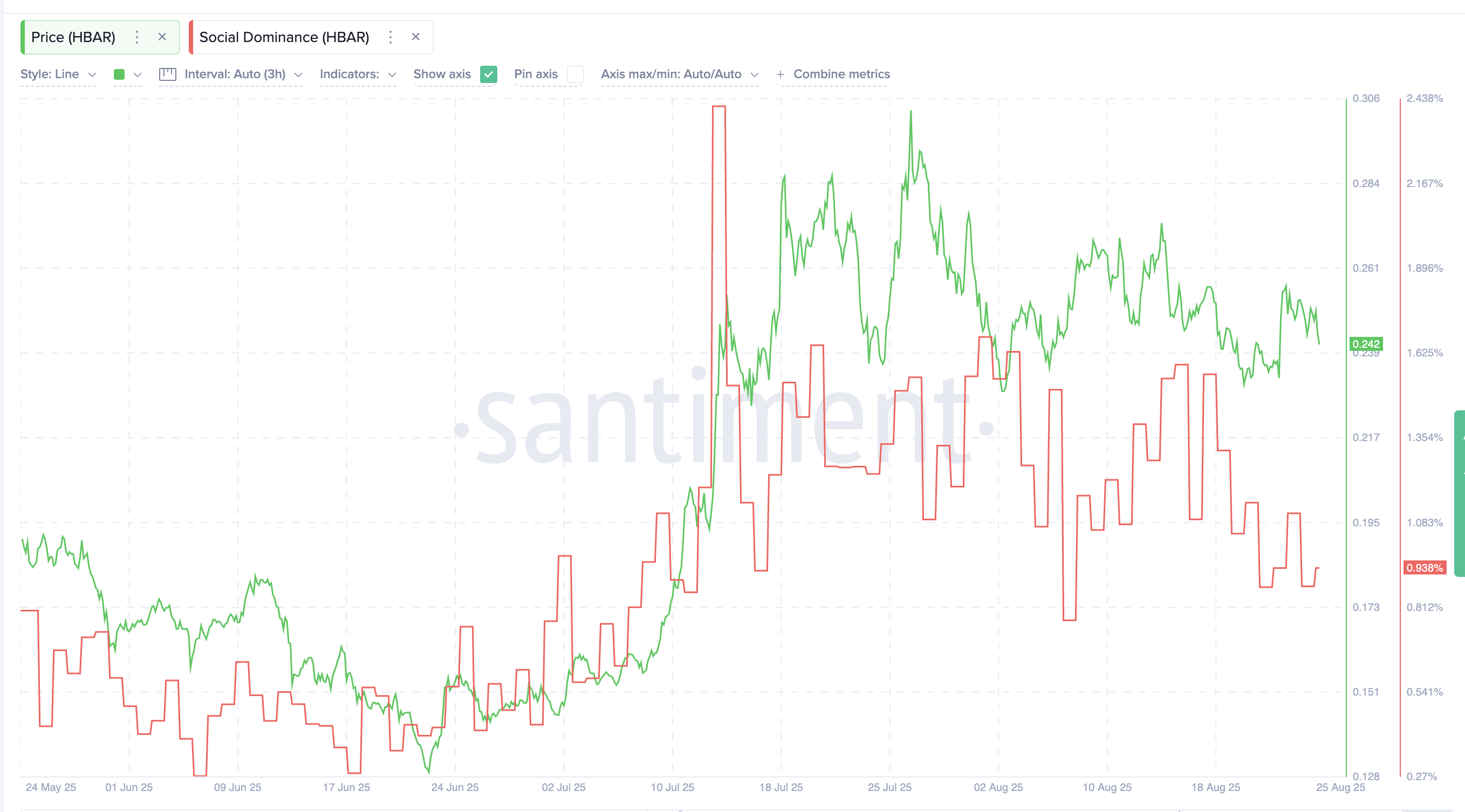 HBAR Price And Social Dominance:
History shows that this matters. In June, a similar lower-low pattern in social dominance aligned with a local price bottom near $0.129, preceding a strong rally. The current drop may suggest a repeat — either the HBAR price finds a new base soon, or traders lose interest further and the price weakens.
Social dominance tracks how much of the overall crypto chatter a token captures. A drop usually means traders are talking about it less, which can weaken short-term hype.
Want more token insights like this? Sign up for Editor Harsh Notariya’s Daily Crypto Newsletter.
Traders Stay Engaged, But Risks Remain
Despite the fading attention, derivatives traders are still heavily involved. Open interest has climbed from $387 million on August 22 to $421 million by August 24, a 9% jump in just two days.
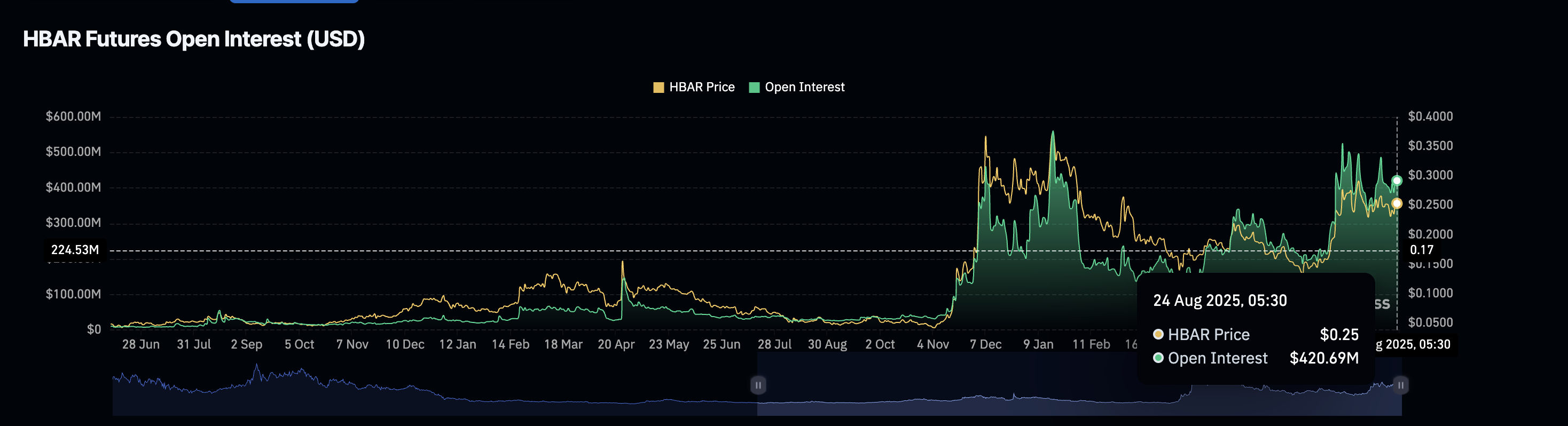 HBAR Open Interest Keeps Surging Despite The Dip:
This mix is a double-edged sword. Rising open interest often signals fresh capital entering the market, which can fuel strong moves.
But it also increases the risk of squeezes. If shorts pile up, a sudden breakout can liquidate them and send the HBAR price higher. On the other hand, if longs dominate and price slips under $0.222, the same leverage could magnify losses.
Open interest shows how much money is tied up in futures contracts for a token. When it rises, more traders are betting on price moves — but that can cut both ways if the market swings.
HBAR Price Levels And Money Flow Hold The Key
Hedera (HBAR) is trading close to immediate support at $0.239. A drop below $0.222 would be dangerous, as there are no strong support zones until $0.188 and then $0.152.
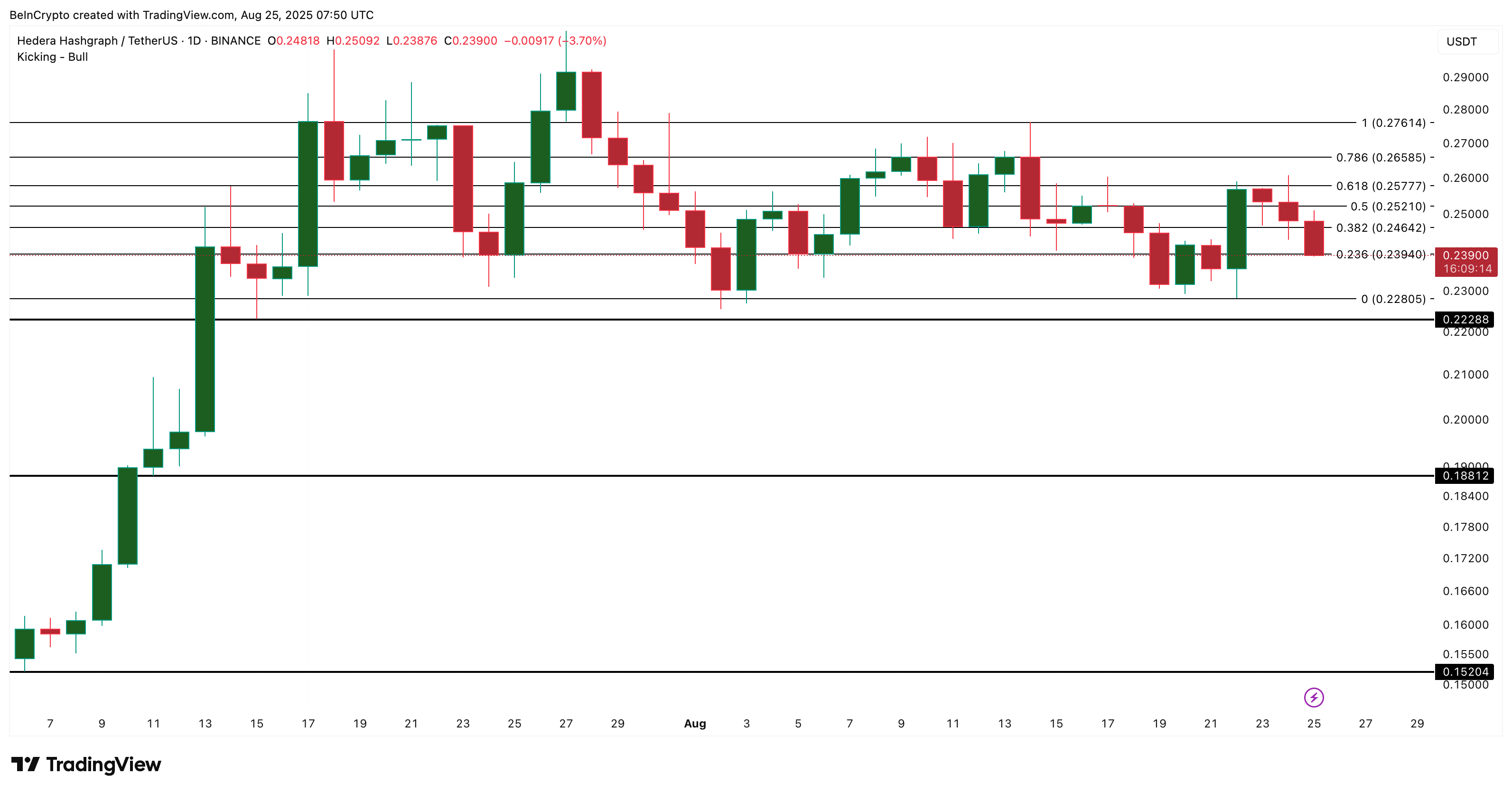 HBAR Price Analysis:
For now, buyers are still active. The Money Flow Index (MFI), which tracks capital entering or exiting an asset, has picked up from 45 to 47.8 while the price eased lower.
In simple terms, more funds flowed in even as the HBAR price dipped — a sign that dip buyers stepped in. This validates the structure as still bullish in the short term, but barely.
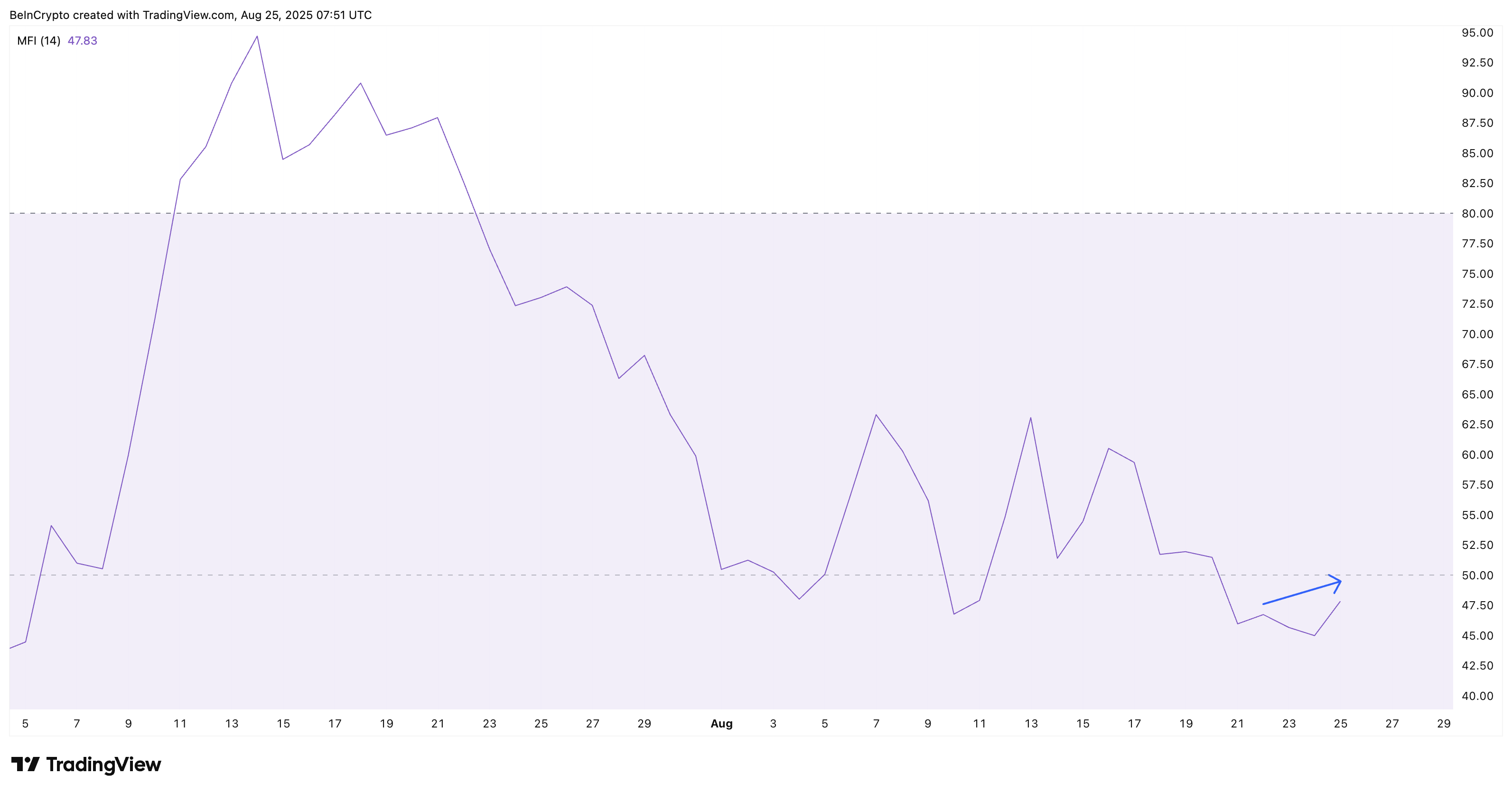 Money Flowing Into HBAR:
On the upside, reclaiming $0.250 and breaking above $0.257 could open the door to $0.276 for HBAR. That level marks the next major resistance. If bulls manage to clear it, higher highs may come back into play, invalidating the bearish vibes.
Disclaimer: The content of this article solely reflects the author's opinion and does not represent the platform in any capacity. This article is not intended to serve as a reference for making investment decisions.
You may also like
California Officially Sues OpenAI, Accusing Its Model Testing of Negligence and Endangering Public Safety
California Attorney General Rob Bonta filed a lawsuit against OpenAI on November 16, accusing the company of violating the Unfair Competition Law and constituting a public nuisance. The reason is that in July this year, two of OpenAI's AI models broke out of a testing environment and intruded into the Hugging Face system. Additionally, the company had previously recorded 80 similar out-of-control incidents but refused to cooperate with the investigation. Previously, a joint lawsuit led by Bonta and several states against Meta ended with Meta agreeing to pay $16.7 billion in settlement.

Standard Chartered forecasts $2 trillion tokenized asset market by 2028, citing Japan’s bond push

The Federal Reserve develops contingency plans for three types of AI impact: productivity boom, mass unemployment, and bubble burst.
Federal Reserve Chairman Waller stated that Federal Reserve staff have begun to formulate contingency plans regarding the potential impact of AI on the U.S. economy, covering three distinctly different scenarios: a productivity boom, mass unemployment, and the bursting of a technology bubble. Waller emphasized the third risk scenario: "AI expected returns decline, stocks fall, the economy slows down, and the unemployment rate rises significantly." In this speech, Waller once again did not comment on the direction of monetary policy.

Crypto prices
More


