
Google Play to Enforce Licensing Rules for Crypto Wallet Providers in US, EU and Beyond

Google Play is tightening oversight on cryptocurrency wallet providers, with a new policy requiring licensing and compliance with “industry standards” in more than 15 jurisdictions — including the United States and European Union.
Google Play is tightening oversight on cryptocurrency wallet providers, with a new policy requiring licensing and compliance with “industry standards” in more than 15 jurisdictions — including the United States and European Union.
The updated rules , which take effect on October 29, will not apply to non-custodial wallets.
Under the revised framework, developers operating in the US must register with local regulators as either a money services business or a money transmitter. EU-based providers will need to secure registration as a crypto-asset service provider (CASP).
In the US, firms registered with the Financial Crimes Enforcement Network (FinCEN) are subject to strict obligations, such as implementing a written Anti-Money Laundering (AML) program. These requirements could pave the way for expanded Know Your Customer (KYC) checks and other compliance measures across the industry.
 Source:
Google
Responding to criticism from the crypto community, Google clarified via X that non-custodial wallets remain outside the scope of its Cryptocurrency Exchanges and Software Wallets Policy. The company added that it is updating its Help Center to reflect this exemption.
Google Play’s relationship with the crypto sector has been turbulent. In 2018, it banned crypto mining apps; in 2020, it removed the Bitcoin Blast game and delisted crypto news apps from outlets like Cointelegraph and Coindesk without explanation. The platform also barred eight so-called “deceptive” crypto apps in 2021, accusing them of tricking users into paying for a fraudulent cloud service.
In 2023, Google shifted course slightly, allowing non-fungible token (NFT) games under certain conditions, including mandatory disclosure of NFT features, a ban on gambling mechanics, and the removal of “loot box” systems that deliver random rewards.
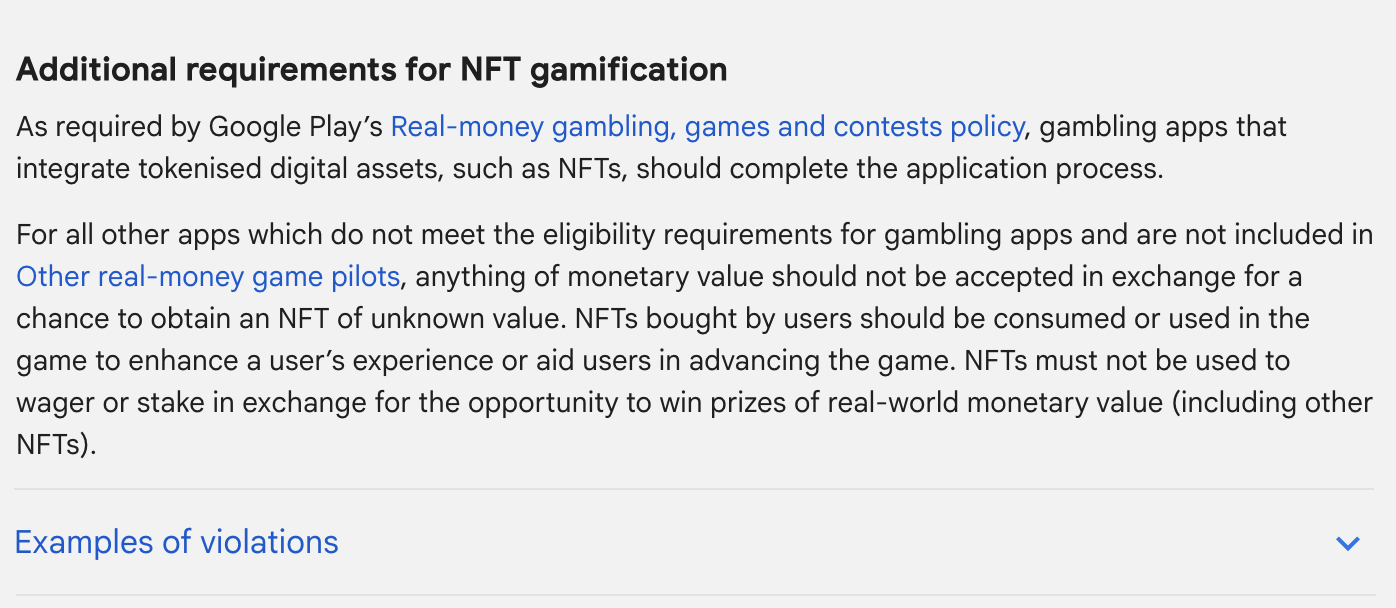
According to Google Play’s blockchain content guidelines, four categories of applications currently face heightened scrutiny: cryptocurrency exchanges and software wallets, crypto wallets, tokenized digital asset distribution platforms, and NFT gamification apps.
Notably, Google uncovers new malware ‘LOSTKEYS’ used by russian-backed coldriver group in sophisticated attacks targeting high-profile Western individuals and organizations.
Disclaimer: The content of this article solely reflects the author's opinion and does not represent the platform in any capacity. This article is not intended to serve as a reference for making investment decisions.
You may also like
Report: Samsung's storage capacity is nearly sold out for the next three years, clients rush to secure long-term contracts until 2031
According to media reports, most of Samsung Electronics' memory manufacturing capacity for the period from 2027 to 2029 has already been secured through contracts. Some customers are even seeking to extend long-term supply agreements until 2031. Currently, leading memory manufacturers can only meet about 60% to 70% of client demand, and the supply shortage may intensify further in 2027.

Anthropic commits to about $900 billion in computing power expenditure; bond market expects its bonds to be junk-rated
Despite Anthropic raising over $100 billion in its public offering and reaching a market capitalization of $1.18 trillion, the company is widely expected by the debt market to be rated as BB-level "junk bonds" due to its lack of profitability and approximately $900 billion in massive computing power expenditure commitments. Amid pressure on tech giants in the debt market and chip companies planning to reduce loan guarantees, Anthropic will still need to rely on structured financing in the short term, facing about a three-year window to strive for an investment-grade rating.
JPMorgan Trading Desk Abandons Tactical Bullish Stance on S&P 500: Rebound May Occur, Bottom Not Yet Reached
J.P. Morgan's trading division has shifted from a tactical bullish stance to a cautious one, expecting stock market volatility in the coming weeks, but emphasizes that market fundamentals—from the economy to earnings—remain solid.

AI sell-off brings a "fat pitch"? Hedge funds "give up" and clear positions, Morgan Stanley loudly calls to buy
Hedge funds have shifted to a net bearish stance on momentum stocks, abandoning bets for the first time since April 2025 that recently outperforming stocks will continue to rise.

Crypto prices
More


