
ChatGPT-5 Disappoints: OpenAI's New AI Model Does Not Suit Everyone

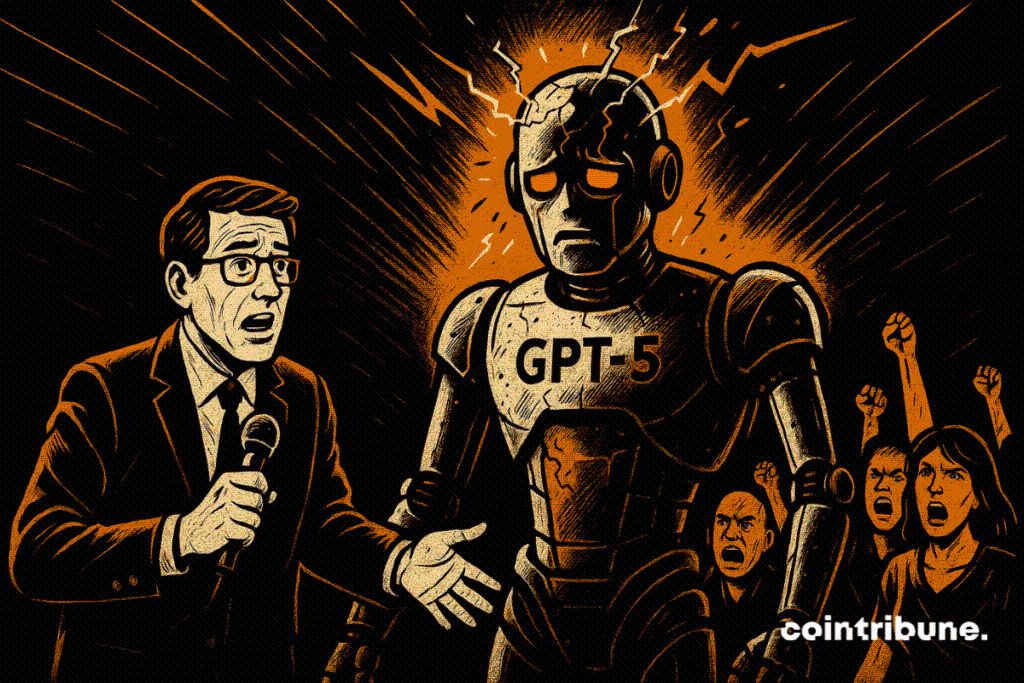
The highly anticipated launch of ChatGPT-5 turned into a disaster on social media. Presented by Sam Altman as the smartest AI ever created, the new model is accused by a large portion of users of degrading the experience compared to its predecessors. This backlash breaks out as rivals like DeepSeek quickly gain ground. Did Sam Altman offer a dream… for a harsh awakening?
In brief
- OpenAI faces an unprecedented wave of criticism for ChatGPT-5, considered less efficient than its predecessors.
- Users complain about restrictive rate limits and the inability to revert to older models.
- DeepSeek and other open AI platforms are nibbling away at OpenAI’s market share.
- Sam Altman promises adjustments amid the outcry, notably doubling rate limits.
Launch euphoria gives way to disappointment
This Thursday, Sam Altman grandly presented ChatGPT-5, promising a “major upgrade” and a “significant step” towards general artificial intelligence.
Yet, barely 48 hours later, Reddit and social networks were ablaze with criticism. The complaints pile up : stricter rate limits, inability to revert to older models, responses deemed “generic” and “sanitized.”
One user bitterly sums up the mood : “They turned it into a beige corporate zombie who completely forgot it was your best friend two days ago.“
Under pressure, Altman urgently reacted on X, announcing a doubling of rate limits for Plus subscribers. A conciliatory gesture that nevertheless raises a question: how could a company valued at 157 billion dollars have so underestimated the reception of its flagship product?
Beyond the incident, it is the growing gap between marketing promises and users’ real expectations that is striking.
Used to the spectacular advances of previous updates, many consider GPT-5’s improvements too limited. This perception fuels the idea of a clear slowdown in innovation, suggesting that the technological progress curve now reaches a plateau.
The open source AI revolution threatens OpenAI’s hegemony
User dissatisfaction arises at the worst possible moment for OpenAI. Sam Altman’s firm faces fierce competition from open source platforms that are stealing market share.
DeepSeek , a Chinese AI company, symbolizes this offensive. Its R1-0528 model now matches OpenAI-o3’s performance on benchmark tests.
The numbers speak for themselves: 75 million downloads for the DeepSeek app since January. A meteoric success that reflects massive demand for transparent alternatives to proprietary “black boxes.” These users avoid the restrictions imposed by tech giants.
Ironically, OpenAI, which once carried the banner of openness – as its name suggests – now finds itself challenged on this ground by actors more faithful to this original philosophy.
This phenomenon is part of a broader movement: the rapid democratization of AI. Technical barriers are falling, tools are multiplying, and new entrants disrupt a market that seemed locked.
Meanwhile, the European Union tightens its AI Act , imposing transparency, traceability, and respect for copyright to generalist AIs like ChatGPT. An evolution that could paradoxically benefit open source actors, naturally better aligned with these requirements.
Thus, the GPT-5 controversy could mark a strategic turning point. Between disillusioned users, more agile competition, and an increasingly restrictive regulatory environment, OpenAI stakes a lot. The question remains whether the GPT-5 fiasco is just a setback… or the harbinger of the end of ChatGPT’s golden age.
Disclaimer: The content of this article solely reflects the author's opinion and does not represent the platform in any capacity. This article is not intended to serve as a reference for making investment decisions.
You may also like
The script at the end of 2018: The Federal Reserve continued to raise interest rates, US stocks plunged 20% from the September highs, forcing the Federal Reserve to "pivot" in January.
Goldman Sachs' head of trading believes the current US stock market is repeating the scenario of late 2018, with monetary tightening and equity market pressure. The Goldman Sachs Financial Conditions Index has tightened by about 8 points in two weeks, reaching the highest level in a year. The selloff has broadened from tech stocks to defensive sectors. Gold and equities are declining simultaneously, possibly indicating investors are selling assets to raise cash, making gold a key indicator for observing liquidity stress.

Goldman Sachs Trader “Revisits the 2018 Playbook”: Still Clearly Remembers “On December 24th, Clients Asked Why the Market Dropped So Much—And I Had No Idea”
Brian Garrett pointed out that the current adjustment in the US stock market is similar to the sharp decline in Q4 2018: the S&P 500 has already experienced 42% of the corresponding drop, and the VIX is approaching its peak just before Christmas. If history repeats itself, the bottom of this cycle may appear in January next year. However, the credit market and Federal Reserve policy have yet to provide clear signals of a bottom.
Anthropic (ANT.US) nearly “broke issue price,” but Claude knocks on the doors of “the highest peak in mathematics”! 17 million lines of Lean code used to write a candidate proof for the Riemann Hypothesis
On November 20th, Eastern Time, on its second day of trading, Anthropic's intraday price dropped to a low of $83.05, just 5 cents above the offering price of $83, and finally closed at $88.91, a decline of 8.50%. On the same day, the company's mathematician Levant Alperg announced on his personal website that he and Claude had found a candidate proof for the Riemann hypothesis, which has puzzled the mathematics community for 167 years, and released about 17 million lines of Lean formalized code.

As US stocks plummet, the parent company of GTA 6 rises against the market! First-day sales hit a record $3.79 billion; Wall Street shifts focus to next-generation GTA Online.
According to Rentrak data, the global box office of "Grand Theft Auto VI" has also surpassed that of "Avengers: Endgame," the highest-grossing film of all time, which has a global box office of approximately $2.94 billion.

Crypto prices
More


