
Billionaire Bill Gross says GameStop now trades more like Bitcoin than a meme stock
Key Takeaways
- GameStop isn’t the meme it used to be, according to billionaire Bill Gross.
- The company recently purchased 4,710 BTC, and its stock price has begun to mirror Bitcoin's price movements.
Legendary investor Bill Gross said GameStop (GME) is shedding its meme stock roots and now “mimics Bitcoin.”
The “Bond King” recently told Business Insider that GameStop is “much less volatile” and no longer behaves like a meme stock, though he still considers it “a good candidate for option selling.”
According to Gross, GameStop has moved in a pattern similar to Bitcoin. The stock rose in late 2024, dipped in spring 2025, and then rebounded in May.
It has traded between $20 and $35 over the past 12 months, a stark contrast to its wild swings from $1 in the summer of 2020 to an intraday peak of $121 in January 2021.
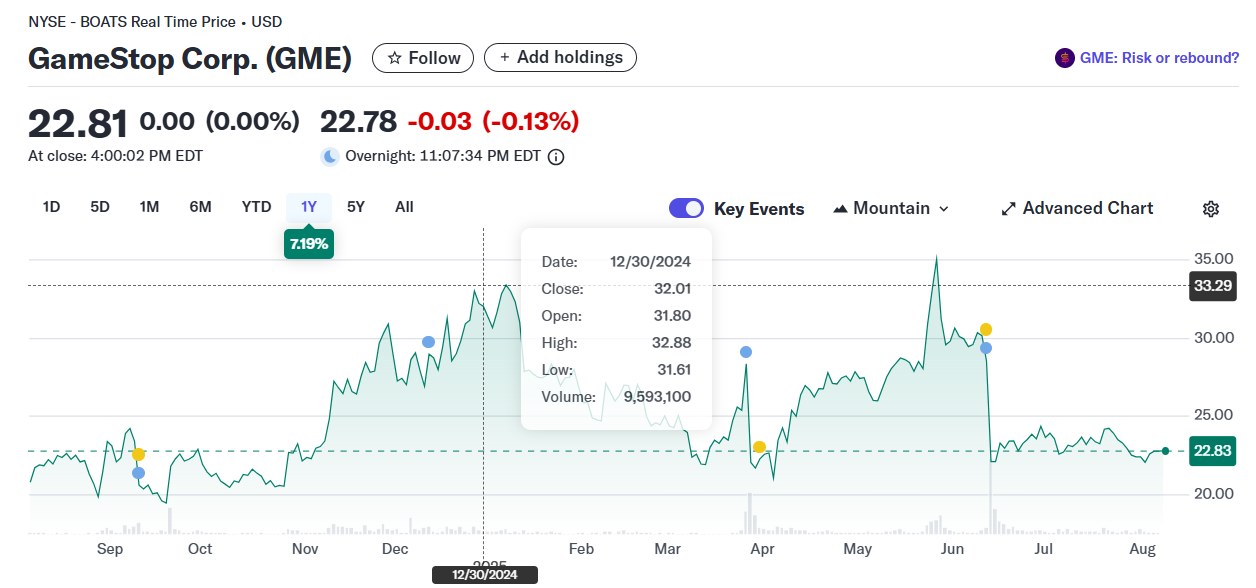
GameStop reached a 12-month high above $35 in May, just one day before the company revealed its first Bitcoin purchase . GameStop’s 4,710 BTC stash is now valued at around $539 million.
The stock has since declined; it closed at approximately $23 on Wednesday, down 27% year-to-date, per Yahoo Finance data .
Gross said he’s steering clear of new meme stocks like American Eagle, despite profiting from shorting GameStop and AMC during the 2021 trading frenzy. American Eagle recently gained meme stock status after a Sydney Sweeney ad campaign fueled retail buzz.
He noted that retail traders are focusing on tech giants Microsoft and Meta, which are up 30% and 25% this year, respectively, due to artificial intelligence enthusiasm.
GameStop plans more Bitcoin investments and may accept crypto for trading cards
GameStop, holding over $9 billion in cash and marketable securities, intends to continue investing in Bitcoin and other digital assets.
However, unlike Strategy, formerly known as MicroStrategy, the largest corporate holder of Bitcoin, and others, the video game retailer is following its own playbook .
CEO Ryan Cohen said previously that the company would be selectively engaging when the risk-reward balance is favorable. Cohen also discussed the potential for accepting crypto payments for trading cards, dependent on customer interest.
Disclaimer: The content of this article solely reflects the author's opinion and does not represent the platform in any capacity. This article is not intended to serve as a reference for making investment decisions.
You may also like
Zoom (ZM.US) gets a bullish rating from Citi ahead of earnings: AI monetization signals emerge, target price raised to $131
Citibank has issued a forecast ahead of Zoom's Q3 financial report: Two major signals from channel partner surveys and Analyst Day both reinforce its view of a "moderate acceleration in the second half of the year."

JPMorgan: The CUDA moat is crumbling, and Nvidia faces real challenges beyond the CEO's departure
JPMorgan points out that Nvidia’s share in the 2026 compute protocol will drop to just 28%, with strong competition emerging from AMD, Google TPU, and others. Meanwhile, CUDA’s moat was breached by AI in only three days. The open-source market is facing tightened regulation and increased risks of export compliance. Although Nvidia’s current valuation remains attractive, both major drivers supporting high growth expectations have been undermined.
Bridgewater's $23 Billion Portfolio Reshuffle: Drops Google (GOOGL.US) and Amazon (AMZN.US), Increases Holdings in AI Hardware and Energy
Bridgewater's Q3 portfolio was restructured, with a total market value of $23 billion. The fund significantly increased holdings in AI hardware and energy stocks such as Qualcomm and Micron, reduced positions in Google, Amazon, and S&P 500 ETF, and fully exited industrial stocks like Union Pacific, with a notable increase in the weighting of the healthcare sector.

Crypto prices
More


