
Solana Treasuries Are Growing, But Price Drops Take a Toll

Solana’s corporate treasury market is growing rapidly but is still small compared to Bitcoin and Ethereum. Upexi, a leading firm, aggressively expanded its holdings, only to face a significant loss due to a price drop. Despite the risks, these early investors could position themselves well if Solana rebounds.
CoinGecko released a report on Solana treasury firms, yielding several important insights. The sector is much less crowded than corporate Bitcoin and Ethereum investors, but interest is rapidly growing.
However, Solana’s price has been more volatile. In July, its largest corporate holder lost $.09 million on this investment. So far, a handful of companies have exhibited a race to outdo each other, establishing a firm head start.
Corporate Solana Treasuries
In the race for corporate crypto acquisition, Bitcoin is the most popular asset, but other tokens are becoming more prominent. Earlier this week, two new standouts became clear: Ethereum and Solana are the most popular altcoins for private treasury firms.
According to a report from CoinGecko, the rate of corporate SOL acquisition is increasing dramatically.
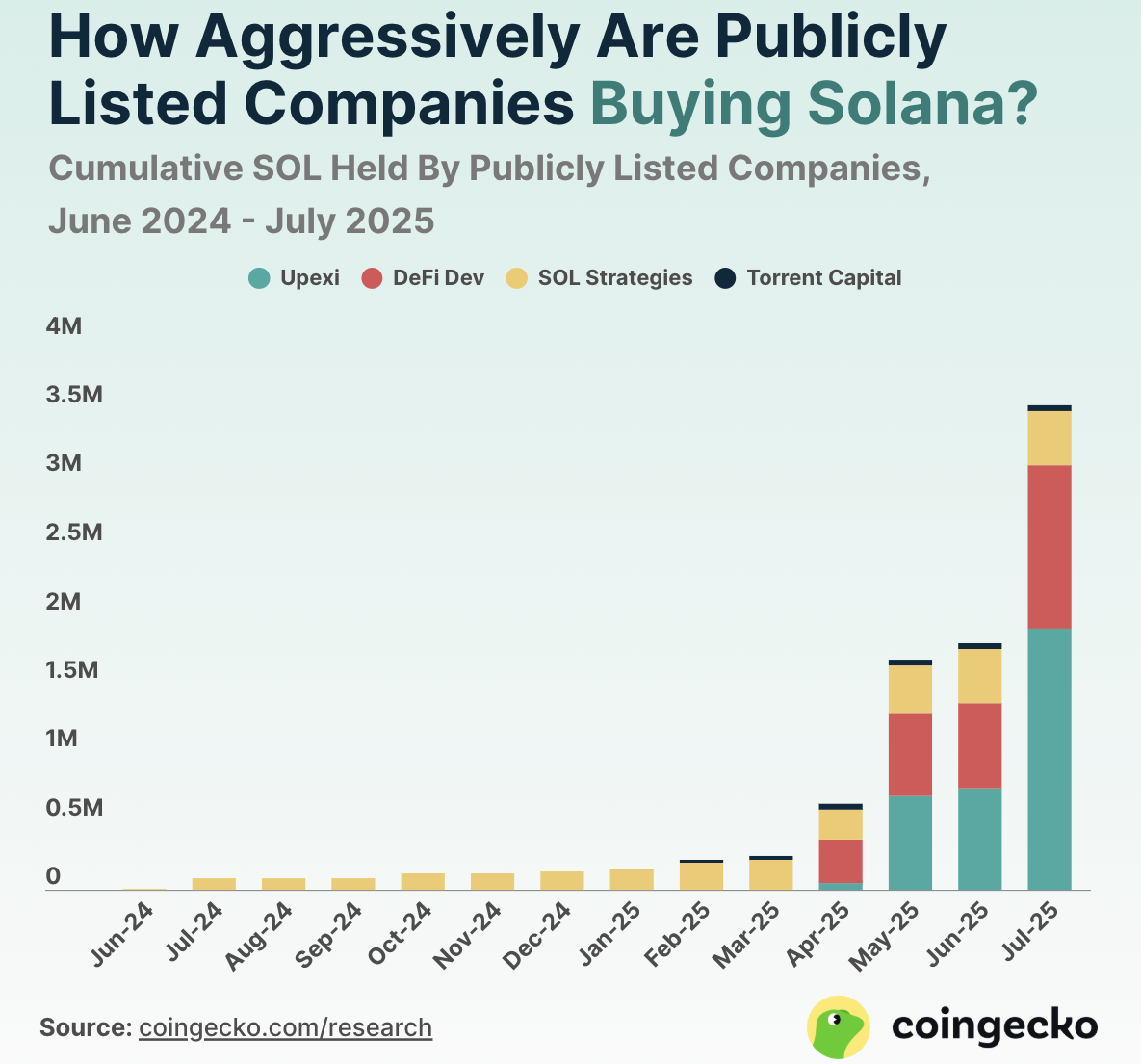 Corporate Solana Purchases. Source:
CoinGecko
As this data shows, newcomers have repeatedly disrupted this market sector. SOL Strategies is by far the oldest player in this space, making substantial investments before this tactic was on anyone’s radar.
By April 2025, however, DeFi Development rebranded to become a Solana treasury firm, immediately surpassing the other company’s consumption.
Taking the moniker of ‘Solana’s MicroStrategy’, DeFi Development’s purchases have been accelerating.
Meanwhile, Upexi started small with its own Solana treasury, but supercharged its spending in July. The firm currently holds 1.9 million SOL, towering above DeFi Development’s 1.1 million.
Solana’s Volatility Remains a Challenge
Clearly, the Solana treasury market is defined by fierce competition, but it remains quite small. There are only four serious stockpilers, and Torrent Capital holds only 40,000 SOL.
This begs a simple question: are these Solana buys a good investment? Prices have fallen considerably since late July, and it’s unclear when a rebound might happen.
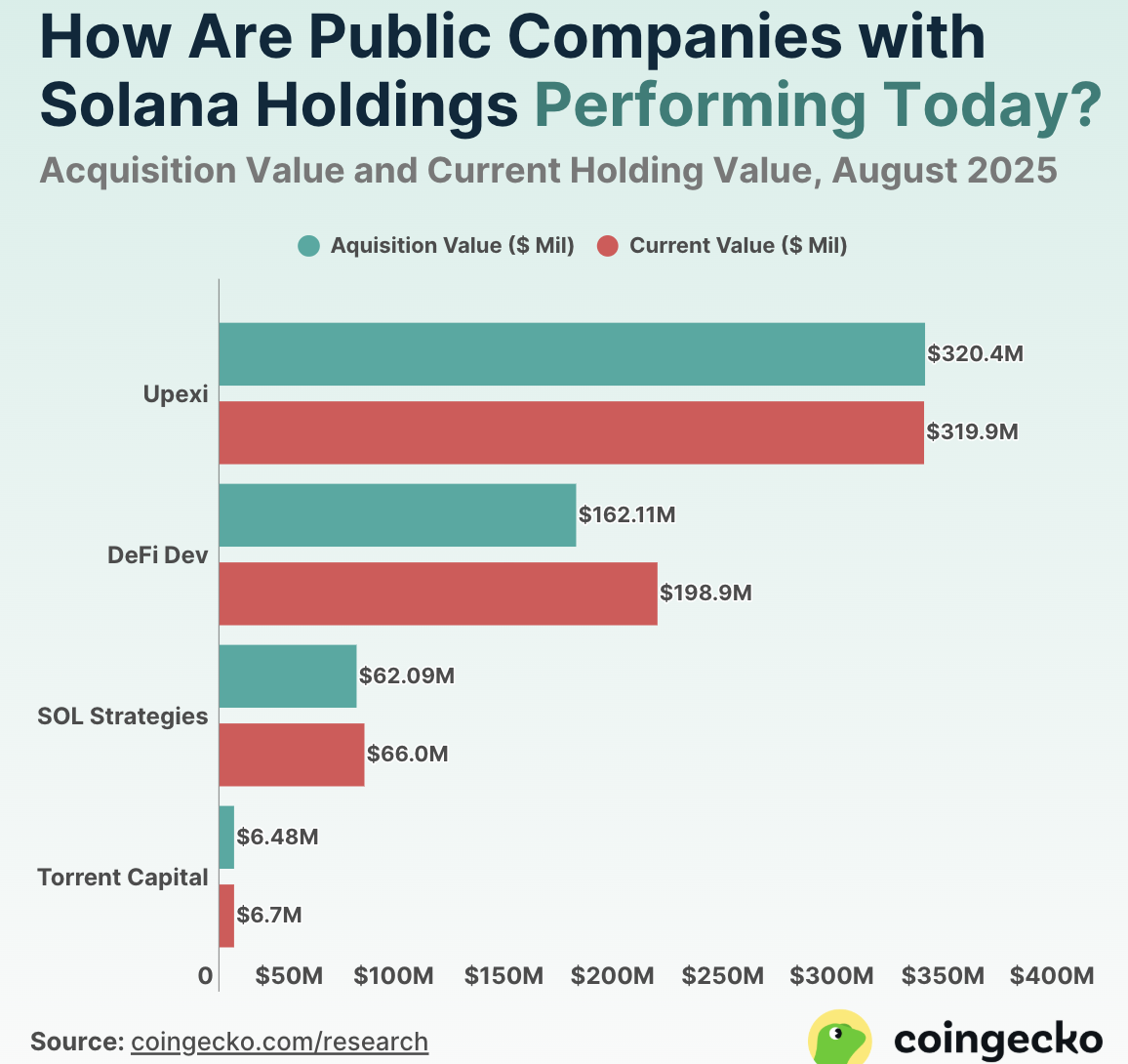 Solana Treasury Firms’ Performance Metrics. Source:
CoinGecko
So far, Upexi’s aggressive expansions have come at a cost. By stockpiling so much Solana directly before a downturn, the firm actually lost around $0.9 million.
The other companies performed better, but nothing like MicroStrategy’s wild returns. BTC treasury investors frequently expect a stellar performance, but Solana isn’t there yet.
These metrics have provided some valuable information about Solana as a potential treasury asset. Ethereum has returned a better performance, but there’s no shortage of corporate investors.
Meanwhile, these SOL maximalists have a commanding head start in a tiny market. If Solana jumps back up soon, these firms could become trendsetters.
Disclaimer: The content of this article solely reflects the author's opinion and does not represent the platform in any capacity. This article is not intended to serve as a reference for making investment decisions.
You may also like
Warner Music (WMG.US) Q4 Conference Call: Suno Sets Precedent for Generative AI Paid Model, AI Licensing Expected to Contribute Significant Revenue by 2027
Warner Music (WMG.US) reported Q4 revenue of $2.001 billion, setting a quarterly record, with subscription streaming up 15% year-on-year; Suno became the first generative AI company to pay copyright holders, and AI licensing is expected to contribute substantial revenue in fiscal year 2027.
Current market focus: Is AI capital expenditure "peaking" or undergoing a "mid-term correction"?
Jefferies believes that the market has priced in a "peak" scenario, but there is no "real-world evidence" to support this judgment: Nvidia, with an off-balance-sheet exposure of $330 billion, acts as the "central bank" of the AI ecosystem, and a shift in governance could tighten the financing chain; the net profits of the four major cloud providers grew by 73%, but only by 15% after excluding non-cash AI-related gains; new chip export regulations in Southeast Asia have further raised the threshold for cross-border expansion of computing power.

Anthropic adds another victory in listing, Nasdaq (NDAQ.US) further distances itself from the New York Stock Exchange
Anthropic's listing further consolidates Nasdaq's leading position over its rival, the New York Stock Exchange.
On Anthropic's first day of listing, retail trading volume hit a record high, but nearly half of the trades were sells!
On its first day of listing, Anthropic saw a total retail trading volume of $772 million, setting a new historical high. However, nearly half of the transactions were sell orders, with net buying amounting to only $60 million, far below the expected $250 million. Dragged down by the overall market decline, a high proportion of retail profit-taking, and funds diverted in advance to crypto perpetual contracts, the stock opened high but closed lower. Going forward, it still faces potential selling pressure from a significant amount of low-priced retail holdings.
Crypto prices
More


