
Stablecoins No Match for Visa and Mastercard’s Dominance

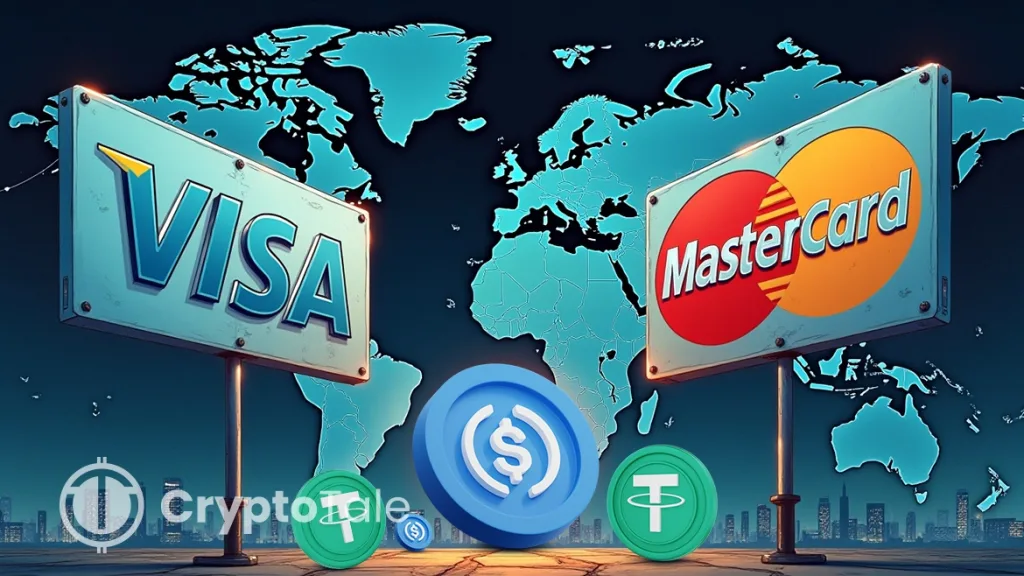
- Visa and Mastercard report that stablecoins still lack real-world payment utility and trust.
- Around 90% of stablecoin volume is tied to crypto trading, not consumer or retail spending.
- Despite crypto growth, card giants lead with $15T volume and strong fraud protection systems.
Visa and Mastercard have declared that stablecoin payments do not threaten their dominance in the global payments industry. This comes amid a significant rise in crypto adoption during 2025. Visa processed $15 trillion in transactions over the year. That figure remains far ahead of the entire stablecoin market, which is still considered niche.
According to Reuters, both companies said most stablecoin usage is limited to crypto trading. Around 90% of stablecoin volume flows through digital asset exchanges. They are often used for value storage or crypto speculation, not for day-to-day purchases. This restricts their role in the broader financial system.
Card Giants Lean on Strength, Scale, and Stability
Visa and Mastercard continue to rely on proven strengths. These include consistent performance, global reach, and strong security standards. Both networks offer predictable outcomes, unlike the still-developing stablecoin ecosystem. Fraud protection remains a key advantage traditional networks provide.
Financial results also support the card companies’ strong position.LSEG data shows Visa reported an 8% rise in quarterly earnings, reaching $5.3 billion. Mastercard posted a 14% increase, with profits totaling $3.7 billion.
Mastercard and Visa handle nearly 70% of U.S. consumer transactions, according to the Nilson Report. Their strong presence in the market makes it difficult for new competitors to gain traction. Previous challengers such as peer-to-peer apps failed to dent their market share.
Their stock prices reflect their continued dominance. Visa shares have climbed 31% over the past year. Mastercard’s stock rose by 24% in the same period. They currently trade at 28 and 32 times their expected earnings, respectively. Investors continue to back their long-term value.
Profits Hold, but Pressure Builds from Stablecoins
The companies remain profitable, but their fee margins are gradually shrinking. Together, they generated roughly $95 billion in swipe fees during the last fiscal year. Visa earned 6.6 cents per transaction in the recent quarter, a drop from nearly 9 cents ten years ago. Mastercard averaged 7.3 cents over the past year, marking a slight year-over-year decline.
Company executives acknowledged the advanced technology behind stablecoins. However, they emphasized that stablecoins lack scale and infrastructure. They also lack the fraud safeguards and consumer trust needed for mainstream use. These gaps leave stablecoins far behind traditional payment networks.
Both companies are investing in stablecoin-related infrastructure. They aim to support future integrations between digital assets and traditional finance. This is being done in response to regulatory developments. The recently introduced GENIUS Act has brought more clarity to stablecoin frameworks.
Stablecoins are gaining traction in unstable markets. In countries facing high inflation or weak national currencies, they serve as a digital store of value. They also offer faster and cheaper remittance solutions. These use cases are growing where fiat currencies are unreliable.
Related: Mastercard Moves on Stablecoins Post-GENIUS Act
In the developed markets, adoption is slower. In this case, regulatory uncertainty and low consumer demand exist. Disadvantages such as the advent of protections are significant stumbling blocks. Card networks are still at the forefront of these environments. Their risk and compliance systems are well established, and thus they have an upper hand.
Stablecoins lure other merchants due to cheaper costs and quicker settlement. Nonetheless, the majority of these digital assets are related to the crypto industry. In contrast, Visa and Mastercard are deeply embedded in the global financial system. The vast scale of their networks continues to limit stablecoins’ ability to gain widespread adoption.
Global payments pretty much still go through Visa and Mastercard. Their networks have been tested and trusted. Stablecoins are increasing, but are already at the edge. At the moment, the giants in the payment world remain in their positions of power.
The post Stablecoins No Match for Visa and Mastercard’s Dominance appeared first on Cryptotale.
Disclaimer: The content of this article solely reflects the author's opinion and does not represent the platform in any capacity. This article is not intended to serve as a reference for making investment decisions.
You may also like
Will the traditional Christmas rally still happen in the US stock market this year?
After a simultaneous technical and position-based recovery in the US stock market, Goldman Sachs, Morgan Stanley, and JPMorgan have successively signaled a year-end rebound. Extremely light positions, mean reversion of valuations, and seasonal support together create conditions for a short squeeze. However, global manufacturing import price inflation has annualized at around 24%, surpassing the pandemic peak, and the inflation bill will come due intensively in the first quarter of next year. Goldman Sachs warns that once the year-end rally materializes, it may exhaust future upside potential.

Anthropic IPO Roadshow: CEO Says "Doesn't Care About Market Conditions", Hopes to "Underpromise and Overdeliver"
As Anthropic gears up for its IPO, CEO Amodei remains deliberately low-key during the roadshow, emphasizing "under-promise and over-deliver," and appears calm regarding market volatility at the time of listing. In response to fluctuations in the AI sector and the Nvidia situation, Amodei stated he is not particularly concerned about the specific month of listing or market conditions, and frankly admits that allocation of computing power is "the most fundamental business challenge."
SpaceX (SPCX.US) Starship's 15th Test Flight: Booster recovery failed for unknown reasons; first orbital round-trip mission still awaits upper stage "tower catch" landing
On Friday local time, SpaceX conducted its 15th Starship flight mission in Texas.

Unlike Elon Musk’s “One Price” Approach: Anthropic (ANT.US) Roadshow Pricing Inquiry at $70-78, Institutional Investors Become the True Decision Makers in IPO Pricing
Anthropic will launch what is set to be the largest IPO in history next week, aiming to take this title from SpaceX. However, unlike Elon Musk’s conglomerate, large investors will have greater influence over its IPO pricing amid the ongoing turbulence in the artificial intelligence (AI) market.
Crypto prices
More


