
Solana Stakeholders Urge SEC to Approve Liquid Staking for ETPs Amid Regulatory Uncertainty

A coalition of major players in the Solana ecosystem, including Jito Labs, VanEck, Bitwise, the Solana Foundation-backed Policy Institute, and Multicoin Capital, has formally appealed to the U.S. Securities and Exchange Commission (SEC) to permit liquid staking for Solana-based exchange-traded products (ETPs).
A coalition of major players in the Solana ecosystem, including Jito Labs, VanEck, Bitwise, the Solana Foundation-backed Policy Institute, and Multicoin Capital, has formally appealed to the U.S. Securities and Exchange Commission (SEC) to permit liquid staking for Solana-based exchange-traded products (ETPs).
Liquid staking allows investors to stake tokens while receiving a tradable derivative token in return, enabling them to participate in DeFi activities or loan markets without locking up assets. The move, advocates say, could enhance capital efficiency and improve investor access — but it comes with increased technical and financial risks.
In a joint letter to the SEC, the group argued that allowing liquid staking would reduce operational costs for ETPs and minimize tracking errors. The letter emphasized that without access to liquid staking, issuers may be forced into expensive and inefficient rebalancing during large-scale creations or redemptions of ETP shares.
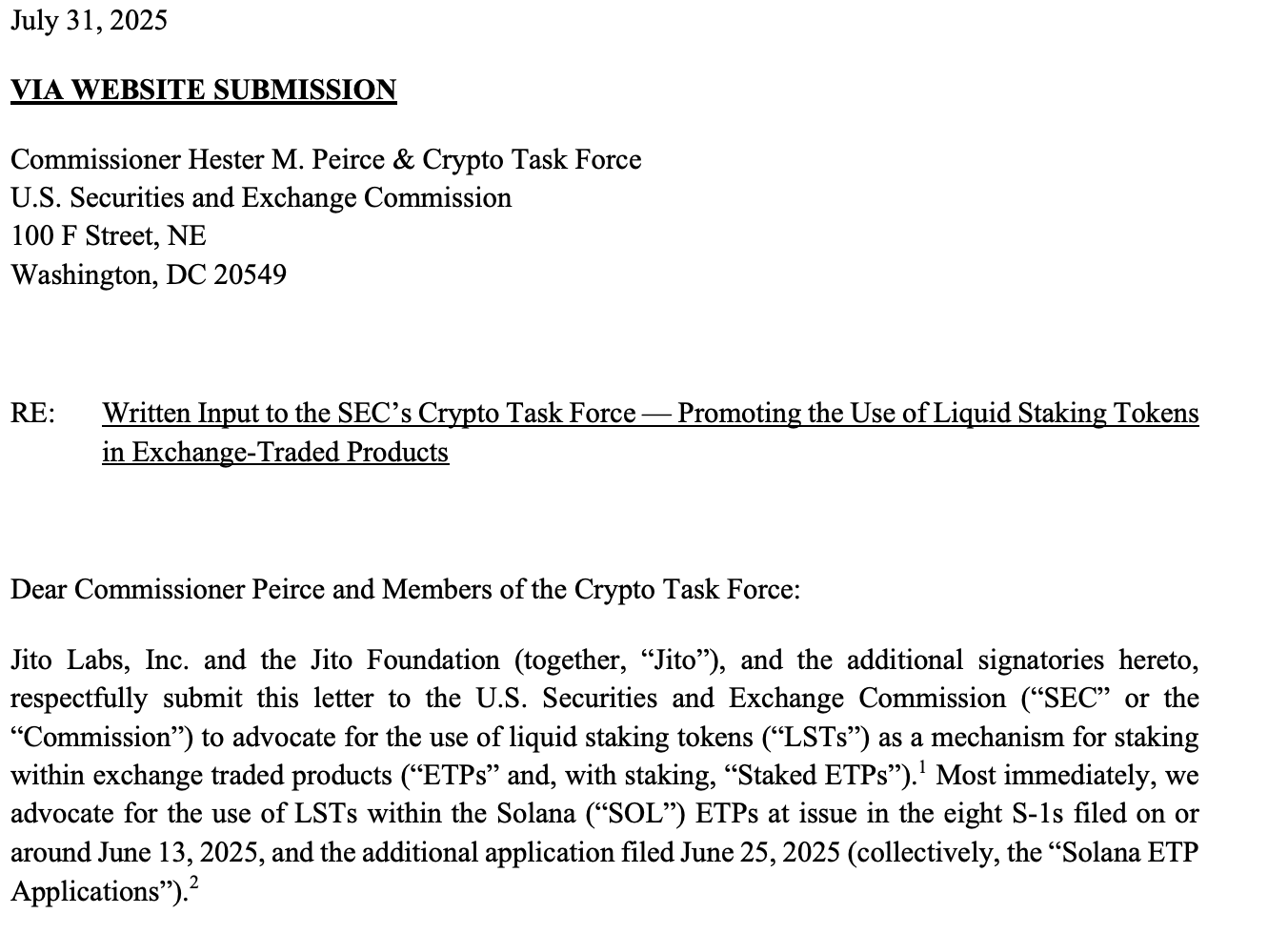 Source
: SEC
“LSTs could be used to rebalance quickly in that scenario and could even be delivered or received in-kind by [authorized participants]…”
the letter stated.
Supporters also claim the addition of liquid staking could bolster network security, expand product offerings for investors, and generate more revenue opportunities for ETP issuers. As of now, at least nine Solana ETP applications are pending with the SEC.
However, the letter notably omits discussion of key risks tied to liquid staking, such as smart contract vulnerabilities, slashing events, and potential depegging of derivative tokens — risks the SEC may scrutinize in its ongoing evaluation.
The SEC has not issued formal guidance on liquid staking, although it has suggested that traditional staking mechanisms directly tied to consensus may not always qualify as securities offerings. The U.S. SEC also expressed significant compliance concerns regarding proposed ETFs based on Ethereum (ETH) and Solana according to a recent report by Decrypt.
Solana isn’t the only network in focus. Ether ETF issuers are also pushing for staking capabilities. Notably, Nasdaq filed an application on July 17 to enable staking in BlackRock’s iShares Ether ETF — following a similar move for Grayscale earlier this year.
Disclaimer: The content of this article solely reflects the author's opinion and does not represent the platform in any capacity. This article is not intended to serve as a reference for making investment decisions.
You may also like
AI: "Bull Market Continuation" or "Bubble Burst"? This week, the Anthropic IPO is a crucial litmus test
As the first independently listed, cutting-edge AI company in the United States, its valuation will directly impact the $895 billion capital expenditure logic of cloud giants such as Google, Amazon, and Microsoft. Dan Ives believes that if Anthropic’s IPO valuation stabilizes at $1.25 trillion to $1.4 trillion or even higher, accompanied by strong stock performance, it will directly provide powerful endorsement for the entire AI investment chain.

Wrong bet again after liquidation? Before the major drop in October, Situational Awareness leveraged full positions to re-enter AI stocks
Situational Awareness is once again betting on artificial intelligence before the stock market crash in October.

After the NVIDIA "earthquake," Altman was the first to speak out: AI demand remains strong, don't panic.
Sam Altman, CEO of OpenAI, stated that he believes the AI industry can withstand the impact despite the uncertainty caused by the departure of Nvidia's former CEO Jensen Huang last week.
Tiger Global Q3 Holdings: Significantly Increased Nvidia, Reduced Google and TSMC, Nearly Liquidated Spotify
Tiger Global Management LLC submitted its third-quarter holdings report (13F) as of September 30, 2026, on November 16.
Crypto prices
More


