
DeFi Summer Returns? IMF Embraces Crypto and More

DeFi's TVL returns to pre-Terra levels, the IMF acknowledges cryptocurrencies in national wealth accounts, and Visa broadens stablecoin support as institutional adoption grows.
Welcome to the Asia Pacific Morning Brief—your essential digest of overnight crypto developments shaping regional markets and global sentiment. Grab a green tea and watch this space.
DeFi TVL hits pre-Terra levels while IMF formally recognizes crypto in national accounts. Visa expands stablecoin support across multiple blockchains as institutional adoption accelerates amid growing regulatory clarity worldwide.
DeFi Summer Back? TVL Hits Pre-Terra Levels
DeFi total value locked reached $138 billion, matching pre-Terra collapse highs. The sector briefly exceeded $140 billion during the July 28-30 trading sessions. This marks the highest TVL since May 2022’s UST-LUNA crisis.
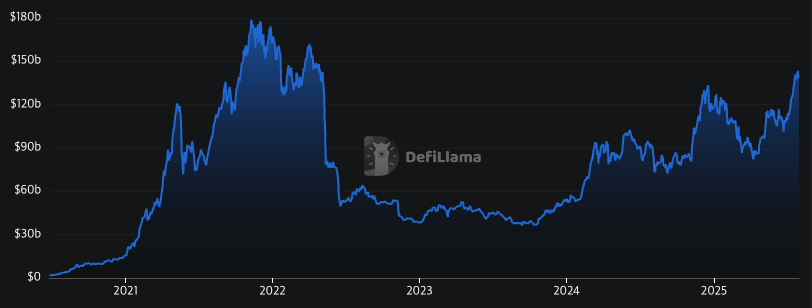 DeFi total value locked reached $138 billion, matching pre-Terra collapse highs. Source:
DefiLlama
Lending and staking services drove the recovery across major protocols. AAVE leads with $34.405 billion in locked assets for lending operations. Lido follows closely at $33.619 billion in liquid staking services.
EigenLayer rounds out top three with $18.029 billion in restaking protocols. Whether this signals a sustained DeFi revival remains uncertain. Market observers question if momentum can surpass 2020’s original summer.
IMF Embraces Crypto in National Accounts
The International Monetary Fund softened its stance on digital assets this week. Global regulators updated national wealth measurement standards to include Bitcoin and cryptocurrencies. The revised System of National Accounts now classifies crypto as “non-produced nonfinancial assets.”
Countries will report crypto holdings on national balance sheets starting 2029-30. These assets remain excluded from GDP calculations but gain formal recognition. The change reflects growing adoption and potential financial stability implications.
El Salvador benefits significantly from this policy shift amid ongoing IMF negotiations. The country’s 6,000+ Bitcoin holdings will now appear in official wealth statistics. This development marks a pragmatic turn in institutional acceptance of digital assets.
The framework modernizes economic data collection for the digital age. New guidelines also cover artificial intelligence, cloud services, and digital platforms. Regulators aim to balance financial innovation with systemic stability concerns.
Visa Expands Stablecoin Support Across Multiple Blockchains
Visa added PayPal’s PYUSD, euro-backed EURC, and Global Dollar to its platform. The payment giant now supports Stellar and Avalanche blockchain networks. Users can send payments or convert stablecoins to fiat currency.
The expansion builds on existing USDC support across Ethereum and Solana. Visa has processed over $225 million in stablecoin volume since 2023. Institutional interest surged following the passage of the GENIUS stablecoin bill.
Mastercard reports 30% of transactions are already tokenized through crypto partnerships. JPMorgan and Bank of America are developing similar stablecoin infrastructure. Amazon and Walmart explore issuing proprietary stablecoins for cross-border payments.
The $256 billion stablecoin market attracts traditional finance and tech giants. Visa’s May investment in BVNK signals deeper crypto infrastructure commitment. Cross-border transactions remain expensive through legacy payment networks.
Disclaimer: The content of this article solely reflects the author's opinion and does not represent the platform in any capacity. This article is not intended to serve as a reference for making investment decisions.
You may also like
New York Federal Reserve President: Overall price increases remain too high, inflation may not reach the Fed's target level until 2028
John Williams, President of the New York Federal Reserve, stated on Monday that although some inflationary pressures in the United States have shown signs of easing, the overall rise in prices remains too high.
No more mandatory retention! Anthropic launches EFS system, allowing enterprises to take control of their own AI data
Anthropic has launched the public beta of its Enterprise Frontier Security (EFS) system, allowing corporate clients to store AI data on their own cloud platforms, with clients holding their encryption keys. Anthropic only performs automated security scans and cannot access the data itself. The system retains the 30-day data retention requirement, but control over storage is returned to enterprises, addressing strong customer backlash sparked by the mandatory retention policy implemented in June.

Report: Samsung's storage capacity is nearly sold out for the next three years, clients rush to secure long-term contracts until 2031
According to media reports, most of Samsung Electronics' memory manufacturing capacity for the period from 2027 to 2029 has already been secured through contracts. Some customers are even seeking to extend long-term supply agreements until 2031. Currently, leading memory manufacturers can only meet about 60% to 70% of client demand, and the supply shortage may intensify further in 2027.

Anthropic commits to about $900 billion in computing power expenditure; bond market expects its bonds to be junk-rated
Despite Anthropic raising over $100 billion in its public offering and reaching a market capitalization of $1.18 trillion, the company is widely expected by the debt market to be rated as BB-level "junk bonds" due to its lack of profitability and approximately $900 billion in massive computing power expenditure commitments. Amid pressure on tech giants in the debt market and chip companies planning to reduce loan guarantees, Anthropic will still need to rely on structured financing in the short term, facing about a three-year window to strive for an investment-grade rating.
Crypto prices
More


