
The BRICS Could Launch Their Currency In 2026!

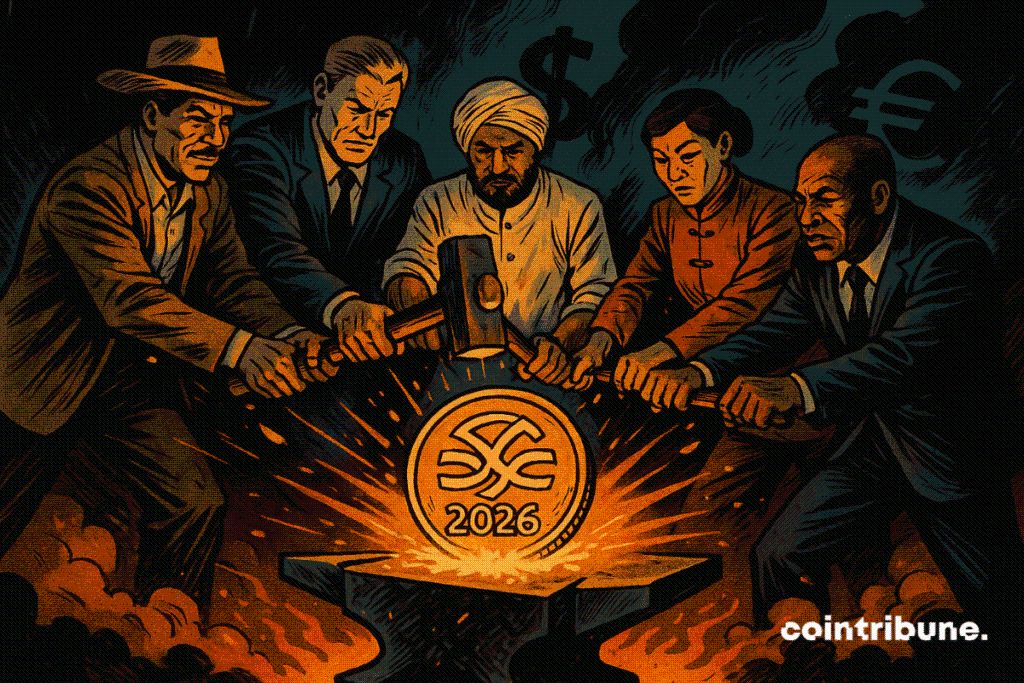
Facing the fragilization of the global monetary system and the contested dominance of the dollar, the BRICS are quietly but surely moving towards a strategic alternative: a common currency backed by sovereign digital infrastructures. Carried by a now enlarged and economically influential bloc, this initiative aims to redraw the global monetary balance. As the instability of fiat currencies worsens, the emergence of such a project calls on markets, institutions, and observers: is this a strong signal towards a new multipolar economic order?
In Brief
- The BRICS strengthen their monetary cooperation with a clear goal: to launch a common currency as early as 2026.
- At the last summit, leaders endorsed concrete advances, notably through the expansion of settlements in local currencies.
- The project relies on BRICS Pay, a digital infrastructure under development to facilitate cross-border payments.
- Pilot tests are planned before 2026 to assess system compatibility and the viability of a common currency.
The political and monetary axis is strengthening
During the 17th BRICS summit , held in early July 2025 in Brazil, leaders took a new step in their drive for monetary emancipation from the dollar. Thus, the bloc members reaffirmed their commitments to monetary cooperation and endorsed substantial advances in the expansion of trade in local currencies as well as in the development of BRICS Pay.
Although no official launch date has been set, analysts estimate that the project follows a structured multi-phase approach and that 2026-2027 is now the realistic horizon for operational implementation.
The dynamics underway within the bloc show concrete empowerment, supported by several strategic levers:
- Intensification of settlements in local currencies: Russia and China favor the ruble and yuan in their bilateral trade, while India is expanding the use of the rupee with Global South countries;
- Strengthening of the BRICS Pay project: a common payment system at the heart of the bloc’s financial sovereignty strategy;
- The declared objective of dedollarization: an active reduction of dollar use in exchanges, especially for raw materials;
- The enlargement of the bloc: this new perimeter represents 46% of the world population and 37% of global GDP, which increases the legitimacy of a monetary alternative.
These elements are no longer just diplomatic rhetoric. They reflect real coordination, reinforced by tangible economic and diplomatic facts. The bloc now expresses a clear ambition: to build an independent monetary infrastructure, on a precise timetable, and with interoperable tools already in development.
The digital infrastructure, pillar of the monetary project
Beyond the political and commercial dimensions, the BRICS currency project rests on an ambitious technological foundation. Indeed, member states “are actively building sophisticated payment systems” capable of supporting the future common digital currency.
These infrastructures notably rely on blockchain to facilitate cross-border payments and bypass traditional systems such as SWIFT. The development of BRICS Pay is at the core of this technical strategy, aiming to interconnect central banks and end users through a unified, interoperable, and resilient interface.
Research work on central bank digital currencies (CBDCs) is also being integrated into the project architecture. Thus, member countries “are making productive progress in research on integrating CBDCs”, with pilot programs planned to test key stages of the timetable by 2026.
These experiments should allow calibrating the compatibility between existing national digital currencies and a supranational monetary unit still in development. The stakes are twofold: ensure smooth multilateral settlements while guaranteeing the monetary sovereignty of each member state.
The implications of such a shift are major. A functional BRICS currency, particularly the great shift towards local currencies , could redefine global monetary correlations, influence pricing of raw materials (especially energy), and offer Global South countries a credible alternative to the dollar. However, the success of the project will depend on fine coordination between economies with divergent profiles, political stability among members, and the ability to establish trust in a monetary unit still theoretical.
Disclaimer: The content of this article solely reflects the author's opinion and does not represent the platform in any capacity. This article is not intended to serve as a reference for making investment decisions.
You may also like
On the eve of the earnings report, bearish sentiment surrounds Nvidia (NVDA.US): "Big Short" Burry holds on to put options, while Musk warns that key protocols may be lost with Jensen Huang
According to reports, "The Big Short" Michael Burry continues to hold his put options on Nvidia ahead of its earnings release on Tuesday Eastern Time, although he acknowledges that retail buying still has a chance to push the stock price higher. Meanwhile, Elon Musk has issued a warning, stating that some key supply agreements for Nvidia may be lost if Jensen Huang leaves.

As AI tech stocks face heavy losses, Walsh will join Silicon Valley leaders tonight to discuss the economic impact of AI: Can a trillion-dollar investment deliver productivity gains?
Coinciding with the sharp decline in AI tech stocks, the market is re-examining the return prospects of massive capital expenditures. Whether AI investment can ultimately translate into sustained productivity gains has become the focus.
Anthropic's Potential Supply Reaches 1.141 Billion Shares on First Day of Listing
Anthropic plans to issue 825 million shares in its IPO, combined with the unlocking of 316 million existing shares, resulting in a potential total supply of 1.141 billion shares on the first day. In addition, future financial report dates will see the release of more than 4.7 billion shares, presenting significant supply pressure.
Nvidia (NVDA.US) Compression Shock to the Blockchain: Is AI Hardware Peaking? Structural Opportunities in Crypto Emerge
Wu Blockchain discusses the controversy surrounding Jensen Huang and Nvidia's risk from strategic contraction. Didier warns that the AI hardware cycle may have peaked, with CoreWeave facing a funding shortfall of billions; Minta highlights opportunities in software and alternative chains. BTC faces short-term pressure, but its long-term logic remains unchanged, and compliant perpetual contracts may become a new growth point.

Crypto prices
More


