
First crypto bill vote fails to get 100% Republican support despite Trump’s call

Cryptocurrency-related bills backed by US President Donald Trump failed to clear a key procedural step in the House of Representatives on Tuesday, despite the president’s public push for action.
Trump had urged Republican lawmakers to “get the first vote done this afternoon” on legislation to regulate payment stablecoins as part of a larger effort to pass crypto legislation before the August recess.
In a Tuesday post on his social media platform Truth Social, Trump ordered all Republicans to vote yes on the Guiding and Establishing National Innovation for US Stablecoins, or GENIUS Act, a bill designed to regulate payment stablecoins in the US.
The legislation is one of three bills, along with ones to address market structure and central bank digital currencies, that Republican House leaders had been pushing as part of the party’s “crypto week” plans.
The president may have been referring to a House resolution to consider the three bills and a defense bill, which failed to get support from a majority of lawmakers present on Tuesday — at least 13 Republicans may have voted against the resolution.
House Speaker Mike Johnson reportedly said the chamber would take up another vote “this afternoon.”
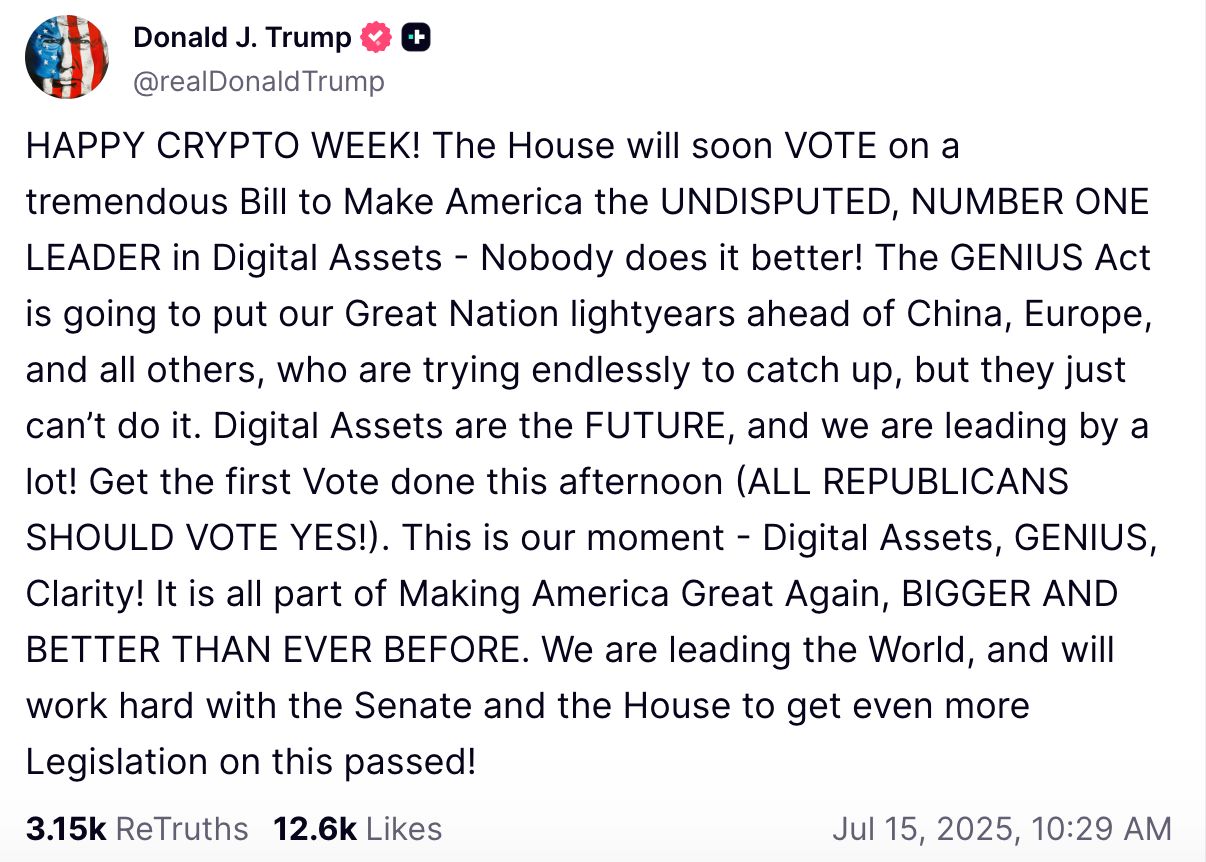 Source: Donald Trump
The GENIUS Act, which passed through the Senate in June with bipartisan support despite initial resistance from many Democrats, is expected to head for a floor vote in the House by Thursday. At the time of publication, the bill was scheduled to be considered by the House sometime this week, but it was unclear whether the chamber planned a separate floor vote on Tuesday.
Signing off on a stablecoin law while investing in stablecoins?
Trump has personally come under scrutiny for his role in pushing the stablecoin legislation due to his involvement in his family-backed crypto company World Liberty Financial (WLF), which issued its own stablecoin and suggested a conflict of interest. Bloomberg reported on Friday that Binance helped create WLF’s USD1 stablecoin, also used by an Abu Dhabi-based investment firm to settle a $2 billion investment into the crypto exchange.
“World Liberty Financial has received a significant portion of its funding from overseas, which has brought about serious ethical and national security concerns,” said California Representative Maxine Waters’ office on Tuesday, adding: “[F]oreign investment is not just a business deal, it’s a direct payment to the sitting US president with the goal of currying favor and influence within the White House.”
Many Democratic leaders have responded to Republicans’ push for the digital assets bills with their own “anti-crypto corruption week” agenda. They are calling for amendments in the three bills to address consumer protection and prevent the president, vice president, and members of Congress from holding or promoting crypto over concerns with conflicts of interest.
Disclaimer: The content of this article solely reflects the author's opinion and does not represent the platform in any capacity. This article is not intended to serve as a reference for making investment decisions.
You may also like
Jensen Huang steps down, Nvidia (NVDA.US) money becomes "cautious": $500 billion may only be invested in major companies in the future
After Jensen Huang's departure, Nvidia's $500 billion AI financing platform is expected to continue, but may be paused in the early stages. The cost of new deals will rise, and funds may shift from emerging cloud providers to more established large-scale cloud companies.
Philadelphia Semiconductor Index Rebound "Stalls": Technicals at Risk, Could NVIDIA (NVDA.US) Earnings Be the Final Straw?
In the calculations of technical analysts' charts, the market is never random noise, but rather a repeated contest between support and resistance levels. Now, the balance of this contest is quietly tilting in favor of the bears.

What you think is diversified holdings is actually all betting on AI? Wall Street starts to penetrate AI risks, seeking cash flow winners
Until recently, investors regarded artificial intelligence as one of the biggest bets in Wall Street history. Now, many portfolio managers are more cautious about this field and are trying to assess just how much AI risk exists within their portfolios. There is a lot at stake. According to the MSCI Global Think Tank Index, at least $25.3 trillion is invested in the world’s largest companies that are directly related to artificial intelligence. In addition, there are countless other investments that are difficult to quantify—companies that could either benefit from or be harmed by the way AI is reshaping various industries.

The More Impressive AI Agents Become, the More Valuable Cybersecurity Becomes! Morgan Stanley Anticipates Accelerated New Subscriptions for CrowdStrike (CRWD.US), Urges "Overweight" During Stock Price Pullback
This institution is optimistic about CrowdStrike benefiting from the surge in cybersecurity budgets driven by the AI era, particularly favoring next-generation SIEM, cloud security, and Falcon Flex in driving customer expansion. They look forward to quarterly performance exceeding expectations being reflected in full-year guidance. Morgan Stanley maintains an "Overweight" rating on CrowdStrike with a target price of $254.
Crypto prices
More


