
Solana highlights 3,200 active devs, $1b+ app revenue for second straight quarter

Solana’s network continues to attract strong engagement, with more than $1 billion in app revenue.
Solana (SOL) continues to see strong user engagement. On Friday, the Solana Foundation published its Solana Network Health Report , showcasing its performance in Q2 of 2025. Notably, the app revenue on the network exceeded $1 billion for the second quarter in a row.
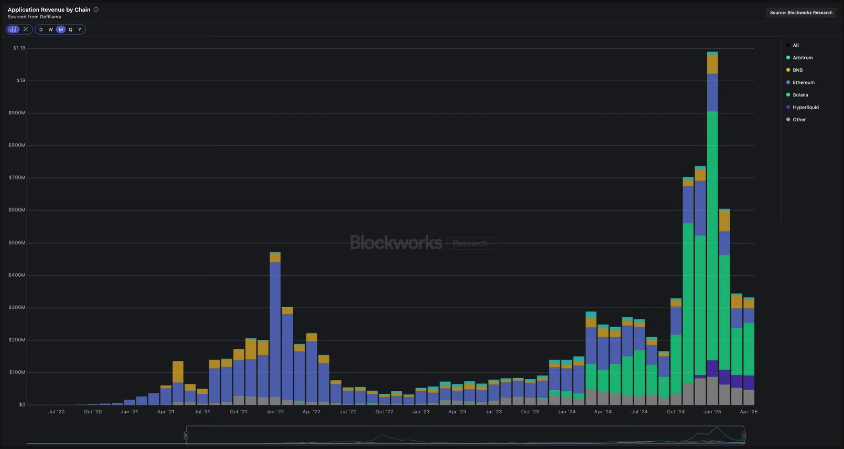 Application revenue by chain | Source: Solana Foundation
In Q2, Solana’s app revenue rose compared to Q1—even as application revenue on other major networks declined. In fact, Solana’s app revenue now surpasses the combined total of all other blockchain networks.
This activity also contributed to a sharp rise in validator income, which reached an average quarterly level of $800 million. The peak occurred on Jan. 19, with $56.9 million earned in a single day. At the same time, validator costs have dropped dramatically.
Notably, the breakeven SOL stake required for validators to cover their costs has fallen significantly. Validators now require just 16,000 SOL to break even, down from 50,000 SOL in 2022. According to the Solana Foundation, this reflects substantial improvements in network efficiency.
Solana has also topped the charts in attracting new developers. In 2024, the network drew 7,625 developers, more than any other blockchain, including Ethereum.
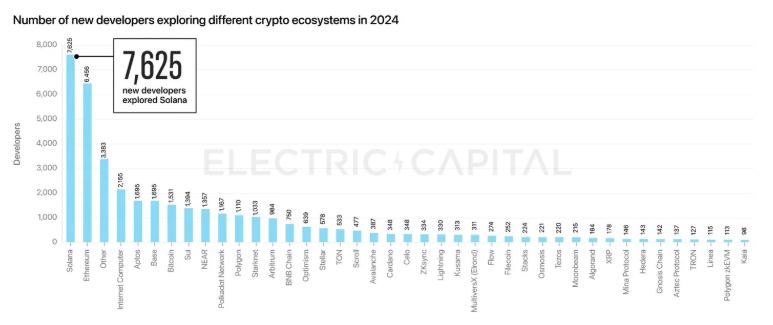 Number of new developers exploring different crypto ecosystems | Source: Electric Capital report
Solana Foundation showcases decentralization gains
According to the Solana Foundation, the network has made significant gains in decentralization. The Nakamoto Coefficient, used to measure how decentralized a network is, reached 20 by June. This puts Solana ahead of Ethereum, Sui, and Sei, which have coefficients of 6, 18, and 7, respectively.
Solana validators are also geographically distributed, with no single country or data center controlling more than 33% of the total stake. Germany leads with 23.55%, followed by the U.S. at 17.37%, and the Netherlands at 14.36%.
Disclaimer: The content of this article solely reflects the author's opinion and does not represent the platform in any capacity. This article is not intended to serve as a reference for making investment decisions.
You may also like
Breaking SpaceX's Record! Anthropic (ANT.US) IPO Raises $8.13 Billion, Priced Above Guidance Range, Landing on Nasdaq Tonight
Anthropic (ANT.US) and its seven co-founders raised a total of $81.3 billion through a large-scale IPO, becoming the first cutting-edge AI lab to secure funding for intelligent machine development via the public market.
INJ market cap at $694 million, SEC registration highlights no maximum supply
Jensen Huang's Return Hopes Dashed! Nvidia (NVDA.US) Accelerates Search for "New Leader", Arm (ARM.US) CEO Rene Haas Enters Candidate List
The headhunter firm Heidrick & Struggles, hired by Nvidia, has approached Arm Holdings CEO Rene Haas, considering him as a potential candidate for Nvidia's new leader.
Largest decline in half a year! Overseas U.S. Treasury holdings saw a sharp drop in September, with the top three "creditors"—China, Japan, and the UK—all reducing their holdings; China’s holdings hit a new low since 2008
According to the U.S. Treasury's TIC report, foreign holdings of U.S. Treasury bonds in September decreased by $75.5 billion compared to the previous month. U.S. long-term capital net inflows were $155.3 billion, shrinking by nearly 46% compared to August. Overseas investors made net purchases of $80.8 billion in U.S. Treasuries, down 26% from August. Japan’s holdings declined for the fifth consecutive month, hitting a 21-month low. Mainland China’s holdings decreased by $26.8 billion, with a reduction of over $130 billion in the past year. The UK’s holdings fell by $8.7 billion after two consecutive months of record highs. Among the top ten "creditors", only three increased their holdings in September, with France seeing the largest decrease, reducing by $31.4 billion.
Crypto prices
More


