
Polyhedra Network’s ZKJ Crashes 60% Amid Liquidity Crisis

ZKJ and KOGE crashed over 50% after liquidity pools were drained, sparking panic selling and community backlash over mismanagement concerns.
Polyhedra Network’s ZKJ token crashed nearly 60% in under an hour on June 15, wiping out over $360 million in market capitalization.
KOGE, the governance token of 48 Club DAO, also dropped by 50% during the same window, losing more than $100 million in market cap.
ZKJ Faces Major Liquidity Mismanagement
The sharp sell-off began when the KOGE/USDT liquidity pool was depleted, leaving liquidity providers unable to exit. Panic selling followed as investors began converting KOGE into ZKJ.
According to early community reports, the KOGE team failed to add USDT to its liquidity pool. This triggered what some users called a “rug from both sides.”
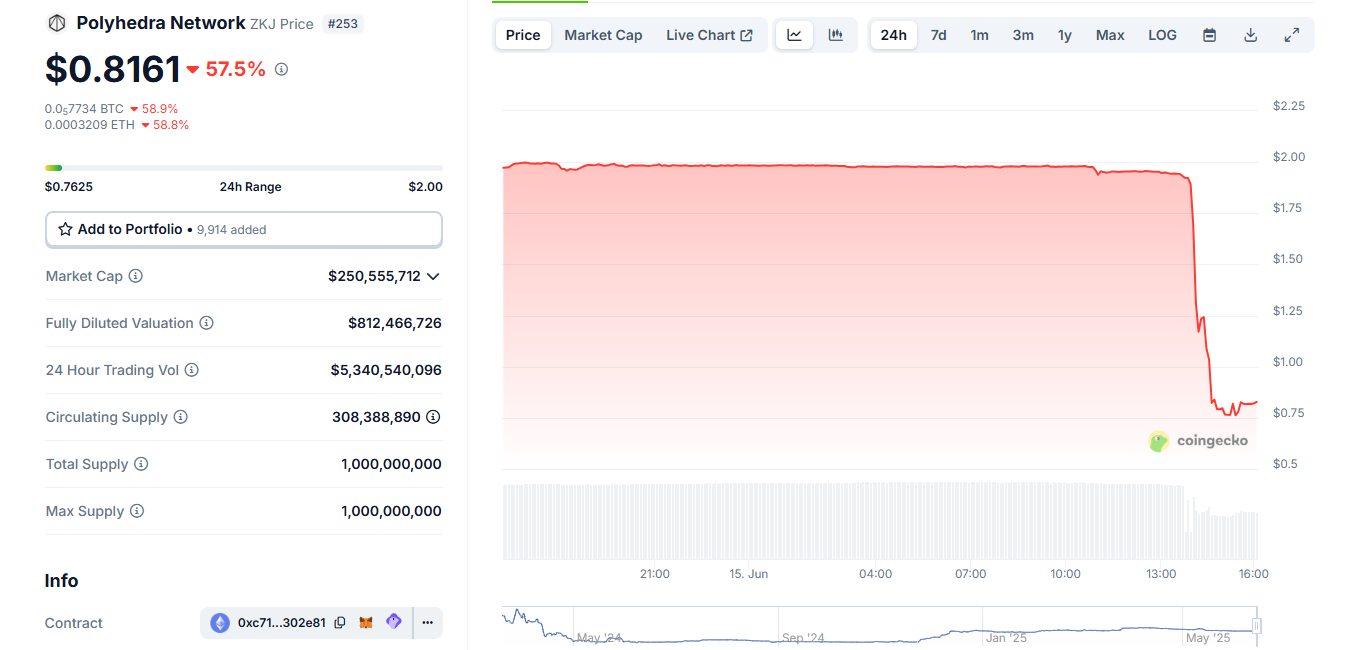 ZKJ Price Crash. Source:
CoinGecko
With no USDT left in the KOGE pool, holders rushed to offload KOGE into the ZKJ pool, which was still actively defended by its team.
However, the rapid influx overwhelmed the ZKJ/USDT pair, causing a domino effect that tanked ZKJ’s price and investor confidence.
— Mayank Dudeja (@imcryptofreak) June 15, 2025
Why is $ZKJ dumping -41.1% today?Price dropped to $1.164 with plunging volume & bearish momentum
Binance Alpha volumes collapsed = whales & bots dominate

Members of the 48 Club DAO, the group behind KOGE, expressed outrage over the incident, accusing the team of negligence and mismanagement.
Social media was flooded with posts demanding accountability from both projects. The phrase “rugged from both sides” trended within crypto circles.
This incident has severely damaged trust in both ecosystems, with users questioning the sustainability of their liquidity strategies.
Yes, $KOGE was fully diluted from day one.And no — 48Club never promise we wouldn’t sell. Neither did Binance for $BNB, right?Do your own research.Take your own risk.
— 48 Club (Est. '17) (@48Club_Official) June 14, 2025
Beyond liquidity concerns, market structure added further pressure. A 5.3% ZKJ token unlock, worth $32 million, is scheduled later this week.
With Binance Alpha volume collapsing, analysts warned that bots and whales dominate the order books, exacerbating volatility in both tokens.
ZKJ and KOGE: Tightly Linked Ecosystems
The crash highlights the intertwined nature of ZKJ and KOGE. Both tokens are frequently paired in liquidity pools and used in farming strategies.
While ZKJ powers zkBridge and ZKP infrastructure, KOGE operates as a governance token for 48 Club—a group focused on BNB Chain DeFi.
Recent coordinated farming and arbitrage activity had inflated volumes between the two, making them vulnerable to liquidity shocks.
Disclaimer: The content of this article solely reflects the author's opinion and does not represent the platform in any capacity. This article is not intended to serve as a reference for making investment decisions.
You may also like
Anthropic commits to about $900 billion in computing power expenditure; bond market expects its bonds to be junk-rated
Despite Anthropic raising over $100 billion in its public offering and reaching a market capitalization of $1.18 trillion, the company is widely expected by the debt market to be rated as BB-level "junk bonds" due to its lack of profitability and approximately $900 billion in massive computing power expenditure commitments. Amid pressure on tech giants in the debt market and chip companies planning to reduce loan guarantees, Anthropic will still need to rely on structured financing in the short term, facing about a three-year window to strive for an investment-grade rating.
JPMorgan Trading Desk Abandons Tactical Bullish Stance on S&P 500: Rebound May Occur, Bottom Not Yet Reached
J.P. Morgan's trading division has shifted from a tactical bullish stance to a cautious one, expecting stock market volatility in the coming weeks, but emphasizes that market fundamentals—from the economy to earnings—remain solid.

AI sell-off brings a "fat pitch"? Hedge funds "give up" and clear positions, Morgan Stanley loudly calls to buy
Hedge funds have shifted to a net bearish stance on momentum stocks, abandoning bets for the first time since April 2025 that recently outperforming stocks will continue to rise.

South Korea's 10 trillion rescue plan: why is it not working anymore?
The 10.76 trillion won stabilization fund has become comparatively insignificant against the current scale of the stock market. The National Pension Fund lacks further capacity to increase its holdings, and regulators are hesitant to restrict short selling. Meanwhile, semiconductor sell-offs triggered by the global retreat from AI trading continue to impact the Korean market, and the government's available tools for market rescue struggle to counter the outflow of international capital.

Crypto prices
More


