-
Whale inflows to Binance have hit a six-month low at $3.27 billion, indicating potential shifts in market dynamics and investor sentiment.
-
This decline implies reduced selling pressure, suggesting that major holders are becoming increasingly cautious about unloading their assets.
-
Noting the trend, CryptoQuant emphasizes that a tight supply of BTC can enhance its price stability, despite potential macroeconomic challenges.
This article examines the recent decline in Bitcoin whale inflows to Binance, highlighting implications for market stability and investor behavior.
Bitcoin Whales Continue Holding Position
Analysts have observed that Bitcoin whales have generally reduced their activity, with inflows dropping significantly from previous months. In March and November 2024, inflows exceeded $6.17 billion and $8.44 billion, respectively, coinciding with profit-taking strategies. This current trend of lower deposits raises questions about the readiness of large holders to sell at current price levels, particularly as they may be cognizant of potential upside.
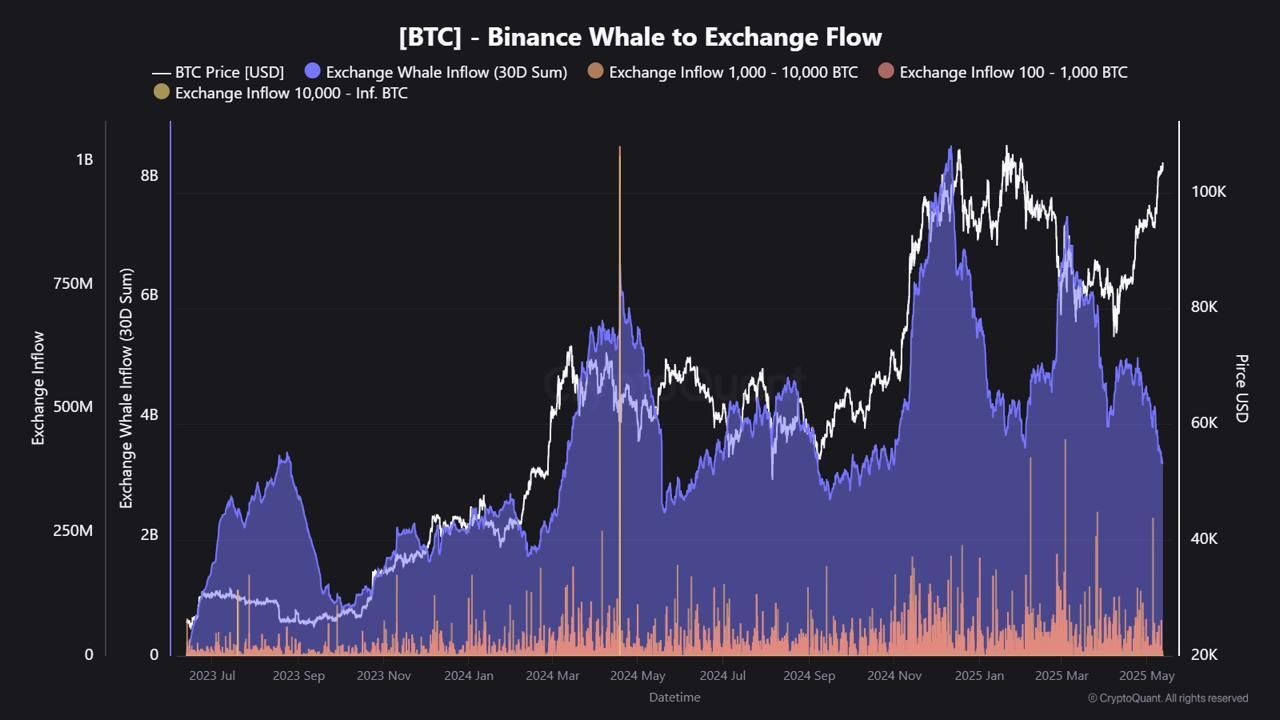
The liquidity landscape appears more constrained, which traders interpret as a bullish sign. With fewer Bitcoin assets listed on exchanges, the conditions for price appreciation become more favorable, as transaction volumes may not overwhelm the available supply.
As Bitcoin’s price hovers around $104,000, the support can be attributed to the absence of significant sell orders that usually accompany such price movements. Additionally, data from CryptoQuant indicates that many newly established Bitcoin whales acquired their holdings at an average price of $91,922, suggesting a strategic outlook on price appreciation.
Macro Factors and On-Chain Metrics Affecting BTC Prices
Despite positive signs from whale behavior, external factors complicate the market’s trajectory. Federal monetary policies, regulatory developments, and geopolitical uncertainties can rapidly change market dynamics, potentially bringing additional supply onto the exchanges.
On-chain analysis reveals an increase in long-term holders actively accumulating Bitcoin, which typically precedes substantial price movements, as their activities effectively withdraw coins from circulation.
Nonetheless, the cautious approach from whales does not outright eliminate the prospect for increased volatility. Market sentiment from retail investors, derivatives positioning, and institutional demand can quickly reverse the current trends, particularly in an ever-evolving financial landscape.
Diverging Investor Sentiment: Whales Versus Retail
The current data illustrates a stark contrast between whale activity and retail investor sentiment. As noted by a CryptoQuant analyst, “Overall, total inflows across all investor categories remain much lower than what we’ve seen in peak market phases.” This disparity highlights the cautious posture of major players amidst a recovering market.
In conclusion, the notable drop in whale inflows to Binance highlights a period of caution among significant Bitcoin holders. If this trend continues, Bitcoin could stabilize above the critical $100,000 mark. However, investors should remain vigilant for any signs of activity changes from whales, as these can serve as early indicators of shifting market sentiment.
Conclusion
In summary, the current landscape suggests that while Bitcoin whales are showing restraint, this could lend itself to longer-term price stability. For traders and investors closely monitoring market movements, understanding whale behavior could offer essential insights into future price trends and market confidence.