
BlackRock’s IBIT Tops Inflows as Bitcoin ETFs See Mixed Sentiment | ETF News

Despite market volatility, Bitcoin ETFs attracted $115 million on Thursday, led by BlackRock’s iShares fund. BTC’s price rose 2%, though cautious trading hints at mixed sentiment.
On Thursday, institutional investors continued to pour capital into US-listed spot Bitcoin ETFs, signaling persistent interest in crypto exposure among institutional investors.
Total net inflows across all US-listed Bitcoin ETFs amounted to approximately $115 million, reflecting sustained bullish sentiment despite short-term market volatility.
Institutional Appetite Holds as BTC ETFs See $115 Million Inflows
On Thursday, net inflows into BTC ETFs totaled $114.96 million, down 64% from Wednesday’s $319.56 million. While this marked sustained institutional interest in these funds, yesterday’s figure marked a steep decline from Wednesday’s inflows, suggesting a temporary cooldown in momentum.
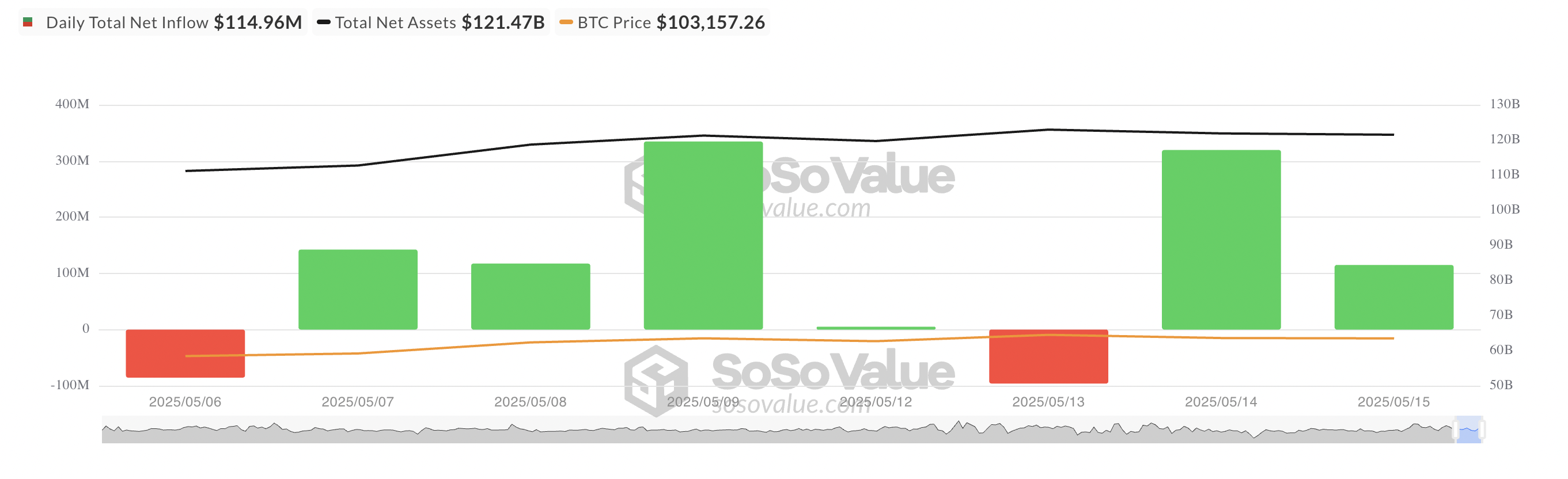 Total Bitcoin Spot ETF Net Inflow. Source:
SosoValue
BlackRock’s IBIT ETF once again led the pack, recording the highest net daily inflows among its peers. The fund saw a daily net inflow of $409.72 million on Thursday, bringing its total historical net inflow to $45.42 billion.
Meanwhile, ARK 21Shares Bitcoin ETF (ARKB) had the highest net outflow among all issuers on Thursday, with $132.05 million exiting the fund. ARKB’s total historical net inflows remain at $2.57 billion as of this writing.
Futures Interest in BTC Rises Slightly
At press time, the leading coin trades at $104,007, recording a 2% price surge amid a broader market rally over the past day. During the review period, the coin’s futures open interest (OI) has risen by a modest 1%, signaling a slight uptick in leveraged positions.
 BTC Futures Open Interest. Source:
Coinglass
Open interest refers to the total number of outstanding futures contracts that have not yet been settled. When OI increases alongside rising prices, it indicates fresh capital entering the market and a strengthening of the current trend.
With BTC, the modest rise in its OI suggests that market participants remain somewhat cautious while bullish momentum is building. The small uptick points to limited conviction among traders, with many still adopting a “wait and see” approach.
Moreover, in the coin’s options market, there is an uptick in demand for put contracts today.
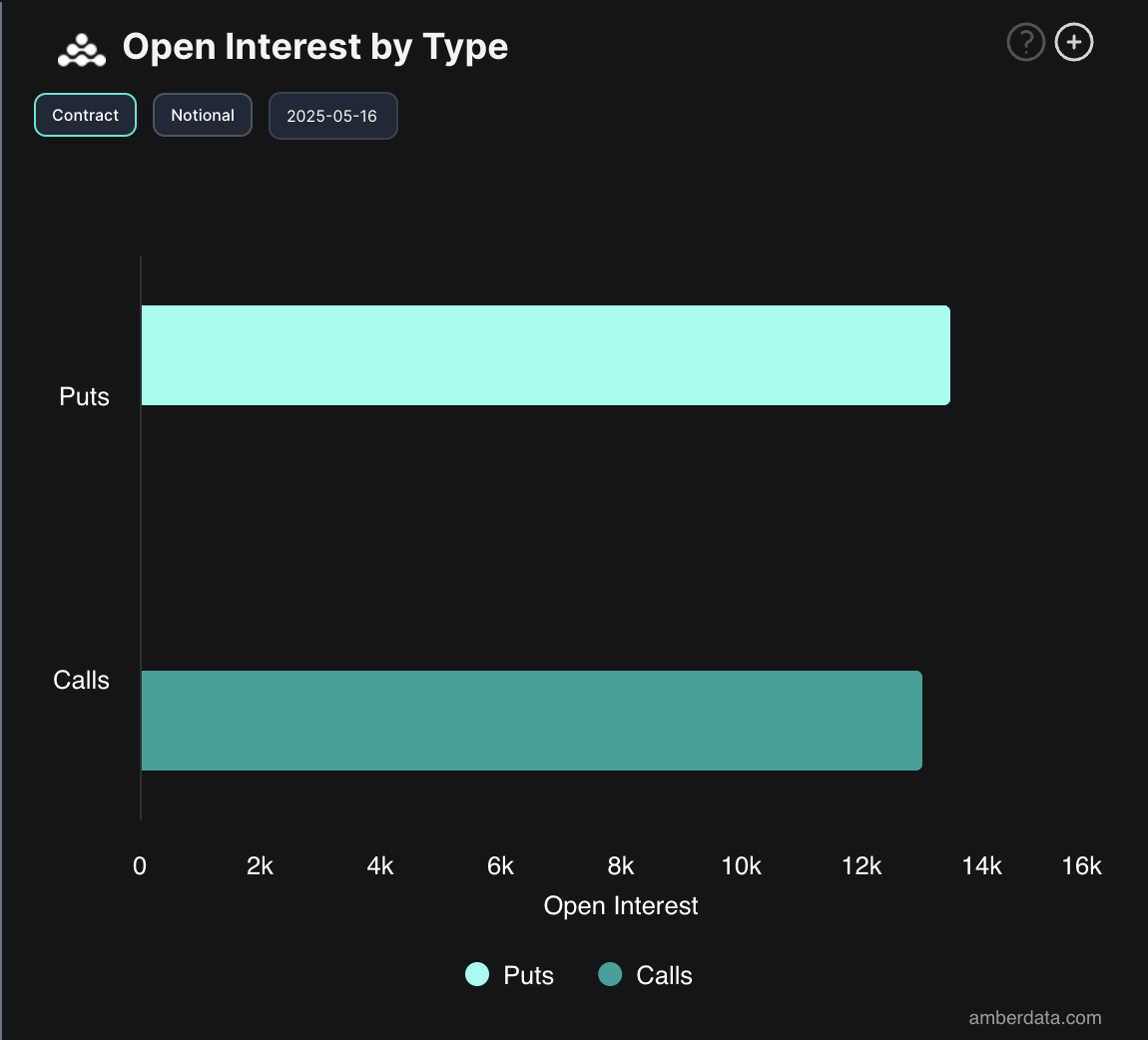 BTC Options Open Interest. Source:
Deribit
This indicates rising hedging activity and lingering bearish sentiment, which signals a lack of optimism among BTC options traders.
Disclaimer: The content of this article solely reflects the author's opinion and does not represent the platform in any capacity. This article is not intended to serve as a reference for making investment decisions.
You may also like
How much CPO demand will Nvidia Rubin Ultra generate? Bernstein: Optical value per Pod will increase fivefold
Bernstein believes that the co-packaged optics (CPO) and fiber demand driven by Nvidia's Rubin Ultra architecture will surge significantly, with the optical content per Pod rising from $1 million to $5.4 million. This will propel the size of Nvidia's optical ecosystem market to $46.8 billion by 2028 (a 91% annual increase). Although the industry faces supply bottlenecks with InP substrates, the outlook remains positive. The institution reiterates its “outperform” rating for Lumentum, Coherent, and Ciena.
UBS Q3 implements a two-way strategy with gold options, heavily invests in technology stocks, and builds positions in SK Hynix (SKHY.US)
UBS Group (UBS.US) has submitted its Q3 holdings report (13F) as of September 30, 2026.
SpaceX (SPCX.US) reportedly attempts “de-Nvidiaization” at the rack level: developing Kessel cabinets to bypass L6 compute boards, purchasing only chips
SemiAnalysis: SpaceX has developed its own Kessel cabinet, bypassing Nvidia's L6 cards to provide more options for manufacturing its own hardware.

$3.7 billion “data center power equipment prepayments” abandoned! What did "the most active buyer of gas turbines", SoftBank, see?
In the second quarter of fiscal year 2026, SoftBank reported a net loss of $7.1 billion, primarily due to a $3.7 billion impairment charge from a $9.5 billion advance payment for power generation equipment for US data centers—of which about $2.9 billion was non-refundable and effectively lost. The CFO admitted that SoftBank placed orders before the project plan was finalized, and is now conducting a comprehensive review of its procurement strategy. "The most aggressive purchaser of gas turbines has now written off the deposit in this way."
Crypto prices
More


