
Research Report | In-depth Analysis of Space and Time & SXT Market Valuation
I. Project Overview
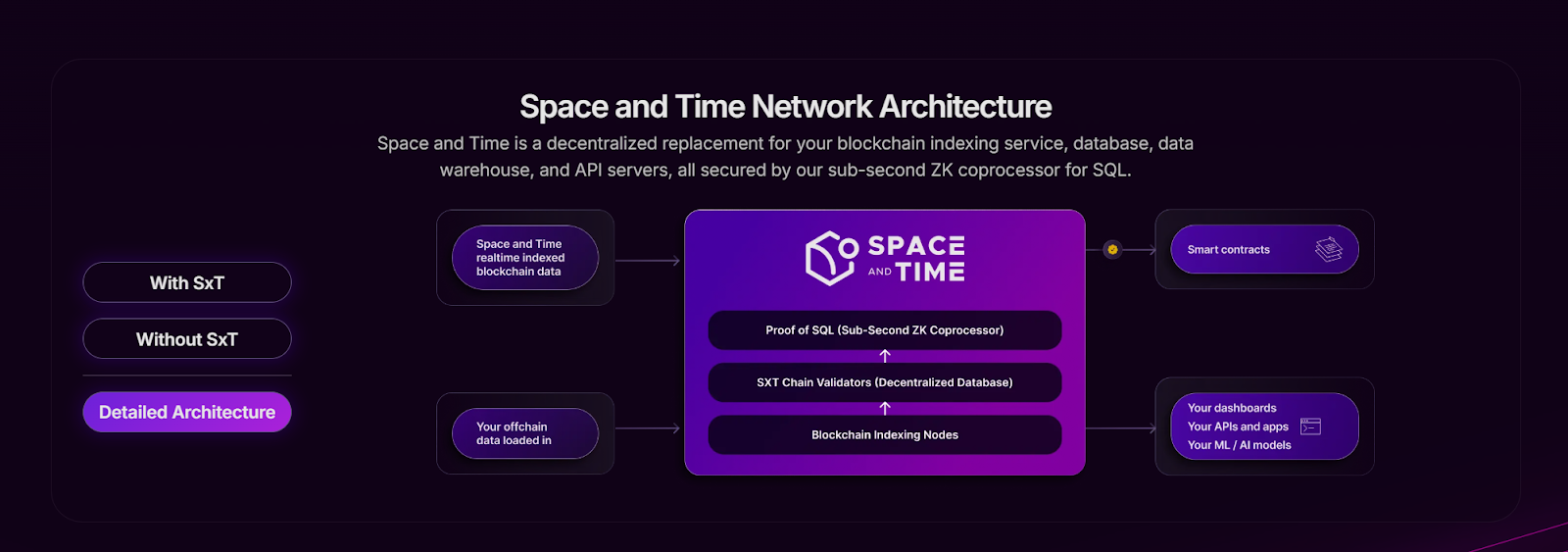
II. Project Highlights
-
Enabling Verifiable Queries: Expanding Smart Contract Data Boundaries Traditional smart contracts have limited capabilities in data access, especially when dealing with cross-chain, off-chain, or complex structured data. SXT’s proprietary Proof of SQL establishes a full pipeline from “data query → ZK proof → smart contract call,” allowing contracts to not only interpret structured data but also verify it without needing to trust the source. This lays the groundwork for complex contract logic in DeFi, RWA, and AI agents while vastly expanding the programmable scope of on-chain applications.
-
Decentralized Validator Network + Structured Indexing System: A Web3 Data Warehouse Prototype Instead of merely fetching specific events or prices on-chain, SXT adopts a database-centric approach to long-term indexing and structuring of full-chain data from major blockchains (Ethereum, Polygon, ZKsync, etc.). Validators stake $SXT and participate in a BFT consensus mechanism for coordinated data updates and signing, forming a full decentralized loop from data production to usage and avoiding the centralization bottlenecks of traditional oracles.
-
Native Fit for Complex Financial and AI Contract Scenarios Proof of SQL balances between speed and verifiability, enabling on-chain contracts to support real-time queries and state assessments. This makes it ideal for logic-intensive applications like AI agents, on-chain credit scoring, and cross-chain asset mapping. DeFi protocols like Lendvest have already used SXT to create personalized lending schemes, a model that can be extended to various trading structures and risk models—paving the way for truly intelligent smart contracts.
-
Launchpool + Chainlink Collaboration: Building Early Token Network Effects Rather than relying on a single channel for token distribution, SXT adopted a dual approach via Binance Launchpool and the Chainlink Staking airdrop program to broaden early token ownership. On-chain data shows Launchpool attracted over 18 million BNB and more than $1B in stablecoins, while the LINK community airdrop reached core crypto user groups. This multi-source traffic strategy has helped SXT establish early consensus and kickstart its validator ecosystem.
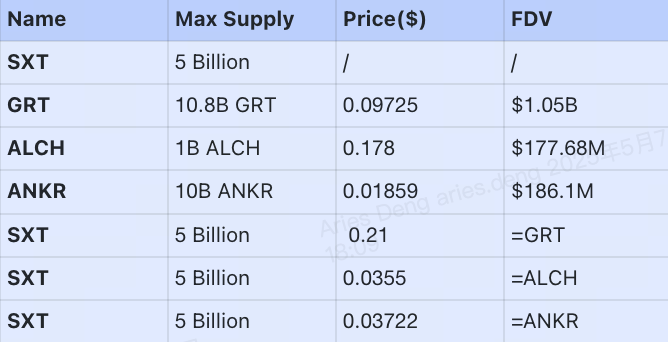
III. Market Valuation Outlook
IV. Tokenomics
-
Total Supply: 5,000,000,000 tokens (5 billion)
-
Initial Circulating Supply: 1.4 billion tokens (28% of total supply)
-
Community (51.7% / ~2.585 billion tokens):
-
1.4B for rewards (staking incentives, retroactive claims, dev grants)
-
1.185B for ecosystem expansion (partnerships, protocol integrations)
-
375M initially unlocked for community incentives like Gigaclaims; the rest will vest over 7 years
-
-
Investors (25.9% / ~1.295 billion tokens):
-
Allocated to seed, strategic, and Series A investors
-
Vesting: 12-month cliff post-TGE, followed by 24 months linear release
-
-
Team Advisors (22.4% / ~1.122 billion tokens):
-
Allocated to MakeInfinite Labs core team and advisors
-
Vesting: 4 years linear, with no tokens released at TGE
-
-
Staking: Validators must stake $SXT to join consensus and secure data tables. Delegators earn a share of rewards.
-
Incentives: Table owners providing valuable datasets are rewarded in $SXT based on usage frequency—creating a content-as-value loop.
-
Payments: All queries, writes, and ZK computation services are paid in $SXT, with fees split between validators and table owners.
V. Team Funding
-
Nate Holiday – Founder Former President of Teradata Cloud Division and EVP of Oracle Cloud Sales. Brings enterprise software and BD expertise, helping align Space and Time with traditional database systems.
-
Scott Dykstra – Co-Founder CTO Technical lead focused on zero-knowledge computation, blockchain indexing, and ZK co-processor architecture. Main driver behind Proof of SQL.
-
Carlos Bort – Head of Web3 Data Solutions Leads real-world Web3 collaborations, bridging enterprise data management with decentralized environments.
-
Seed Round (July 2022) – $10M Investors: Framework Ventures*, IOSG, Alliance DAO, GSR, DCG, Samsung Next, SNZ, HashKey, Galxe, 3Commas, etc. Use: Validate technical feasibility and initiate network deployment
-
Strategic Round (Sept 2022) – $20M Investors: M12 (Microsoft’s VC arm)*, Polygon, Hash Global, Foresight, CoinDCX, SevenX, Blizzard Fund, etc. Use: Refine ZK data warehouse vision and secure backing from major Web2 players
-
Series A (Aug 2024) – $20M Investors: OKX Ventures, Circle Ventures, Gate Ventures, Arrington Capital, Alumni Ventures, ArkStream, Contango, STIX, M31, etc. Reflects growing institutional support for its tech trajectory.
VI. Risk Factors
-
Scalability Concerns for ZK-Based SQL Computation Although the “Proof of SQL + ZK co-processor” model is highly innovative, it remains cutting-edge. Real-world performance limitations—such as ZK proof generation time, on-chain verification costs, and cross-chain data sync latency—may deter developer adoption if not efficiently addressed.
-
Token Utility vs. Speculation While $SXT is designed for staking, payment, and incentives within a closed-loop ecosystem, maintaining the balance between user cost and validator rewards—and ensuring real demand comes from usage, not speculation—will require sustained observation and governance optimization.
VII. Official Links
-
Website: https://www.spaceandtime.io
-
Twitter: https://twitter.com/spaceandtimedb
-
Telegram: https://t.me/spaceandtimedb
Disclaimer: The content of this article solely reflects the author's opinion and does not represent the platform in any capacity. This article is not intended to serve as a reference for making investment decisions.
You may also like
Funds swarm into US Treasuries, helping the "anchor of global asset pricing" fall below 5%! After "Black Friday," can tech stocks take advantage and rebound?
On November 20th, Eastern Time, the yields on 10-year and 30-year U.S. Treasury bonds fell to 4.92% and 5.31% respectively, while the Philadelphia Semiconductor Index plunged by 10.73%. On "Black Friday," long-term bonds realized their value as safe-haven assets, while AI computing power and semiconductors continued to digest investors' concerns about returns on AI capital expenditures.
After Starship recovery success, Citigroup raises SpaceX (SPCX.US) target price: Launch leading advantage is "rapidly expanding into a 20-year gap", Starlink will become the core for value realization
After SpaceX successfully caught the Starship upper stage with the launch tower for the first time, Citi released a research report, raising its target price for the stock from $240 to $280. The report also pointed out that the gap between SpaceX and other players in the aerospace launch industry is widening further.

After a week of "bloodbath" in US stocks, valuations now show investment value, but no one dares to say the bottom has arrived.
Last week, U.S. stocks experienced a massive sell-off, but in fact, there have been no fundamental changes in the underlying factors. Multiple valuation indicators now highlight their investment value, and the willingness of contrarian funds to buy the dip should be strong.

The script at the end of 2018: The Federal Reserve continued to raise interest rates, US stocks plunged 20% from the September highs, forcing the Federal Reserve to "pivot" in January.
Goldman Sachs' head of trading believes the current US stock market is repeating the scenario of late 2018, with monetary tightening and equity market pressure. The Goldman Sachs Financial Conditions Index has tightened by about 8 points in two weeks, reaching the highest level in a year. The selloff has broadened from tech stocks to defensive sectors. Gold and equities are declining simultaneously, possibly indicating investors are selling assets to raise cash, making gold a key indicator for observing liquidity stress.

Crypto prices
More


