
Solana’s Vision of Internet Capital Markets: Insights from Lily Liu

Lily Liu, President of the Solana Foundation, is looking beyond meme coins to establish Solana as the infrastructure for what she calls “internet capital markets.” In an exclusive interview with BeInCrypto and a presentation at the 2025 Web3 Festival in Hong Kong, Liu outlined her vision for blockchain technology’s role in democratizing financial access. From …
Lily Liu, President of the Solana Foundation, is looking beyond meme coins to establish Solana as the infrastructure for what she calls “internet capital markets.”
In an exclusive interview with BeInCrypto and a presentation at the 2025 Web3 Festival in Hong Kong, Liu outlined her vision for blockchain technology’s role in democratizing financial access.
From Meme Coins to the “Everything Chain”
“Solana has evolved from being the DeFi chain to the NFT chain, the gaming chain, the payment chain, and recently the meme coin chain,” Liu explained. “When you sum all that up, Solana is the everything chain.”
While meme coins drove Solana’s price to an impressive $290 high in January before falling 60% to around $120 today, Liu views them as just one transient asset class in a much broader ecosystem. “Meme coins are just one type of asset. There will be something else—there’s always going to be the tulip market and the beanie baby market. That’s been going on for a really long time. That’s just what humans do with or without blockchain,” Liu noted.
Despite price volatility, Solana’s Total Value Locked (TVL) reached an all-time high in April 2025, demonstrating continued investor confidence in the ecosystem beyond speculative assets.
The Crisis of Capital Access for Young Generations
Liu, who previously co-founded Earn.com (acquired by Coinbase in 2018) and served as CFO of Chinaco Healthcare Corporation, brings significant experience from building businesses in both the US and China to her current role at Solana. Her background in traditional finance gives weight to her critique of current capital markets.
“Fifty years ago, it took 25 hours of labor to buy one share of the SP 500. Today, it takes 195 hours,” Liu noted in her presentation, highlighting how capital gains have become less accessible to average workers while losses are increasingly socialized through national debt.
This inaccessibility to capital markets has created anxiety among young people globally. Liu pointed to challenges in Korea and China, where housing prices have skyrocketed beyond what young professionals can afford without parental support.
“In Korea and China, the parents’ generation has retained the upside of a major asset class like housing. Young people’s ability to convert hours of labor into capital and freedom later in life has become extremely limited,” she observed. “In China, it creates huge anxiety for families where young men are culturally expected to own an apartment before marriage, yet average professional salaries make this impossible without parental help.”
Blockchain as Global Financial Infrastructure
Liu sees blockchain’s core purpose as creating a unified global financial infrastructure, similar to how the internet unified attention. “What crypto is doing is providing this unified infrastructure to unify the wealth, the transactions, the financial coffers of five and a half billion people,” she explained.
This infrastructure enables what Liu calls “internet capital markets,” making the full range of financial assets available to anyone with an internet connection. She contrasts the simplicity of downloading a crypto wallet against the complex paperwork of traditional banking and investment systems.
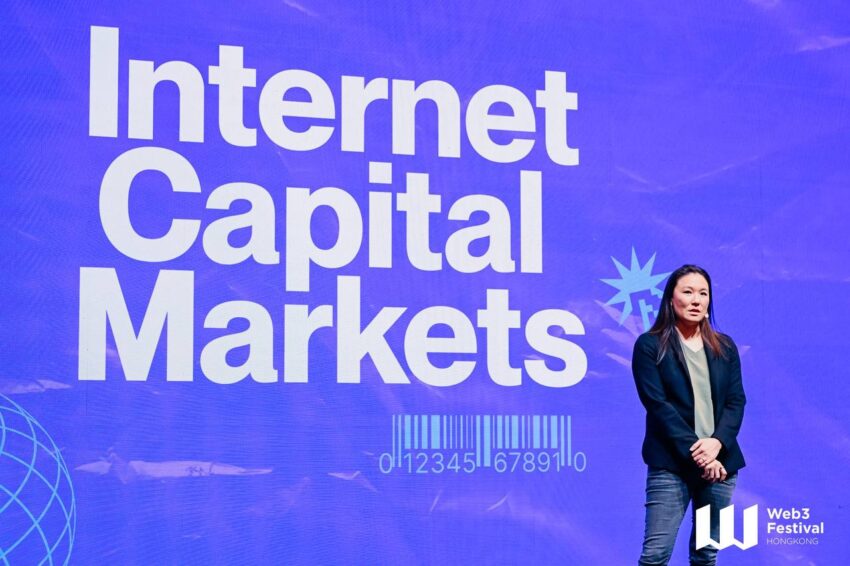 Lily Liu, President of Solana Foundation. Source: 2025 Web3 Festival Hong Kong.
For Liu, this infrastructure is particularly valuable in expanding access to equities and other assets that have both fundamental value and price discovery—currently reserved primarily for accredited investors even in developed markets.
Community-Based Capitalism and the Ownership Economy
Liu argues that blockchain offers an alternative to traditional economic systems. “In the last 100 years, we’ve come to accept that the dominant ownership models are either capitalist or communist—corporate ownership or state ownership,” she explained. “What Bitcoin proposed is that those aren’t the only choices.”
This has evolved into what Liu calls “community-based capitalism,” a term she uses to describe economic models where value accrues to network participants rather than just shareholders or the state. “Instead of universal basic income, which is essentially a welfare economy, crypto proposes universal basic opportunity,” she said. This model allows early participants in network building to share in the upside.
Liu contrasts this with traditional platforms like Uber, where early drivers who helped bootstrap the network received hourly pay but no equity upside. Her “ownership economy” concept refers to this more inclusive approach to capital formation where contribution and ownership are more closely aligned.
Solana’s governance reflects this philosophy, which was recently demonstrated in a controversial proposal to reduce inflation. Liu actively participated in this discussion, explaining that inflation reduction might seem efficient from a network security perspective but would potentially harm Solana as a yield-generating asset.
“Dynamic yield on an asset makes it a worse asset,” Liu emphasized. “If you have an asset yielding a fixed percentage annually, you price that very differently than an asset yielding at variable rates.”
Looking five years ahead, Liu envisions Solana enabling an ownership economy where blockchain creates new pathways for individuals to convert labor into capital, bringing “more inclusivity for five and a half billion people on the internet into capital markets.”
“The end state is moving into assets that have value, can also command price, and bring more inclusivity around the world,” Liu concluded. “This is where crypto is going.”
Disclaimer: The content of this article solely reflects the author's opinion and does not represent the platform in any capacity. This article is not intended to serve as a reference for making investment decisions.
You may also like
The script at the end of 2018: The Federal Reserve continued to raise interest rates, US stocks plunged 20% from the September highs, forcing the Federal Reserve to "pivot" in January.
Goldman Sachs' head of trading believes the current US stock market is repeating the scenario of late 2018, with monetary tightening and equity market pressure. The Goldman Sachs Financial Conditions Index has tightened by about 8 points in two weeks, reaching the highest level in a year. The selloff has broadened from tech stocks to defensive sectors. Gold and equities are declining simultaneously, possibly indicating investors are selling assets to raise cash, making gold a key indicator for observing liquidity stress.

Goldman Sachs Trader “Revisits the 2018 Playbook”: Still Clearly Remembers “On December 24th, Clients Asked Why the Market Dropped So Much—And I Had No Idea”
Brian Garrett pointed out that the current adjustment in the US stock market is similar to the sharp decline in Q4 2018: the S&P 500 has already experienced 42% of the corresponding drop, and the VIX is approaching its peak just before Christmas. If history repeats itself, the bottom of this cycle may appear in January next year. However, the credit market and Federal Reserve policy have yet to provide clear signals of a bottom.
Anthropic (ANT.US) nearly “broke issue price,” but Claude knocks on the doors of “the highest peak in mathematics”! 17 million lines of Lean code used to write a candidate proof for the Riemann Hypothesis
On November 20th, Eastern Time, on its second day of trading, Anthropic's intraday price dropped to a low of $83.05, just 5 cents above the offering price of $83, and finally closed at $88.91, a decline of 8.50%. On the same day, the company's mathematician Levant Alperg announced on his personal website that he and Claude had found a candidate proof for the Riemann hypothesis, which has puzzled the mathematics community for 167 years, and released about 17 million lines of Lean formalized code.

As US stocks plummet, the parent company of GTA 6 rises against the market! First-day sales hit a record $3.79 billion; Wall Street shifts focus to next-generation GTA Online.
According to Rentrak data, the global box office of "Grand Theft Auto VI" has also surpassed that of "Avengers: Endgame," the highest-grossing film of all time, which has a global box office of approximately $2.94 billion.

Crypto prices
More


