

Last updated: April 8, 2025 06:37 EDT
Arthur Hayes Says China’s Tariff Response Could Drive Capital Into Crypto – Here’s Why
By:Hassan Shittu
China’s potential yuan devaluation in response to U.S. tariffs could reignite Bitcoin demand as investors seek refuge from economic uncertainty, as analysts point to historical trends.
Bitget offers one-stop trading for cryptocurrencies, stocks, and gold. Trade now!
A welcome pack worth 6200 USDT for new users! Sign up now!

As tensions mount over China’s counter tariff, BitMEX co-founder Arthur Hayes claimed that Bitcoin and other crypto assets could once again be the beneficiaries of this trade war.
In a series of posts on X (formerly Twitter), Hayes suggested that China’s likely response to new U.S. tariffs could be a devaluation of the yuan.
This, in turn, could catalyze capital flight into crypto, reviving a historical trend that has previously buoyed Bitcoin during periods of Chinese economic stress.
Hayes pointed to prior market cycles where capital flight from China, in the wake of currency devaluation and trade tensions, helped fuel Bitcoin bull runs.
Arthur Hayes Points to the Devaluation of the Yuan As a Historic Opportunity For Bitcoin and Crypto
The U.S. recently escalated trade tensions by imposing a sweeping 34% tariff on all Chinese imports, prompting Beijing to respond immediately.
China, framing the U.S. move as economic blackmail, retaliated with its own 34% tariffs on American goods and vowed to “fight to the end.”
The exchange of barbs and policy measures has rattled global equities and prompted a strategic recalibration within the Chinese central bank.
For Hayes, a weakened yuan appears to be the most plausible retaliatory tactic Beijing can deploy without triggering immediate escalation.
“Xi’s major weapon is independent monetary policy, which necessitates a weaker yuan,” Hayes wrote, adding that the yuan’s ongoing slide against the U.S. dollar is approaching 5-year lows.
This notion is echoed by Bybit CEO Ben Zhou, who commented that a devaluation of the yuan would be consistent with historical patterns and that such moves have previously led to an increase in Bitcoin demand from Chinese investors.
A Decoupling Market and a Volatile Crypto Climate
As macroeconomic turmoil unfolds, Bitcoin itself is navigating a period of heightened volatility.
Over the past week, BTC experienced a 9.1% correction, plunging below its five-month low and testing the $74,500 support zone before bouncing.
On Sunday, it closed below the key $78,500 mark, failing to sustain its footing above the crucial Bull Market Support Band.
Daan Crypto Trades noted that this technical band has served as a reliable momentum gauge.
So far, each time Bitcoin has dipped below it during this cycle, it has rebounded within a 20% margin, but if it fails to regain the band soon, further drawdowns could ensue.
Popular market analyst, Rekt Capital, also explained that Bitcoin’s current correction is nearing the depth of the post-halving retracement of -33%.
Since hitting its all-time high of $108,786 in January, Bitcoin has fallen around 31%. He suggests the price may yet drop to the $70,000 range before bottoming out.
The RSI (Relative Strength Index) analysis supports this bearish outlook. Rekt Capital notes that historically, price bottoms tend to occur between 0.3% and 8.4% below the initial RSI low.
This pattern could see Bitcoin touch as low as $69,000 if the same conditions play out.
Moreover, Rekt Capital emphasized the importance of BTC reclaiming the $78,500 level to build a base for recovery.
A failure to do so, followed by a daily close below, would signal a continuation of downside pressure, potentially leading to a retest of pre-halving highs in the $69,000 to $72,000 range.
Despite the recent drop, Bitcoin is trading at $79,025 as of this writing, up 2.3% on the day. If it can consolidate above support, it may yet see a short-term rebound.
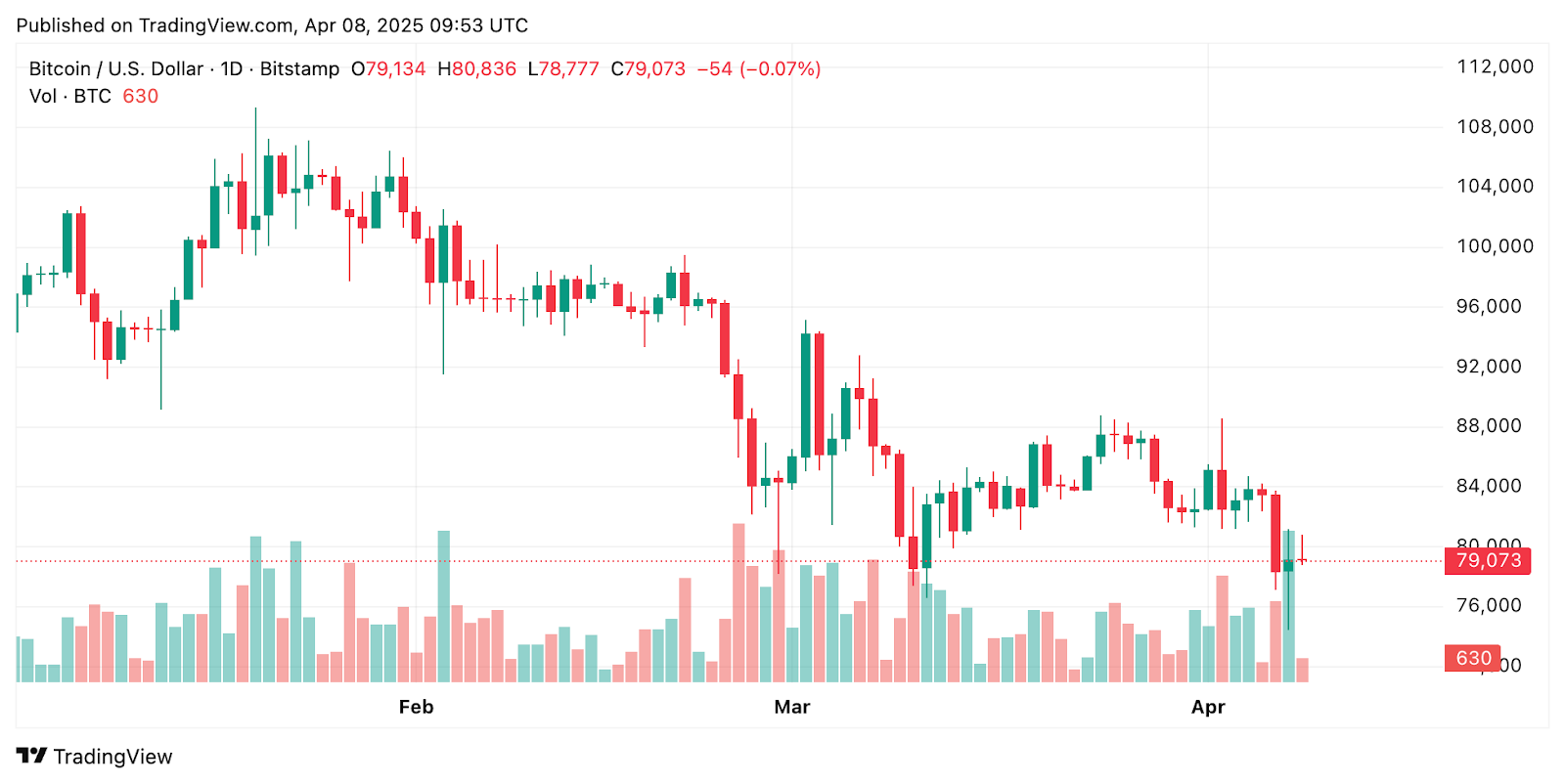 Source: Cryptonews
China Sees Opportunity In Turbulence
As for China, its current defiance is more than just an economic war. The country is embracing a narrative of strength and resilience, asserting its ability to weather any financial storm brought on by tariffs.
In official statements and state-run media, Beijing insists that this moment of adversity is an opportunity to grow stronger, not weaker.
This posture, however, increases the likelihood that China will continue to weaponize monetary policy, potentially through yuan devaluation, to counteract U.S. pressure.
If that happens, as Arthur Hayes suggests, Bitcoin may once again become a safe haven for capital seeking refuge from currency depreciation.
1
0
Disclaimer: The content of this article solely reflects the author's opinion and does not represent the platform in any capacity. This article is not intended to serve as a reference for making investment decisions.
Understand the market, then trade.
Bitget offers one-stop trading for cryptocurrencies, stocks, and gold.
Trade now!
You may also like
Federal Reserve October Meeting Minutes: Inflation Pressure Continues to Rise, Nearly All Officials Support Further Rate Hikes in the Coming Months
The minutes from the Federal Reserve's monetary policy meeting in October, released on Wednesday, show that almost all officials believe further interest rate hikes may be needed in the coming months to ensure inflation returns promptly to the 2% target level.
智通财经•2026/11/18 22:48
Palo Alto Networks (PANW.US) Q1 revenue surged 39% year-on-year to $3.445 billion; full-year guidance raised; after-hours stock price soared over 9%
Driven by the continued growth in enterprise cybersecurity demand and strong expansion in next-generation security services, Palo Alto Networks' quarterly revenue increased by 39% year-on-year, and net profit grew by 44% year-on-year.
智通财经•2026/11/18 22:46
Anthropic (ANT.US) IPO priced at $83, above the upper end of guidance, to debut on Nasdaq Thursday
On Wednesday, Anthropic set its IPO offering price at $83 per share, which is higher than the previously announced guidance range upper limit of $70 to $78.
智通财经•2026/11/18 22:46
The controversy over Jensen Huang's resignation continues to ferment! Nvidia (NVDA.US) interim CEO urges employees to "move forward" as the board reaffirms no intention to reinstate him
Nvidia's interim CEO called on employees to "look forward" at the first all-hands meeting after Jensen Huang's departure, in an effort to stabilize team morale.
智通财经•2026/11/18 22:46
Crypto prices
More
Bitcoin
BTC
$62,151.05
-4.02%

Ethereum
ETH
$1,753.12
-3.43%

Tether USDt
USDT
$0.9987
-0.02%

BNB
BNB
$578.26
-2.47%

USDC
USDC
$0.9999
+0.01%

XRP
XRP
$0.9582
-1.48%

Solana
SOL
$72.47
-2.02%

TRON
TRX
$0.3085
+0.38%

Hyperliquid
HYPE
$65.83
-4.98%

Zcash
ZEC
$897.88
-5.42%
How to buy BTC
Bitget lists BTC – Buy or sell BTC quickly on Bitget!
Trade now
Become a trader now?A welcome pack worth 6200 USDT for new users!
Sign up now