
Ethereum Fees Hit 4-Year Low as Activity Shifts to L2 Networks

Ethereum transaction fees have dropped to their lowest level since 2020, driven by increased adoption of Layer 2 networks like Base and the impact of the Dencun upgrade.
Ethereum’s transaction fees have dropped to their lowest point over four years, marking a significant shift in on-chain activity.
The decline comes as the network faces mounting challenges, including falling market performance and weakening fundamentals.
Ethereum Faces Declining Fees and Inflation Concerns
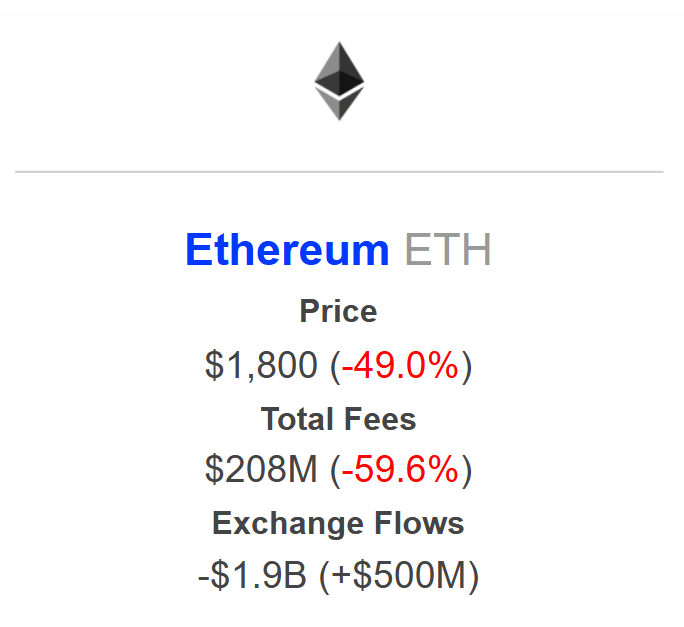
According to IntoTheBlock, Ethereum’s total transaction fees dropped by nearly 60% in Q1 2025, falling to roughly $208 million as of April 4. The firm noted that this was their lowest level since 2020.
“Total ETH fees decreased to their lowest level since 2020 this quarter, primarily driven by the gas limit increase and transactions moving to L2s,” IntoTheBlock stated.
 Ethereum Fees. Source:
IntoTheBlock
Several factors have contributed to this decline. The biggest driver is the adoption of Layer-2 networks, especially Coinbase’s Base. Ethereum’s Dencun upgrade, which launched in March 2024, made transactions on these scaling layers much cheaper.
As a result, more users are bypassing Ethereum’s mainnet and shifting to faster, cost-effective alternatives. According to L2Beat, Base currently processes over 80 transactions per second, leading all other Layer-2 networks.
Despite the benefits of lower fees, Ethereum’s underlying metrics are showing signs of strain.
Michael Nadeau, founder of The DeFi Report, flagged a steep drop in ETH burn rates. He noted that ETH burned through major platforms like Uniswap, Tether, MetaMask, and 1inch, which collapsed by more than 95% since November 2024.
Nadeau explained that fading retail enthusiasm and the slower-than-expected scaling from L2s are contributing to Ethereum’s reduced deflationary pressure.
“ETH’s annualized inflation is now 0.75%. We should expect it to continue to rise, exceeding BTC inflation. We should also expect Ethereum’s fundamentals to continue to erode over the next year,” he added.
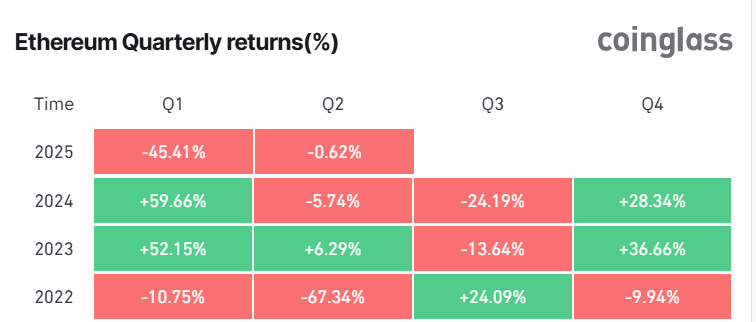
Meanwhile, the network’s financial performance reflects these concerns. ETH’s price fell over 45% in Q1 2025, marking its worst quarterly performance since 2022.
 Ethereum Quarterly Performance Since 2022. Source:
CoinGlass
In comparison to Bitcoin, Ethereum has also underperformed, losing 39% of its value against BTC this year. That drop has pushed the ETH/BTC ratio to its lowest point in nearly five years.
Still, long-term investors are not backing down. IntoTheBlock pointed out that Ethereum whales accumulated over 130,000 ETH as the price dipped below $1,800—its lowest since November 2024—signaling strong buy-the-dip sentiment.
Beyond that, industry experts believe the upcoming Pectra upgrade, scheduled for May, could give the asset a fresh start.
According to them, Pectra can help restore confidence and drive renewed growth across the Ethereum ecosystem with its improved wallet functionality and user experience.
Disclaimer: The content of this article solely reflects the author's opinion and does not represent the platform in any capacity. This article is not intended to serve as a reference for making investment decisions.
You may also like
Peter Brandt warns Bitcoin may never reclaim $126,000 all-time high after sharp drop
This Week's Market "Surprise": U.S. Treasury Yields and Tech Stocks Rise Together
Nomura strategist Matsuzawa believes that the U.S. stock market's tech rally is more of a technical correction, and the market has not rebuilt confidence in AI investments. Expectations for a Fed rate hike have surged, with the implied probability of a December hike reaching 111%. If dovish officials fail to correct overly hawkish expectations, financing pressures for tech companies will re-emerge, making it difficult for stocks and bonds to rise simultaneously.

Successfully recovered the Starship upper stage, SpaceX debuts “chopstick ship-clamp,” analyst: the most critical step supporting its trillion-dollar valuation
SpaceX has, for the first time, used the launch tower's mechanical arm to catch the Starship spacecraft mid-air, setting a precedent for orbital spacecraft recovery via tower mechanism in aerospace history. Bernstein analysts believe this is a key step supporting SpaceX's multitrillion-dollar valuation—full reusability will significantly reduce orbital costs, directly enhancing Starlink deployment efficiency and raising the commercial ceiling. Morgan Stanley warns that the market is underestimating the value of this mission, as it will significantly lower execution risks tied to commercial reuse and the expansion of AI-powered space computing capacity.

Solana falls 10%, $69 million in liquidations as ETF outflows weigh on price
Crypto prices
More


