

Last updated: April 4, 2025 10:01 EDT
Is Pi Network Headed to Zero? Price Crashes to New Low Below $0.60
By:Simon Chandler
Pi Network has suffered from a lack of trust in its project, as well as from a relative absence of big-name listings.
Bitget offers one-stop trading for cryptocurrencies, stocks, and gold. Trade now!
A welcome pack worth 6200 USDT for new users! Sign up now!
Disclaimer: Crypto is a high-risk asset class. This article is provided for informational purposes and does not constitute investment advice. You could lose all of your capital.
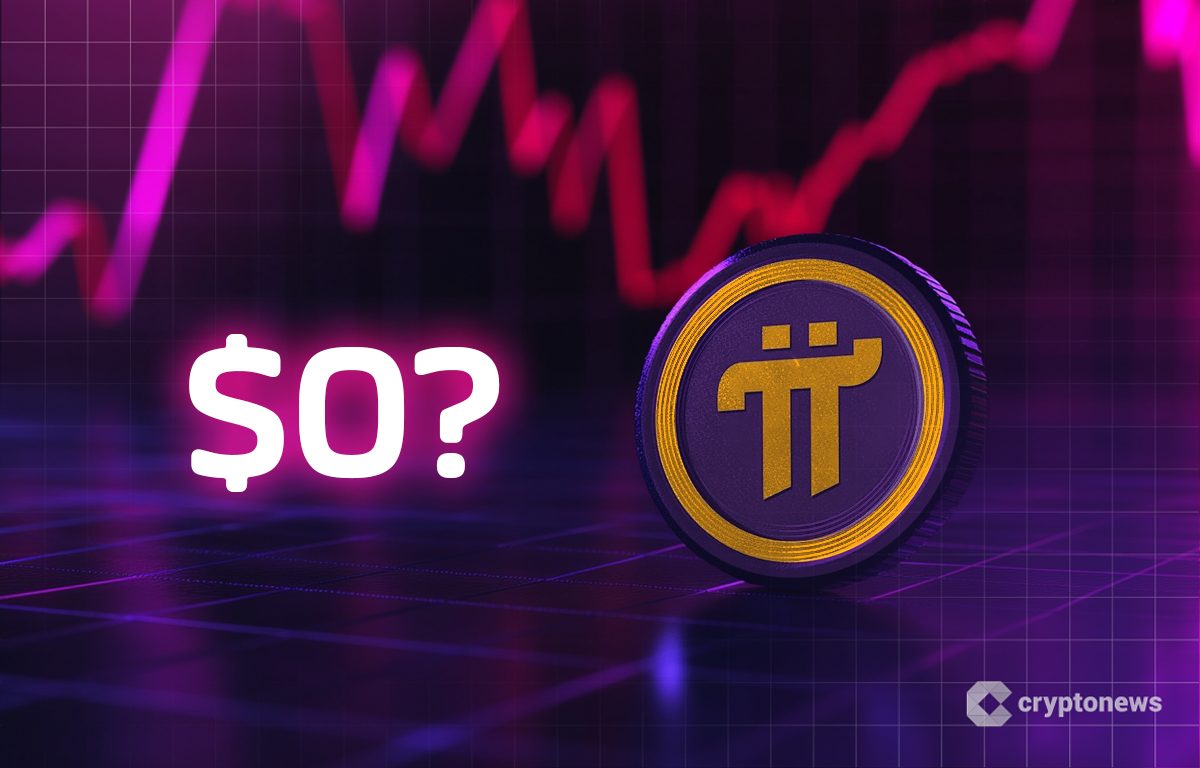
Pi Network has dived by 16% in the past 24 hours, with its fall to $0.5128 coming as the crypto market drops by 1% in the wake of ongoing tariff and recession concerns .
PI has now declined by a whopping 38% in a week and by 74% in a month, raising concerns that it has entered a death spiral.
The token is also down by 82% since reaching an all-time high of $2.99 on February 26, another indicator of a serious decline in interest and confidence in it.
And with no new major exchanges willing to list PI (at least for now), it’s likely to continue declining for as long as the market remains spooked by the incipient trade war between the US and the rest of the world.
Is Pi Network Going to Zero? Price Crashes to New Low Below $0.60
There’s no credible way of sugarcoating what PI is currently experiencing, which is a potentially terminal collapse in value.
As noted above, it has lost 80% of its value since peaking in late February, and its chart reflects its all-but complete loss of momentum.
Its RSI (purple) was already struggling prior to yesterday’s market-wide selloff, yet it has now plunged below 25, which is indicative of serious underselling.
 Source: TradingView
The same goes for PI’s 30-period average (orange), which continues to sink further below the 200-period (blue).
Under a normal circumstances, an asset would have rebounded after suffering such weak indicators for so long, so it’s potentially a sign of a serious problem that Pi Network hasn’t enjoyed a rebound in recent weeks.
And with the global economy entering a period of uncertainty and potentially even recession , it would be foolhardy to expect a sustained recovery anytime soon.
On top of this, Pi Network suffers from low confidence in the wider market, with some traders and analysts continuing to refer to it as either a data-harvesting scheme, a Ponzi, or both.
This lack of faith may account for why the likes of Coinbase, Binance and Kraken have yet to list the token, a fact which is also conspiring to send it lower.
Given these negatives, the only way for Pi Network is down, with the coin likely to sink below $0.50 in the next few weeks.
It could drop as low as $0.40 by June, unless one of the above exchanges does take the step of listing it.
New Altcoins with Stronger Fundamentals
Because Pi Network now looks so doubtful, many traders may be much happier investigating newer tokens, with several up-and-coming coins showing the potential for gains in the near future.
This is something that could be said about MIND of Pepe (MIND), an ERC-20 token that is currently holding its presale, having raised $7.8 million so far.
What’s exciting about MIND of Pepe is that its platform will launch an agentic AI, one which will interact with the cryptocurrency market and social media.
In particular, it will process trading data and social media posts to provide MIND holders with market analysis, helping investors to make better decisions.
It will also generate its own meme coins, using the insights it has gleaned to produce tokens with the highest potential to go viral.
And what makes MIND itself bullish is that holders of the coin will gain early access to MIND of Pepe’s auto-generated tokens, something which could enable them to make big profits down the line.
Investors can join its presale now by visiting the MIND of PEPE website , where MIND currently costs $0.0036671.
This price will rise tomorrow, and will continue to rise incrementally until the sale’s end.
4
4
Disclaimer: The content of this article solely reflects the author's opinion and does not represent the platform in any capacity. This article is not intended to serve as a reference for making investment decisions.
Understand the market, then trade.
Bitget offers one-stop trading for cryptocurrencies, stocks, and gold.
Trade now!
You may also like
Early Exercise of Green Shoe Leads to "No One Supporting the Price the Next Day," Anthropic Nearly Fell Below Issue Price, Criticized for "Eager to Cash Out"
Listed for just one day and already exercising options, raking in $12.2 billion. The core controversy lies in: despite a 19% increase in issuance size, a slump in tech stocks, and the heavy pressure of $26 billion in insiders unlocking and selling shares, the company abandoned the "insurance" mechanism designed to support the stock price in order to quickly secure massive cash. This move exposes investors directly to the risk of share price dropping below the issue price, revealing a speculative mentality that disregards market conditions and aims for extreme fundraising.
华尔街见闻•2026/11/23 00:41
Funds swarm into US Treasuries, helping the "anchor of global asset pricing" fall below 5%! After "Black Friday," can tech stocks take advantage and rebound?
On November 20th, Eastern Time, the yields on 10-year and 30-year U.S. Treasury bonds fell to 4.92% and 5.31% respectively, while the Philadelphia Semiconductor Index plunged by 10.73%. On "Black Friday," long-term bonds realized their value as safe-haven assets, while AI computing power and semiconductors continued to digest investors' concerns about returns on AI capital expenditures.
智通财经•2026/11/23 00:12
After Starship recovery success, Citigroup raises SpaceX (SPCX.US) target price: Launch leading advantage is "rapidly expanding into a 20-year gap", Starlink will become the core for value realization
After SpaceX successfully caught the Starship upper stage with the launch tower for the first time, Citi released a research report, raising its target price for the stock from $240 to $280. The report also pointed out that the gap between SpaceX and other players in the aerospace launch industry is widening further.
智通财经•2026/11/23 00:01

After a week of "bloodbath" in US stocks, valuations now show investment value, but no one dares to say the bottom has arrived.
Last week, U.S. stocks experienced a massive sell-off, but in fact, there have been no fundamental changes in the underlying factors. Multiple valuation indicators now highlight their investment value, and the willingness of contrarian funds to buy the dip should be strong.
智通财经•2026/11/22 23:16
Crypto prices
More
Bitcoin
BTC
$60,978.92
+1.38%

Ethereum
ETH
$1,712.83
+1.93%

Tether USDt
USDT
$0.9984
+0.05%

BNB
BNB
$559.01
+1.91%

USDC
USDC
$0.9998
-0.01%

XRP
XRP
$0.9211
-0.87%

Solana
SOL
$70.42
+0.24%

TRON
TRX
$0.3049
+0.01%

Hyperliquid
HYPE
$62.57
+2.01%

Zcash
ZEC
$788.2
+1.32%
How to buy BTC
Bitget lists BTC – Buy or sell BTC quickly on Bitget!
Trade now
Become a trader now?A welcome pack worth 6200 USDT for new users!
Sign up now