
The Booming Markets: Trump's Tariffs Cause A Global Shock

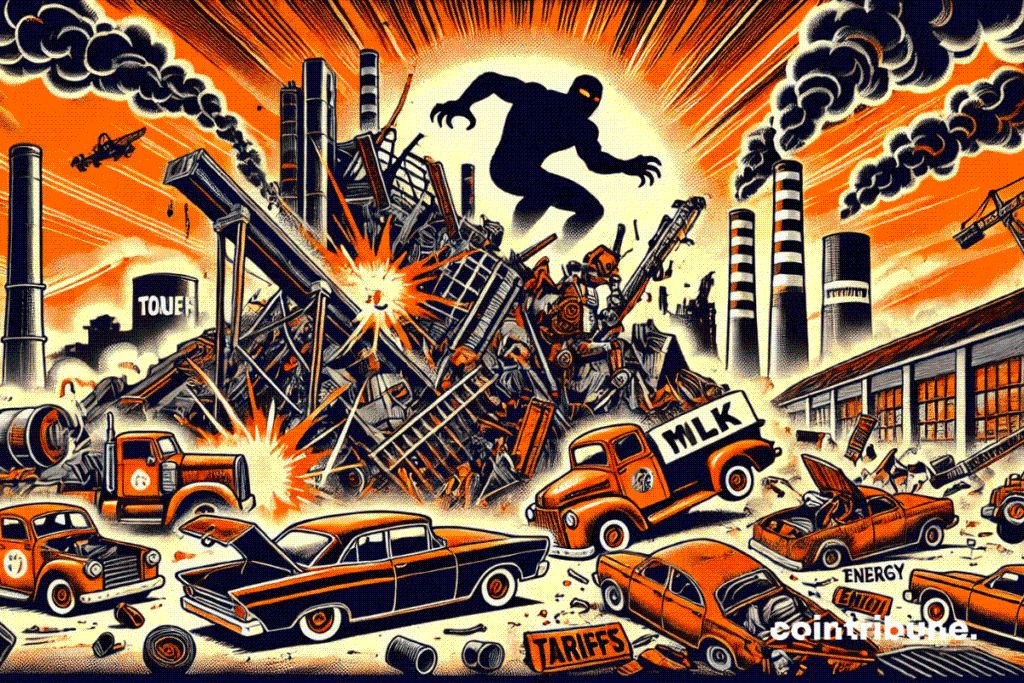
The new tariffs imposed by Donald Trump have triggered a shockwave in global financial markets, leading to an immediate reaction from investors, economists, and the United States’ allies.
Storm on the markets after Trump’s shocking announcement
Donald Trump announced on April 2, 2025, from the White House a series of historic protectionist measures. In a solemn speech lasting nearly 45 minutes, the American president unveiled what he called the “ Day of Economic Liberation “.
He decreed a base tariff of 10% applicable to all trading partners of the United States. Some countries face significantly higher rates: 20% for the European Union, 34% for China, 46% for Vietnam, and 24% for Japan.
These measures, which also include tariffs of 25% on automotive imports, have caused a real earthquake in financial markets.
European stock indices opened sharply lower, with the STOXX Europe 600 index losing about 1.8%, particularly hit was the German DAX index.
Companies like Pandora, Adidas, and Puma saw their stocks drop by 10%, while heavy industry giants like Siemens and ThyssenKrupp lost 4% and 3.4% respectively.
In the United States, the technology sector was severely impacted, with Apple falling more than 6% after the announcement, dragging down other giants like Nvidia (-4%), Tesla (-4.5%), Alphabet, Amazon, and Meta (between -2.5% and -5%).
Allies are worried, partners threaten to retaliate
In response to this trade offensive, international reactions have been swift. The European Union quickly expressed its intention to take countermeasures if negotiations fail.
Ursula von der Leyen, President of the European Commission, called Trump’s decision a “serious blow” to the global economy, lamenting the “chaos and complexity” created by these measures.
The United Kingdom, affected by a 10% tariff, opted for diplomacy. Jonathan Reynolds, Secretary of State for Business, stated that “no one wants a trade war“, while clarifying that “nothing is excluded” to defend British interests.
China, facing the highest rate with a combined total of at least 54%, reacted strongly, urging the United States to cancel these measures and promising to “resolutely take countermeasures“.
According to the Chinese Ministry of Commerce, these tariffs “violate the rules of international trade” and represent “a typical unilateral intimidation act“.
The crypto market has also felt the backlash, as Ryan Lee from Bitget Research explains:
Trump’s unexpectedly severe tariffs have triggered a massive sell-off, with ETH and SOL dropping by about 6%, and a retreat towards stablecoins in the face of rising concerns.
These protectionist measures threaten the global economy in the long term. According to Olu Sonola from Fitch Ratings: “This is a radical change for the global economy” that could plunge “many countries into recession” if these tariffs persist.
The coming days will be crucial to assess the repercussions of this aggressive trade policy, as the specter of a full-blown trade war looms over the markets.
Disclaimer: The content of this article solely reflects the author's opinion and does not represent the platform in any capacity. This article is not intended to serve as a reference for making investment decisions.
You may also like
SemiAnalysis Significantly Lowers AI Computing Power Forecast: 2028 Capital Expenditure Projection Cut by Nearly 30%, Five-Year Wafer Shipment Area Reduced by 17%, Nvidia Hit the Hardest
SemiAnalysis has lowered its forecast for global AI accelerator capital expenditure in 2028 by 28% and cut the 2030 forecast by 40%. The cumulative shipment area of accelerator chips from 2026 to 2030 has been revised down by 17%, demand for HBM in 2028 has been slashed by 30%, and power consumption demand in 2030 has been revised down by 34%. Nvidia is the most impacted, accounting for 66% of the global chip shipment reduction, with its 2030 shipment forecast—based on revenue from computing—also reduced by as much as 66%.

XRP recovers 7%, ETF outflows hit $19.13 million as $1 level tested
On the eve of the earnings report, bearish sentiment surrounds Nvidia (NVDA.US): "Big Short" Burry holds on to put options, while Musk warns that key protocols may be lost with Jensen Huang
According to reports, "The Big Short" Michael Burry continues to hold his put options on Nvidia ahead of its earnings release on Tuesday Eastern Time, although he acknowledges that retail buying still has a chance to push the stock price higher. Meanwhile, Elon Musk has issued a warning, stating that some key supply agreements for Nvidia may be lost if Jensen Huang leaves.
As AI tech stocks face heavy losses, Walsh will join Silicon Valley leaders tonight to discuss the economic impact of AI: Can a trillion-dollar investment deliver productivity gains?
Coinciding with the sharp decline in AI tech stocks, the market is re-examining the return prospects of massive capital expenditures. Whether AI investment can ultimately translate into sustained productivity gains has become the focus.

Crypto prices
More


