

Last updated: March 22, 2025 07:25 EDT
Bulls to Reclaim $2K Threshold: Big Trend Shift for Ethereum?
By:Arslan Butt
Bitget offers one-stop trading for cryptocurrencies, stocks, and gold. Trade now!
A welcome pack worth 6200 USDT for new users! Sign up now!
Disclaimer: Crypto is a high-risk asset class. This article is provided for informational purposes and does not constitute investment advice. You could lose all of your capital.

Ethereum (ETH) has reclaimed the $2,000 mark, a key technical and psychological level it struggled to hold since early March. As of March 22, ETH trades at $1,995.69 with a 24-hour trading volume of $9.05 billion and a market cap of $240.7 billion, maintaining its rank as the world’s second-largest cryptocurrency.
What’s driving this rebound? On-chain data points to a significant shift in investor behavior. Over the past 48 hours, more than 360,000 ETH have been withdrawn from centralized exchanges.
Historically, such outflows are associated with bullish sentiment, as long-term holders move tokens into cold storage in anticipation of future gains. These withdrawals reduce available supply, creating upward pressure on price.
This trend may signal growing institutional interest and renewed investor confidence. If ETH maintains a foothold above $2,000, technical targets include $2,150 and $2,300. However, a breakdown below $1,950 could reignite short-term selling.
Key Levels Market Structure: Signs of a Breakout?
Ethereum is currently forming a symmetrical triangle—a pattern often associated with impending volatility. The lower boundary around $1,956 is reinforced by the 50-period Exponential Moving Average (EMA) at $1,968.20. Immediate resistance aligns closely with the $2,000 level.
A confirmed breakout above $2,073 could strengthen bullish momentum and open the path to $2,153 and $2,233. Conversely, a breakdown would bring support levels at $1,871 and $1,809 into focus.
Key Technical Levels:
- Support: $1,956, $1,871, $1,809
- Resistance: $2,073, $2,153, $2,233
- EMA 50 (4H): $1,968.20
Traders are closely watching volume and price action around these pivot zones for confirmation of Ethereum’s next directional move.
Ethereum Fees Drop 50%: Opportunity or Warning Sign?
While ETH’s price is trending higher, network activity is trending in the opposite direction. Transaction fees on Ethereum have dropped by 50%, reflecting a sharp decline in on-chain engagement. This could be interpreted as either an opportunity—making Ethereum more accessible—or a signal of declining demand.
Lower fees benefit retail users and developers who were previously priced out of the network, potentially encouraging broader adoption. However, the slowdown in DeFi trading, NFT sales, and Layer 1 activity raises concerns about Ethereum’s ability to retain dominance, particularly as competition from Layer 2 solutions intensifies.
Implications of Lower Fees:
- Lower barrier to entry for developers and small users
- Declining transaction volume may reflect weakening user demand
- Key sectors like DeFi and NFTs showing reduced activity
Whether this decline is a temporary dip or the start of a longer-term shift remains unclear.
Outlook: Can Ethereum Maintain Momentum?
Ethereum’s recovery above $2,000 marks an inflection point, but the sustainability of this move depends on more than just price.
Large exchange outflows suggest investors are accumulating ETH with a long-term view. Yet, falling network usage tempers the optimism.
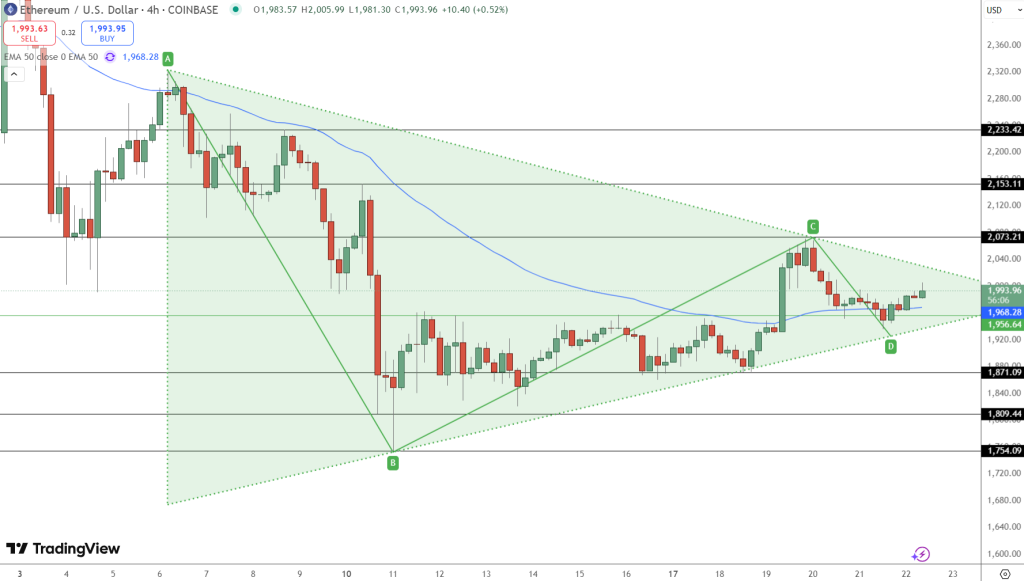
A confirmed move above $2,073 could validate the breakout and pave the way toward $2,300. But if volume and on-chain activity continue to decline, ETH may struggle to hold current levels.
The next few weeks will be critical in determining whether Ethereum’s momentum is part of a broader trend—or simply a short-lived rally.
Want to capitalize on crypto trends? Here’s what’s catching attention:
BTC Bull: Earn Bitcoin Rewards with the Hottest Crypto Presale
BTC Bull ($BTCBULL) is making waves as a community-driven token that automatically rewards holders with real Bitcoin when BTC hits key price milestones. Unlike traditional meme tokens, BTCBULL is built for long-term investors, offering real incentives through airdropped BTC rewards and staking opportunities.
Staking Passive Income Opportunities
BTC Bull offers a high-yield staking program with an impressive 119% APY, allowing users to generate passive income. The staking pool has already attracted 882.5 million BTCBULL tokens, highlighting strong community participation.
0
0
Disclaimer: The content of this article solely reflects the author's opinion and does not represent the platform in any capacity. This article is not intended to serve as a reference for making investment decisions.
Understand the market, then trade.
Bitget offers one-stop trading for cryptocurrencies, stocks, and gold.
Trade now!
You may also like
Goldman Sachs Global Stock Market Outlook: AI Capital Expenditure to Peak Next Year, Earnings Growth to "Slow Down Significantly", Cloud Giants Become "Defensive Assets"
Goldman Sachs’ 2027 Global Equity Strategy points out that the AI capital expenditure boom is nearing its peak, and global profit growth will slow significantly. S&P 500 earnings growth is expected to drop from 36% to 11%, with depreciation pressures gradually emerging. However, cloud giants’ valuations have adjusted to a forward P/E of 19.7, lower than the staples sector, and are classified as “relatively defensive” assets. Goldman Sachs predicts an S&P 500 target of 8,700 points and suggests overweighting the US and Japan, while underweighting Europe.
华尔街见闻•2026/11/14 06:56
With $135 billion worth of Nvidia stock, will Jensen Huang cash out?
After Jensen Huang stepped down, his Nvidia holdings of approximately 812 million shares, valued at $135 billion, became a major pressure on the stock price. Any reduction in holdings is subject to both legal and market constraints: shares can only be sold compliantly after the disclosure of any undisclosed negative information, and the volume is equivalent to six trading days’ total market transactions, meaning large-scale cashouts would have to be spread over several months.
华尔街见闻•2026/11/14 06:56

Will the traditional Christmas rally still happen in the US stock market this year?
After a simultaneous technical and position-based recovery in the US stock market, Goldman Sachs, Morgan Stanley, and JPMorgan have successively signaled a year-end rebound. Extremely light positions, mean reversion of valuations, and seasonal support together create conditions for a short squeeze. However, global manufacturing import price inflation has annualized at around 24%, surpassing the pandemic peak, and the inflation bill will come due intensively in the first quarter of next year. Goldman Sachs warns that once the year-end rally materializes, it may exhaust future upside potential.
华尔街见闻•2026/11/14 02:56

Anthropic IPO Roadshow: CEO Says "Doesn't Care About Market Conditions", Hopes to "Underpromise and Overdeliver"
As Anthropic gears up for its IPO, CEO Amodei remains deliberately low-key during the roadshow, emphasizing "under-promise and over-deliver," and appears calm regarding market volatility at the time of listing. In response to fluctuations in the AI sector and the Nvidia situation, Amodei stated he is not particularly concerned about the specific month of listing or market conditions, and frankly admits that allocation of computing power is "the most fundamental business challenge."
华尔街见闻•2026/11/14 01:46
Crypto prices
More
Bitcoin
BTC
$67,244.39
-2.37%

Ethereum
ETH
$1,899.88
-2.06%

Tether USDt
USDT
$0.9991
+0.01%

BNB
BNB
$616.55
-2.81%

USDC
USDC
$0.9998
-0.00%

XRP
XRP
$0.9857
-4.33%

Solana
SOL
$75.4
-6.27%

TRON
TRX
$0.3124
+0.49%

Hyperliquid
HYPE
$69.66
-2.83%

Zcash
ZEC
$910.97
-4.39%
How to buy BTC
Bitget lists BTC – Buy or sell BTC quickly on Bitget!
Trade now
Become a trader now?A welcome pack worth 6200 USDT for new users!
Sign up now